Warren has been described as the next Billy Graham, an evangelical leader with a moderate reputation and mass-market appeal — although instead of massive open-air rallies and an out-sized television presence, Warren focused on forging partnerships with unlikely allies working to protect the environment and fight AIDS.
As a pioneer of the mega-church movement, Warren looked to translate traditional evangelical messages for a wider audience. He penned “The Purpose-Driven Life,” a spiritually based self-help guide that brought mainstream best-seller status to a muted religious message.
Who cares?
This is the wrong debate.
Why is there even a religion invocation at the presidential inauguration?
Why did we have a debate at a mega church?
Why do we vote in churches?
America sure does argue a lot about mice nuts and not enough about the bigger concepts.
It’s one of these media ventures that seems like such a great idea but really isn’t. It has no growth potential left and is a media product that grabs user bases that really aren’t worth that much to advertisers or big exec firms – for example… the unemployed middle-aged, middle management white guys.
Now, don’t get me wrong. I like LinkedIn as a place to hosted my resume and occassionally link to people. Unfortunately, I think that’s just about what everyone uses it for, excluding marketers and recruiters.
This isn’t so unusual. Almost all other online job boards, professional networking and recruitment sites go the same way.
Site gets announced
Some people join
It catches fire and everyone puts their data in
The recruiters swarm
People get annoyed, bored, or don’t land that dream job and most accounts/profiles age
Network/Site starts blasting out emails and alerts about people looking for you, jobs waiting for you
That powers the site for years
Revenue grows slightly but never breaks out
Next site crops up and chips away at existing sites margins
LinkedIn’s traffic has fallen off. It basically has found the 16 million people looking for jobs it can offer them.
People not in the market don’t update their profiles. The folks most likely to power big network connection growth, don’t need a networking site. Folks who want a bitching resume just go off and build one at their domain or facebook page.
Put all of this together and LinkedIn is another Monster.com. It’s big, has users, might add a bell or whistle but has no place to go. It’s fate is set and completely determined but what it actually is – a job board. It’s only hope to grow is to somehow magically get people more jobs than any of the other methods. It won’t die as people always need networking and jobs.
I predict some old skool news media company will buy it one day and squeeze it for revenue. It’s a safe haven for the weary Internet exec.
So, in a moment only Tony Robbins could love, I was doing my early morning stretches when my wife read the following:
Few things could be more dangerous than letting your children fall into the trap of believing what they do doesn’t matter. Teach them that there are consequences of their actions.Teach them that even small decisions and actions consistently made, have far-reaching effects.
But wait; didn’t we just go over a news article on Google that reported that a teacher was axed because she told the 7 year olds that Santa doesn’t exist? Teaching that in a school, no less.What is the world coming to? Oh-no, Batman, another liberal chop at family traditions and faith-based holidays. It wasn’t on CNN.com or Time.com, Reuters, the washingtonpost.com or wsj.com. Should I believe it?What should I do?
What are the consequences of the Santa thing? I certainly enjoyed it growing up. And we all have heard, “What was good enough for me is damn good enough for…”Oh, wait a minute. That was called upon by my parents concerning values that they wanted me to have….that weren’t true, good, or right. You know, buying GM cars that started on fire, racism, bigotry, sexism in business, education and even dictums on whom to marry.
Hummm… seems there is just one more set of conflict of beliefs. What we do is a testament of our values.We thus value the stuff of our traditions more than we value the truth or all that other stuff we teach in school.…We could use this relational logic to teach intelligent design in schools, maybe a course in Wicca and another in Karma for Tots at the YMCA or JCC.
Should we really be surprised that people go postal or freak out in less dramatic fashion when these ‘absolute’ rules from our parents, teachers, and representatives change?
My sister’s response: “Well as long as it doesn’t hurt anyone (another stellar admonishment that the end justifies the means…) why not have Santa, the Easter Bunny and a Virgin Mary?”
Besides that, consequences are complicated even if they are universal. Myths are fun and simple and that is what we need today so we don’t have to deal with the antecedents that result in foreclosure, bankruptcy, layoffs, SEC fraud and bailouts.
Considering the need for fun and distractions, you might consider a small but compact 22 cal pistol as a gift for your child or perhaps some Mary Jane that isn’t a shoe.
Here’s one of my favorite chunks of the discussion lifted from George Dyson’s comments:
Brown, Kauffman, Palmrose, and Smolin have hit the nail on the head. But is it the right nail? When the patient needs first aid, do you ask “is there a modeler in the house?”
Financial systems exhibit the Gödelian incompleteness characteristic of all (sufficiently powerful) formal systems: within the given system it is possible to construct statements (or financial instruments) whose value appears to be sound, but cannot be proved within the system itself. The same limitations apply to models of financial systems.
There is good news and bad news in this. No financial system (or model of such a system) can ever be completely secure and closed. On the other hand, there is no limit to the level of concepts that an economy (or a model of that economy) is able to comprehend.
So, what should we do? Assigning an international team of experts to formulate a global economic model is a worthy undertaking, but can the rest of us afford to hold our breath and wait? We also need Plan B, just in case. Plan B is to nurture new, grassroots economic systems that directly (and honestly) couple the flow of currencies to the flow of goods, services, and information—down to the last bit, and the last dollar, from the bottom up.
“Ten years ago I started a company based on the assumption that people are basically good,” argued E-Bay founder Pierre Omidyar (at the Santa Fe Institute) in 2004. “And now I have the data to prove it.” Instead of putting a dozen scientists in a room to come up with a better model of the existing global financial system, we should put a dozen Pierre Omidyars, Elon Musks, Salar Kamangars, and Jeff Bezoses in a room (with Danny Hillis) and let them actually build one (a new financial system, not another model).
Why is this my favorite? He seems to be saying, get on with it. Rather than endlessy try to model things you can’t model, start creating. I’m not a huge fan of the Omidyar quote, as it’s not an accurate nor useful statement. However, the idea that we can generate all sorts of new ways to buy, sell, create and generate things/services people want is right. We do it all the time and we need to do even more of it. It’s about the do.
There’s also a fallacy brought up many times by the various contributors that science and modeling can somehow FIX this. It can’t. It helps us explain and make sense of things, but that doesn’t imply control.
Also worth noting is seeing how scientists attack a “real life” problem. Are they shrinking back from the tough stuff or being realistic in what science and scientific approaches can contribute?
Eric Weinstein answers that question:
To be clear, the world’s markets are going to be analyzed, modeled, and regulated by panels of “experts”. That is not at issue. What is at issue is whether the scientific community has the moral luxury, as some commenters here heartily recommend, to sit this one out and complain from the sidelines when most of the skills needed to debunk seemingly sophisticated failed market theory are scientific in origin. But to believe in one’s own ability to improve a theory and make contributions across disciplines require taking serious risk and I well understand that some may find such risk frightening. I would be happy enough for those who feel sure they have nothing to contribute to avoid such an undertaking.
People may have IDs for the various blogging platforms or commenting systems, but most don’t identify with them. It is a necessary inconvenience. They identify with Facebook or their email because that is where they manage their personal and professional lives.
In addition to replicating the comments on your Facebook News feed, the JS-Kit implementation also supports embedding Facebook photos and YouTube videos directly into the comments. It makes commenting much more personal when you know your friends will see it in Facebook. It also has the potential to reduce the amount of comment trolling and general incivility that has taken over many blog comments (we hope).
I disagree with the notion here. Social networking, widgets, ShareThis, Buzz Up and all these single sign ons aren’t about personal identity, better comments, improving connectivity/making it personal or making it easier on the user.
No publisher would bother with FB Connect if it wasn’t going to increase activity. Plain and simple. As publisher you want to get into FB user base and you know that user base is active and going to dump this content everywhere. Sure, eliminating the login is great, but really most these other services aren’t that challenging to a user who really wants to leave a comment.
Yes, it will increase traffic. Facebook and Social network connectivity is the new SEO.
And just like SEO did for Google, so social connectivity will do for Facebook – FB is now the cornerstone of a whole lot of publishers traffic.
Anyhoo, nothing groundbreaking in the post. Just wanted to point out something that might not be obvious about this land rush to see who can put Facebook Connect up first.
[I need to find the various sports year in review as well as more music and entertainment. Ok, fine more politics too…]
More to come as I comb through them.
They are heavily weighted towards the end of the year and they don’t all include the SHOE THROWING?! Goodness.
I also notice that Hurricane IKE and the like 19 storms that blew through Cuba couldn’t compete with Obama, Mumbai, Earthquakes, Britney Spears and LHC. Now that’s what helluva a news year when Houston gets blown off the map and we can’t even remember if that was this year or last year.
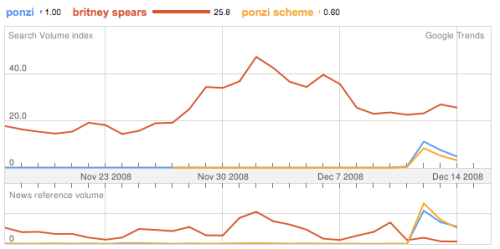
The last 7 days of Internet blogging and searches have been dominated by Ponzi scheme debate and definition.
For reference, here’s Google Trends for Ponzi/Ponzi Scheme vs. Britney Spears. I use Britney Spears as a proxy for actual volume because she’s been a top search term for 8 or 9 years.
The problem with all the debate, like many important debates, is that we’re arguing about definitions and phrasing, instead of analyzing the real issues and behavior.
Whether Madoff was running a Ponzi Scheme or whether social security is some enlightened version of one is irrelevant to what we do about the behaviors contributing to the financial mess we’re in.
In almost all the current financial situations (Social security, housing, credit slump, Madoff…), the contigency management is very inefficient. The rewards and punishments for taking on big risk are many degrees removed from the risky behavior. The reinforcers produced by the situations get lost in translation between computerized trading, industry memos, and the media. We’re rewarding behaviors in one context and punishing them in another (spending without transparency – the bailout- is OK, but it isn’t OK for these businesses… which is it?)
The rules are not clear at all and so no one can play by them.
You can’t call any of this irrational either. it’s perfectly rational to keep investing and spending when you get reinforced (returns on investment) over a long period of time. You come to expect those returns and habituate to the risk involved in investing in companies, financial products and services that don’t have defined outcomes. You can’t totally blame the originator of these investment vehicles either as people keep investing, further reinforcing the behavior of the originator. (I’m simplifying a bit here).
Consider the life of Ponzi. (Find better sources than Wikipedia, but this will do for now because it’s online) His history can be interpreted in many ways. What strikes me is how it builds behavior by behavior. All along the way as people wonder, they continue to make him rich, provide for him, write about him. Even until his death he still found work, press and basically what he needed. So, was it a character flaw in his gene code that created the great mail fraud, or was it the contingencies all along the way?
What’s to think this scenario, now played out with Paulson, Madoff, AIG… isn’t going to be played out again and again when we don’t change the environment? The actors in this play are irrelevant pieces. It’s the environment (the media, the surrounding people, the culture, the financial system..).
Do I have an answer? No. You have to chip away by managing contingencies both with your own life and the wider public. There’s no one set of rules or one policy or a perfect economic system. We have to constantly pay attention and adjust.
Omniture is extending its SiteCatalyst measurement tool to native iPhone applications, enabling developers and marketers to gain insight on how users are interacting with their iPhone apps, based on real-time information. This should allow them not only to improve the user experience based on analytics, but also make adjustement necessary to generate more revenue by enhancing ad clicks, purchasing and increasing page views.
Having implemented Omniture some 50 or 60 times (against my judgement, and sometimes will (not that I have any)!), I can tell you definitively nothing omniture provides is unique nor worth the cash.
You’ve always been able to track native iPhone apps. Here are the many ways
For mostly non-networked apps, simply write a tracker function that dumps data to the app data storage and occassionally send that data back to a remote server
Using google Analytics, create a URL scheme and “ping” those URLS on various events in the app that then fire off the google analytics
Create your own tracking system using URLs
Create your own tracking using custom “pixel” calls
….
The reason I always steer clear of Omniture is that once you’re into a naming convention and particular set up, it’s damn near impossible to change it. Generally you’re trapped with legacy data, reports and business rules unless you want to redo the whole damn thing.
Tis far better to generalize the data warehouse and create a reporting layer that works for what you need at that time. Even Google Analytics is easier to abstract that omniture.
Omniture is the big dog and people will continue to get sucked into it for lack of knowing anything else. Most business intelligence folks who work primarily on the web will have the most experience with Omniture, thus assuring it always gets the nod. It’s basically the same contigencies that kept Microsoft Office in the lead for so long. You can teach an old dog new tricks (software), it just takes a really long time (or a really big disruptor).
Who will be the big disruptor in analytics? Will anyone come up with something substantially better than Omniture and Google Analytics (you can’t compete on price, cause one of them is free!)?
Sanchez: We do. It’s right here. This is from the publisher of the magazine, Raul Sayrols. He says, “The image is not and never was intended to portray the Virgin of Guadalupe,” — which is the Virgin Mary — “The intent was to portray a renaissance-like mood on the cover.” Interesting. Let me bring in somebody for whom this hits home. He’s one of the best known priests in the United States. His name is Father Cutie. I worked with him in Miami many times, has his own show — actually he’s got his own book out now. It’s called “Real Life, Real Love.” Bestseller, by the way. Father, are we as Catholics just too sensitive when it comes to this kind — after all, it’s a beautiful woman being shown to represent what is, in our minds, to all of us, a beautiful woman.
Father Albert Cutie: Listen, there’s no doubt that she’s a beautiful woman. But a stained-glass window and the veil that looks like that, certainly there’s a reference to Mary. Whoever tells you there isn’t is simply being hypocritical or not very honest. And that’s what I don’t like about the statement from Playboy magazine. I think that they timed it not only with the Virgin of Guadalupe, as Glenda was saying, but also with the month of December. How many nativity scenes are out there this time of the year? How many times is Mary a central figure in this whole celebration? And this is offensive. This is very offensive. It’s blasphemous.
Puhlease.
You read in this interview about all sorts of intentions and indications and meanings. Folks, gimme a break. Of course this sells magazines. Of course this is “offensive”.
And why this depection versus the Ivy League’s Hottest or heffner’s twins.
Or why isn’t the continued struggles (for various sexual issues) of the Catholic church constantly objected to?
These are rhetorical questions of course.
The Catholic image does more to sell sex than any other image, certainly online. Think Britney Spears.
Sometimes when you reinforce something as a punishment (sex is bad) so long it becomes an reinforcer for other things (attention for breaking protocol). The more you issue the punishment the more you reinforce the other behavior.
Sometimes the best approach is no reinforcement at all.
Really folks. Mathematica has this out of the box.
Now, you probably should keep this a secret and go raise millions anyway. I mean, you still need to throw a killer launch party and pay for some blogger swag.


 Social Mode