Social Mode

,

  • I’m a bit behind some of the other early movers…

    3tera.  Taking grid and virtualization in a different direction.  They provide services for entire virtual clusters, virtual data centers, and more.

    If implementing massive super computers and data centers becomes little more than filling in a sales web form, watch out hardware, hosting, and desktop sellers.

    Perhaps google will get some competition now that massive CPU resources are being made available to anyone with an idea.

    ~Russ

    Grid, more Grid.

    –––––––

    Dec 22
    • HIV drug… down to one pill.  quietly on the market…  this will change lives
    • .net 3.5 release… finally a really robust .NET release
    • Moonlight/Silverlight – microsoft’s relatively quiet push into multiplatform
    • iphone’s pressure on other handsets… the phones that came out for all platforms kicked ass and made mobile a real platform in the US
    • xbox live’s continued improvement… this converged device is not going to go away and the consumption/tracking is unbelievably useful to businesses
    • online videos destruction of the usefulness of comScore, nielsen as industry benchmarks
    • circulation auditing for news/mags joining with online audience measurement – introducing real performance metrics into a speculation business (offline advertising!) is disruptive
    • Planet Earth HD series -very special visuals of our planet.  may change the nature doc approach forever and certainly was a technical/logistical acheivement
    • vonage knockoffs – voip is here…
    • bad airlines – generating angst to improve travel in novel ways instead of through more shitty snacks and revised loading procedures
    • unlimited calling plans – makes mobile services possible for the masses
    • gps everywhere – mapmakers watch out…
    • mars rovers – they just keep on going and really make a case for clever space exploration
    • solid state memory and memory prices – no need to ever worry about storage. no really
    • elections starting so early – will politics ever be about policy again or just getting elected?
    • green marketing – what a horrible spin job it’s all turning into.  prices go up for green and organic when in most cases it’s CHEAPER (hm, i’ll find some data on that…)
    • rubyonrails (again) – it made other language communities make it just as easy.  not last year, this year
    • … more when I have more time

    ~Russ

    2007 Silent Shifts – The Things We Don’t Talk About That Will Matter

    –––––––

    Dec 20
  • Google Talk now does on the fly language translation.

    This is huge.

    It makes my bluetooth Googler Intelligence adapter that much cooler.  Yup.  I’ve been working on a bluetooth ear piece, clothing clip on that will listen to ambient talk around you and do look ups on anything it hears or you can set it to respond to a cue (clap, tap, voice command) from you.

    The idea is that you can find out about anything via Google, anywhere you get cell service, without looking down or interrupting normal behavior.

    Translation matters because you can do this in ANY COUNTRY.

    Basically my service uses google talk to look things up via IM bot that queries google and/or other resources like wikipedia.  It can read back (text to speech) the abstracts, definitions, calculations, etc. into your ear, or print them on a HUD… now it will be able to do it in any language.

    CONSIDER THAT.

    ~Russ

    GAME CHANGE ALERT: GOOGLE TALK IM TRANSLATOR

    –––––––

    Dec 19
  • Grid is here and it’s a game changer.  Not today, maybe not totally in 08, but certainly in the nearish future.

    What is grid computing (cloud computing), you ask?  well, it’s lots of things.  Generally it refers to the idea that you can rent N number of cpu cycles to compute whatever you need.  Run websites, crunch datasets, run simulations, parse logs.  whatever you need to do, just rent the cycles to do it from grid computing providers, companies with excess cpu time or from your friendly neighborhood tech.

    Grid is useful now because the tools to benefit from it are finally easy enough to generate adoption.  Amazon’s EC2 Cloud computing is amazing.  Really it is.  A webservice approach to setting up custom “nodes”.  Billed simply into accounts you probably have had for years.  Tons of documentation, samples, support developers… all there for you.

    Yahoo just invest in Hadoop which is somewhat of grid computing.  Google is a gigantic grid computer system (use GWT to take some advantage of it!)  All available to Fortune 5, government, and YOU!

    Technically, this matters because you can do a lot more when you do have to sweat the cycles.  Really.  if there’s no computational limit to what you are doing (other than can you afford it) all sorts of new services can be created.  New games, new investor tools, new education software, new advertising, new communications, new social networks.  Bandwidth was the first big damn to break.  With giant pipes readily available, we got to move away from text only experiences.  Look what’s resulted!?!  Computational power is another damn we’re breaking.  Retargeting of content, behavior analysis on the fly, improved AI…  all available to the common dev.  That’s huge.

    At first I thought it would hurt hosting provides, hardware makers and so forth.  Actually though, i think it’s additive.  It’s yet another tool we can all use. It doesn’t replace always on, dedicated servers nor fast locked down storage.  It simply gives us lots of cycles as we need them to do interesting things.  And because I can’t see the future in any detail, I can’t make any claims about what it might do to existing industry and technology.

    If you haven’t played with this stuff or even read about it, you need to.  It likely will be embedded in most online (and what isn’t online anymore?) within a decade.  web services and ajax was just the tip of this type of thinking.

    Here’s what I want to do with cloud computing:

    • Find largest Mersenne Prime Number
    • Power my Decision Engine product (evolution of search engines to actually guide decisions)
    • Hook into ad servers to reforcast in realtime and retarget media based on behavior
    • Hook into a swarm of networked NXT bots to create social behavior across geography
    • fingerprint all YouTube videos and categorize based on transcripts and similarity scores (good for targeting ads or finding related media)
    • Create first homegrown weather forecasting simulation from Global models to Weather On the Ground. make freely available to all
    • Analyze social networks in real time
    • create a bot to play halo 3 for me all the time, but actually using the controller and data on SCREEN!
    • more more more

    ~Russ

    Consumer Grid Computing

    –––––––

    Dec 19
  • Have you ever gone outside your apartment or house to look at the connectivity – the actual wires leading to your internet, phone and television? It’s chicken wire.

    Have you ever been to a typical datacenter housing all this data we like to consume? Mostly chicken wire and not secure.

    In this day of security and war on terror and infrastructure taxes, the fragility of our data streams is ironic. (is that the right term? You get my point…)

    Few people understand the cobbled together ecosystem.

    • HTML was meant to link academic papers together and it is a loose standard (no one follows it) that helps generate trillions of dollars in revenue
    • Cable, dsl have no redundancy. If your line is cut, you’re off the grid
    • VOIP has little location ability and no power backup, rending 911 and other sensitive operations impossible
    • Most websites are single points of failure
    • If google is down for 1 minute, no fewer than 100,000,000 queries will go unanswered and websites will lose one million dollars (per minute)
    • Viruses are EASY to write and even easier to transfer
    • Ipod batteries are not replaceable
    • Cellphones work only 90% of the time in the CITY, and even less in rural areas (and these are the future of communication
    • Writers striking can shut down a huge amount of content flow and ad dollars
    • And so on…

    The question is… so what? It all seems to work. I will follow up with how this very fragility MAKES it all work even better.

    Good Morning.

    ~Russ

    FRAGILE MEDIA

    –––––––

    Dec 17
  • There’s just more and more analysis and speculation about how critical it is to be fast.

    Slashdot linked to this fairly decent NYtimes article about Google and Microsoft.  One of the key points, which I actually agree with, is that GRID COMPUTING IS AT THE CENTER OF ALL FAST INNOVATION IN THE VERY NEAR FUTURE.

    I have tons more to talk about with grid computing and will save that for a later entry.

    I wanted to also point out the recent Yahoo! announcement of their investment in the Apache Foundation and the hiring of a key person there.  They don’t hide from the fact that this will help them be FASTER due to the bigger, quicker open source community.  It’s clearly yet another move to compete with Google and Microsoft.  It’s particularly strategic considering Apache is a foundational component to so many web things and lucene and hadoop (more grid computing!) are directly competitive with Google, Microsoft and Amazon.

    Recently Google announced they are working on these web things called “knols” which are basically wikipedia/about.com style landing pages to search results.  (Gee, all those landing pages on the web are worth something? go figure.)   This is a “get it faster” strategy too… as it get me more ad dollars faster than waiting for wikipedia and others to put google ads all over the place…

    i could go on and on about moves big companies are making to simply KEEP UP.  it’s damn near impossible to keep up the pace at any company.  Why?

    1. The talent is fluid.  They can do themselves or they can go to the competition
    2. Big companies almost always get slow.  Start ups don’t have the cash flow to invest heavily in things like super computing, lots of bandwidth, etc. etc.  (one way or another something is subverting speed)
    3. The foundations of the technology are changing quicker than we can agree on standards.  (Over 10 wireless standards, no browsers work the same, .Net is on version 3.5, vista isn’t taking over, intel macs make them a force (but who knows how to code that), flex, silverlight, ruby on rails, python, ajax…).  Without standards it’s hard to educate buckets of programmers.  Without lots of programmers, hard to transfer knowledge quickly.
    4. If the programmers aren’t getting it fast enough, who in the organization is?
    5. Transparency to users – they get their say and they say it hard and fast.  course correct quickly or it’s over
    6. China
    7. India
    8. Tampa – cheaper US labor markets, accessible for high tech/remote projects
    9. and tons more reason

    In fact, I have so much to say on SPEED, i’m going to launch into a series of posts on who is fast, what it takes to be fast, what undercuts speed, how you can’t fail fast enough………

    fast to bed now.

    ~Russ

    Google, Microsoft, Yahoo and Everyone Else – How Fast Can You Go

    –––––––

    Dec 17
  • One of the great mindbenders of our lives is End of Life directives.

    Here’s a list of where directives go haywire:

    • unclear language in the document
    • document “enforced” by someone other than the subject of the document
    • document not present during decision making
    • assumptions and pre conditions by family, self, doctors
    • written policies surround use of dnr
    • unwritten policies
    • spur of the moment context/second guessing
    • diagnosis of what’s really End of Life
    • lack of directive standards
    • and so on…

    It really bends my mind to consider that one of the most final decisions we can make about ourselves or family members is this damn gray. in previous posts I talk about the data collection and precision targeting of our world, and yet, with directives we bring NONE of that approach.

    Directives are a terrible information device – at this time. What can we do to clear them up? what can we do with the context surrounding them? is it just a matter of experience – the more we interact with them the more precise and effective they become?

    things that make you go… hmmm… argh… help!?

    Check this site out for tons of cool analysis and concepts.  http://www.eperc.mcw.edu/ff_index.htm

    ~Russ

    DNRs – one of the most confusing information concepts of our time

    –––––––

    Dec 15
  • Halo Stats (no laughing)

    Check out my halo 3 stats.

    This is an amazing example of how much data is available to mine.  You can see how i’ve played the game, how others view me, how changes to the game changed my play, how I reacted to marketing.

    Match this data against news about Halo 3, census data, labor statistics, macro economic indicators….  combine it with facebook, linkedin, opensocial networks, google search data… and on and on.

    We can do this for far more than gamers. and lots of companies do!  What’s cooler (more scary?) you can do it yourself to others.

    ~Russ

    More Online Analysis Possibilities

    –––––––

    Dec 15
  • I present yet another example of the data collecting world we live in.

    See this pseudo analysis of online gaming guilds and their “failure cascades” (how guilds / social groups dissipate).

    The linkedto analysis isn’t that great but the idea of it is unique to our day and age.  You can actually run massive social and behavioral analysis without huge academic grants nor fancy labs.  Sign up for Second Life, WoW, Halo 3… and you get access to huge amounts of game theory data, EAB schedules and so much more.

    In fact, I believe it is THIS EXACT FACET of our modern experience that is the reason things are moving so fast (or appearing to move so fast).  We have so much data showing us how, why, when, what, how much people do that we are forced to course correct and evolve every product, service, brand all the time.

    There are several new books/papers on this subject.  SuperCrunchers does a good job outlining this fact of life.  check it out of it interests you…

    ~Russ

    Online Analysis Possibilities

    –––––––

    Dec 15
  • Oh man. Really, are writers still on strike?!

    This never made sense as a defensive measure for writers to get paid for reuse of work on “new media.” It’s making less and less sense as this carries on. The logic and economics breakdown when you consider the only thing a work stoppage on television and movies does is push networks to rerun or break out the shitty shows. The lack of new, interesting content is just going to push more users not only into alternative internet programming but alternative entertainment in general.

    Here’s some intelligent thinking from J. Nickelsburg from UCLA’s Anderson School of Biz:

    While stockpiling and reality shows are two ways the industry has avoided bigger financial troubles, once these shows eventually run out of new episodes and if the strike still continues, Nickelsburg said he fears for the possibility of substitution.

    “I think that’s actually a real danger if you’re not providing the entertainment that people are used to. The risk is the longer the strike goes on the more likely people will decide not to come back and go to other media. … (It is an) incentive for both sides to come back quickly,” Nickelsburg said.

    One increasingly noteworthy form of alternative media is the Internet, with the rise of “webisodes” and Web sites such as Youtube.

    “As consumers demand the new technologies, they will help create an industry which will be a growing industry and an alternative to scripted television shows,” Nickelsburg said.

    As part of the report, the Forecast assumed that 10 percent of mass media consumers would eventually switch to alternative forms of entertainment and never return, the same percent that switched during the 1988 strike.

    Ultimately, the Forecast predicts an economic impact of $380 million, with an even smaller impact if the strike ends before March.

    To put things in perspective, the Forecast pointed out that every year the entertainment industry produces $20 billion of income in comparison with an overall $380 billion across industries the entire city of Los Angeles brings in every year.

    Nickelsburg warned that nothing is certain because of the unpredictably of the strike itself.

    “Do we know what’s going to happen? No, because no one knows how it’s going to play out,” he said.

    Read the rest of Nickelsburg’s stuff. It’s useful insight.

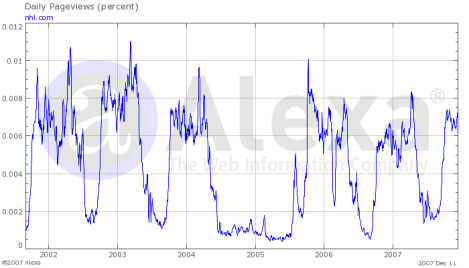
    I’m going to stretch something to make a point. Let’s look at the hockey strike from 2004. The sport was already not in great shape – far behind football, baseball and basketball. Look below at the traffic graph over a 6 year period. NHL produces no new entertainment for a long time. It’s still feeling the impact of that as likely lots of fans went elsewhere and don’t bring new folks in. I’ll wager if we plot some metrics for studios and content franchises (like SNL, late night shows, lost, CSI) over the long haul they will show great weakness for a long time to come.

    NHL Traffic Last 5 years

    Writer’s Strike

    –––––––

    Dec 14
Previous Page Next Page

Blog at WordPress.com.

  • Subscribe Subscribed
    • Social Mode
    • Join 99 other subscribers
    • Already have a WordPress.com account? Log in now.
    • Social Mode
    • Subscribe Subscribed
    • Sign up
    • Log in
    • Report this content
    • View site in Reader
    • Manage subscriptions
    • Collapse this bar