Social Mode

,

  • Yeah, yeah, by now you have the news. Microsoft wants to spend $44bn to buy Yahoo!

    Personally, I want this to happen.  Professionally, I think it will drive search, online media, and social networking to new vistas (hahahaha, good pun!).

    I’m not going to talk about the business case for this.  Everyone and their mother will do that.

    I owe any success I have to 4 things: Yahoo!, Microsoft, Google, and Britney Spears. No really.

    I have no Microsoft stock.  I have no Yahoo! stock.  I don’t work at Yahoo! nor Microsoft.  I have worked at Yahoo!, consulted for a division.  Most of the “investors” in companies I’ve been at made their fortunes at Yahoo! I’ve attempted to sell businesses to Microsoft.  I’ve partnered with Microsoft on media and advertising efforts.  Microsoft software powers most of my daily tasks and has consumed 75% or more of any IT budget I owned. (i know, I know… linux is cheaper….)

    Sites’ SEO and usability I was responsible for accounts for well over 2% of the Google Index.  Most of the businesses in my experience make a substantial revenue line from Google ads and get most of their traffic from Google directly or indirectly.

    In 5 companies I’ve worked at or consulted “Britney Spears” has been the largest source of traffic and best example of how to be “findable”.  Yes, inevitably all pop culture and music sites must devolve into “What is Britney Doing Now?” More advertising money is earned against Britney Spears than any other term on the internet, at these 5 companies and net wide.  (Britney’s handlers should trademark her name and likeness aggressively and attempt to collect royalties.  I mean, she really has made a lot of people very rich and most have no grasp of how much traffic and clicks she drives)

    Putting all that together… literally 98% of my income and assets are tied to those 4 entities.  Microsoft and Yahoo! make up at least 60% of of that 98%.  This is the truth.

    So yeah, I’d rather owe less people than more.  Combine Yahoo! and Microsoft and I only owe 3 entities.  Google should buy Britney Spears (they make enough money and get enough traffic from her in search, youtube and blogger!).  Man, that’d be great.  Just 2 entities.  that’s not so bad.  it’s kinda like parents.  I can handle that.

    ~R

    Yahoo! and Microsoft – A Personal Connection

    –––––––

    Feb 1
  • One of the biggest misconceptions, or non-truths, in business is the idea that there is an agent of innovation.  There is no individual innovator, an innovative business, an innovative group that is the cause or source of innovation.  There is no agent capable of manufacturing innovation.

    That’s a bold statement from someone (me!) who used to put “innovator” on his business card and hold email aliases at companies innovator@company.com.  Yes, I used to think I was a source of innovation.  Somewhere deep inside of me there was a well of not just good ideas but radical execution.

    I was wrong.

    Innovation’s cause is selection by consequences.  No individual nor business innovates.  The environment – market, cubicle group, building, peers, media – selects “innovative” products, methods and behavior.  Individuals and businesses we consider innovative tend to survive and thrive (earn more media attention!) because the market selects them and their more innovative behaviors.  As these entities’ innovative behavior is reinforced, they increase those behaviors.

    Innovative behaviors??!??!  That phrase usually references a new or unconventional approach.  A behavior consider outside its context or environment is not inherently innovative.  When the market (environment) selects (recognizes, buys, talks about…) the uncommon behavior (method or product) above all others, we call it innovative.

    Just as a behavior can be innovative by the market selection, that same behavior may be non-innovative, standard or status quo in a different market (time, money, people, weather change a lot!).

    Herein lies the difficulty in bottling up innovation and xeroxing it into individuals and companies.  Innovation is not anything.  It is not an object.  It is not a property of an individual.  It is not cause of success nor failure.

    Anyone who has an exact prescription for innovation is a fraud.  Anyone who claims to be able to predict market conditions for innovation is a fraud.

    The only thing we can do as businesses and individuals is behave.  The rate of your behavior gives you the best chance to “innovate” – to uncover that method or product the market will reward.  The more you behave (or DO STUFF) the more the market can reinforce or extinguish.

    Again, though no prescription for behavior exists we can categorize businesses and individuals by their rate of behavior.  Google, Apple, IBM, HP, Gentech, Glaxo…. all these companies have enormous rates of behavior.  Robin Williams, Cohen Brothers, Steven Spielberg, Barack Obama, John McCain, Michael Criton, Ian McEwan… all outbehave their counterparts.  These entities all have increased chances at success (market selection) because of their huge repertoire and rates of behaviors.  Need proof?  go look up the number of press releases, new products, new hires, changes to websites, additions to catalogues, documentation and compare to “less innovative” competitors.  Consider the people in your life you call innovative, what’s different about them?  what were they doing when they got their “break”?

    Are these not the icons we turn to for “innovation”?  do we not write endless books about their approach, in search of the magic formula?

    Stop the search for innovation.  Just do.  Not just something.  lots of things.

    (yes, of course, I’ll talk about “focus” at somepoint.  Focus is another baggage word thrown around.)

    ~Russ

    Business and Innovation – Selection by Consequences

    –––––––

    Feb 1
  • Who else watched this insane, inane show? me. myself and I.  Why? because I love watching people.  also, i’m also a sometimes consultant to producers of game television.

    Beyond the obvious hook to this show (jerry springer meets deal or no deal), this show is a perfectly crafted behavior experiment.  This thing works on so many levels.

    The Set Up

    Gameplay is simple.  A set of questions is worth a certain dollar amount.  Answering a set of 6,5,4,3… questions earns you an ever larger amount of money.  Truth is determined by comparing your “live” answers to answers done under a polygraph situation. e.g. You can fail the polygraph without knowing it and then answer the same answer in the live show and not be telling the truth.  or you can attempt to lie or switch your answer from polygraph if you knew you were lying during the lie detector test.

    There are 3 friends/family members in the studio often asked for responses.

    The host cleverly (perhaps not so cleverly) asks leading questions that frame up the truth question.

    The questions get progressively more damaging – the truth could hurt a close relationship, hose a job, lead to distrust, etc. etc.

    There’s ambient music with a “heartbeat” and an ominous female MC voice.

    The family and friends can end it at any time.

    Payout amounts

    First 6 questions are worth $10,000

    Next 5 are worth $25,000

    Behavior Groups

    The Studio Audience

    The questions early on get the audience going.  Lots of typical white lies, religious and sexual overtones.  Raises the stakes while the money is low.

    The Contestant

    The first part of the show eases the contestant into the game.  6 questions remove the fear of telling the truth and get you to lose any “real life” risk aversion you may have.

    The Television Audience

    TV audience is draw immediately in with a quick launch into questions and personality reveals throughout the gameplay.  Lots of questions come early, before the first commercial.  Early questions are very good “conversation starters” for a roomful of people watching on television.

    Lots of up close facial shots.  Shots of nervous ticks.  Audio track includes heartbeats.

    Consequences

    The money, audience and “ease” of early questions provide positive reinforcement to keep going early, at least through $10,000.

    At $25,ooo, contestants claim “i’ve revealed too much to stop.”

    Family members want contestants to continue because “they are curious.”  “They want to know.”

    $25,000 doesn’t seem to matter much to people. (need more data)

    Audience reaction doesn’t matter much to contestant as answers have been given.   However, audience reaction seems to affect the family member.

    Questions

    When will most family members make it stop?  why? how can we measure discomfort?

    What types of family members/friends/relationships are most disrupted?

    Are the contestants coached to add dramatic pauses and misdirection to their responses? I mean, they already took a polygraph…

    how did they screen for contestants?  You need risky people to make this work.  And you need clean cut people that seem like the “truth” could be damaging.

    What’s the dollar figure that matters?

    Notes and Observations

    There is a point/threshold at which this is no longer a “game” for people.  The questions stop being cute or easy or “party” like.  A series of questionable answers may have the same effect.

    There are tons of very nervous humor that only comes out when people are asked to explain their answers.

    The host raises the stakes a lot.  Increasing the interaction between family and contestant has a very interesting effect.

    The “stop” button near the family is just far enough out of reach to put up a physical barrier.

    Need to see the ratings on this.

    The Moment of Truth

    –––––––

    Jan 24
  • Quick hit here…

    Companies are finally aggressively marketing alternatives to TV and using the writer’s strike as user chum.

    This is an economic problem for TV that will not be evident for many months.  Here’s why:

    Ad rates online are at least 1/3rd lower than TV/Print rates.  Migrating the same viewership online cuts your revenue by 2/3rds at minimum.  Even if the writers get back to work, a good chunk of viewership has been lost for a long time.  That is, that viewership will take months to come back and the TV rates will drop as a result (no reach, no high CPM).  With less money at the studios and internet companies already on the cheap for original content development, writers will lose money.  networks will lose money.

    where does all that money go then that would have gone to TV ads?

    utilities:  search, email, social networks.  new site development.

    in otherwords, it will be spread way out between 1000s of media properties and technologies.

    in fact, like global warming, it’s already happening and any change now will simply lessen the damage.

    Writers – just go work on the internet now.  get in before the rush of all the underpaid writers comes in late 08/09.

    Studios –  better figure out this online, iptv, and mobile thing quickly.  Expect to need alternatives (subscriptions, itunes, huge archived downloads, live programming, more hd, straight to tv movies, etc. etc.) to overpriced tv spotsto subsidize underperforming concepts, shows and departments.

    users/viewers – better learn to write and produce.  UGC stinks now and the quality of entertainment – in terms of excellent creative output relative to noise – is very low.

    anyone read brave new world recently?

    Peace,

    ~Russ

    Writer’s Strike and Consequences

    –––––––

    Jan 23
  • This is a hot buzzphrase and has been for 5 or 6 years in online advertising.

    As one company puts it:

    “Behavioral targeting allows marketers to respond to identified consumer behaviors and gives them the ability to deliver “timely” messaging in an environment outside of where the behavior was captured.

    What this means to advertisers is that they now have the ability to deliver a message in a non-automotive research environment to a consumer who has been identified as “in-market” for a particular vehicle segment based on a previous behavior they had captured on a 3rd party automotive research site.

    This level of laser-precision targeting was previously unheard of. Think about it. Imagine for a moment the total U.S. population. Then assume for the purpose of illustration that 2% are in-market at any given time. Of that 2%, the audience becomes even more fragmented across every possible vehicle category from SUVs to Luxury Vehicles to Sedans, etc. As you can see, tracking down in-market car shoppers can be very difficult, and looking for specific category intenders is like trying to find a needle in a haystack.

    Outside of search marketing, contextual advertising and behavioral targeting, every other form of media is likely to have considerable waste, or, in other words, deliver messaging to people who would not consider the respective vehicle in the first place.”

    Pretty marketing heavy and pretty light on “behavior” other than identifying content, keywords and the sites users look at. Here they post info that goes a little deeper.  That’s better.

    So what’s missing? the same thing that’s usually missing from campaigns and most online analytics, about 99% of behavior.  Really.  It’s good to track the clicks, the content affinities, personnas, and some “heat tracking”, but really no one is going to do much better than keyword targeting until they really analyze people’s behavior (schedules of reinforcement, consequences, histories, values).   Not all of this can be done online.  It must be observed.  It must be experimental.

    I’m not suggesting these advertising systems don’t do better than just display ads with no targeting.  I am saying that behavioral targeting isn’t nearly as effective as people claim nor is it all that behavioral, beyond a very limited set of web page tracked behaviors.  I am also not suggesting the industry can’t do better.  it can.

    I would not, as an advertiser, yet throw tons of money at BT as it rarely outperforms a well designed search keyword program.  Why?

    The cost!  The amount of work it takes to run a BT program (asset creation, algos to retarget, spend management, etc. etc.) adds up quickly.  Search marketing has far fewer of these complexities for the end advertiser.

    Consider that BT companies are aggregating data across an infinitely varied set of contexts (lots of sites) vs. just Google, Yahoo, and MSN for Search marketing.  That alone, increases the complexity by many orders of magnitudes.  Keyword searches also are wonderfully simple behaviors and the results and resulting clicks are easily tracked feedback mechanisms.  BT doesn’t have any of this, and certainly in a simple form.

    So how will BT ever get there?

    • Standardization – publishers and advertisers are going to have to agree on creative types, behavior metrics, etc.
    • Transparency – users, publishers and advertisers are going to have to be far more open with data.  only by very open access to data can everyone do their part in reporting and responding to behavior
    • Offline data tie ins – BT companies need offline data or at least, off site, data to tie back all these ad implementations.  Without knowing all the schedules and consequences inbetween, you can’t really be sure you’ve targeted anymore effectively than just running a demographically targeted ad

    In a follow up I will post my outline for my vision for a Behavioral Targeting Tracking and Advertising Company.

    Behavioral Targeting

    –––––––

    Jan 22
  • I can’t say I’m surprised by media and governments narrow-minded approach to re-energizing the economy.

    Normally, I wouldn’t post on this subject, except that I think media plays a big part in reinforcing attitudes the public carries about our economic situation.

    We never seem to get beyond the basic economic indicators to explain the situation in government nor the media.  It’s pretty inaccurate to report only on and issue policies on employment numbers, consumer sentiment, consumer product spending and sub prime housing.  Worse, if you are basing any of your personnel micro economic decisions on those metrics, you’re doing yourself a disservice.

    let’s consider:

    • the largest expense in a person’s budget is HOUSING (whether renting or mortgage paying)
    • the second largest expense in a family budget and elderly budget is HEALTH CARE
    • the third largest expense in working family budgets is CHILD CARE (it becomes education for college people and post graduates)

    Food, transportation, entertainment, and connectivity are all distant runner ups.  Thus most of our analysis and policy deals with our least costly expenses.  Really, think about it.

    So now the economic stimulus package is going to give us $1600 back.  As if that makes EVEN A DENT in any of our major expenses.  Spare us the paper work and IRS work of issuing credits.  Fix Health Care costs via transparency or single payer or vouchers or tougher enforcement of fair practices.  Allow the importing of pharmaceuticals to reduce costs of medicine. Raise minimum wages and provide better laws for maternity/paternity leave to reduce dependence on child care. Don’t reduce school budgets for afterschool programs and more teachers as all it does it put pressure on the family to make up the difference. Stop nailing people on property taxes (which forces landlords to jack up rents and homeowners to not save) – yes we can replace those taxes with other taxes that don’t have such trickle down consequences.

    and so on.

    I don’t have the answers, no one does.  Neither the media nor policy makers are asking the right questions, so there’s no chance to find good solutions.

    Bloggers, News outlets, papers, magazines – report on the big economic factors in our lives, not the mice nuts.  The price of consumer gas is a mice nut. the unemployment rate is a mice nut.  Consumer sentiment and spending is a super mice nut.

    Actually, there’s no point in moralizing.  I’m trying more to deliver analysis.  Media, government, the public, academic instuitions, corps all reinforce each other.  if we want the behavior of the economic “system” to change, we have to change the reinforcers.  Our economy is in trouble because non of us have enough money to spend? or we’re just spending it on things that don’t give back? (health care! over priced housing! replacement child care! expensive secondary education)

    Economic Help?

    –––––––

    Jan 19
  • It’s very evident to me that businesses, organizations and individuals who don’t handle data well (i’ll define that shortly) don’t end up making any difference (traffic, profit, buzz…).

    yeah, that’s probably not intellectual news to anyone.   really, though, how many people really handle data well?

    Here are some common samples bad analysis, bad data, bad labeling, bad process:

    • VCs seriously consider 3 year pro-formas on businesses that have yet to produce or sell a single unit
    • Ad Agencies blatantly ignore sources of traffic when reporting to their clients
    • The whole media world pays attention to comscore, nielsen (and some even alexa!)
    • Product managers never track down baselines and expectations
    • Ad sales teams routinely ignore inventory levels
    • Marketers talk about “brand value”
    • dotcoms install 5 or 6 tracking mechanisms and never sync them
    • analysts/bi people start analysis with false assumptions or no assumptions
    • home buyers don’t calculate property taxes or relative market value of their home
    • employees generally don’t consider all implications of FSA and 401k contributions when consider real take home pay
    • employers evaluate employees on qualities and skills not results
    • traditional resumes feature dates and objectives not results and plans
    • dow = market to general public
    • subprime is word of the year
    • “backing into” a model is a well honed practice in most executive offices
    • Music labels pay attention to “money lost to piracy”

    There are an infinite number of anecdotes on fishy data analysis.

    For those that want actual facts – here’s how I know data analysis is a problem in industry and society:

    • according to the 2006 PISA report, “only 57%  [of students] said that science was very relevant to them personally”
    • Again, according to PISA, only 29% of world wide students (in the US its less than 19%!)  students can work effectively with situations and
      issues that may involve explicit phenomena requiring them to
      make inferences about the role of science or technology. They
      can select and integrate explanations from different disciplines
      of science or technology and link those explanations directly to
      aspects of life situations. Students at this level can reflect on their
      actions and they can communicate decisions using scientific
      knowledge and evidence.
    • Undergraduate degrees issued by major institutions show very low percentage of students in statistics, mathematics, behavior, and other data/experimental disciplines.  Don’t even try to pass off business and management has analytical. (http://facts.ucdavis.edu/largest_undergraduate_majors_by_degrees_conferred.lasso, http://intranet.northcarolina.edu/docs/assessment/Abstract/2006-07/Deg%20Con/F._1107.pdf, http://www.google.com/search?q=report+degrees+conferred)
    • Dial back the news reels 1 year (http://www.msnbc.msn.com/id/17369494/)  Yeah, nice work ECONOMISTS OF THE WORLD.  1 in 5 chance of recession… hahahaha. (read them all: http://www.google.com/search?q=predicting+recession)
    • Economic Indicator reports that total confound, conflict and contradict… (here’s a nice summary of how it all goes down: http://www.ftpress.com/articles/article.aspx?p=775678&rl=1)
    • Billions are gambled (via ads and content deals) on a terrible TV Ratings system http://en.wikipedia.org/wiki/Nielsen_Ratings#Criticism_of_ratings_systems  (don’t even read about how magazine subs are counted, that will really freak you out)
    • Think gas is really that expensive (more expensive than ever?)?  The media and politicians tell us it is… but… http://www.measuringworth.com/uscompare/  read the bottom there for some calculations…

    Ok, ok.  I’ve done a good job of pointing out horrible data analysis and lots of fun factoids but I haven’t demonstrated why poor analysis diminishes opportunities.

    First, let me explain my qualifications for “good analysis”:

    • data should be collected and analyzed in an appropriate timeframe (don’t take 10 years to graduate!)
    • Make a clear statement of analytic objective and methods is a must
    • The accuracy and depth of data and analysis should be relative to the importance of the subject matter
    • prediction of human behavior is impossible, avoid absolutists statements
    • explain relationships between variables, avoid overbearing causation arguments
    • check and recheck (1 set of eyes is not enough)
    • qualitative research should always accompany quantitative, vice versa
    • ask more questions

    With some of those key statements established, i can now draw out why people and orgs miss out or flat out make huge mistakes so often.

    [I will do so in a forthcoming post!]

    Lack of Analysis => Lack of Innovation

    –––––––

    Jan 13
    • 37,000 participants on Facebook during the live debates last night.
    • live polling
    • live blogging
    • email direct to campaign advisors
    • immediate reactions
    • raw videos from the event
    • videos from the location

    The debates were lively and alive.  Interactive and immersive.  Ok, ok, so some of the political banter during the debate itself was the same ol’ schtick but this time we get to tell these campaign managers what we need NOW.

    Pretty amazing that we, the people, received 4 hours of coverage with all the candidates and had accessible and usable interactive tools to discuss.

    The YouTube – CNN debate format was exceptionally cool too.  Imagine if Facebook and YouTube joined up to bring the audience, media tools, and interactive experiences all together.  Man, what a tool for democratic discussion!

    Perhaps there’s a downside to this… the American Public.  The online / social network crowd is NOT representative of the American public.  Facebook and YouTube are not the tools of most people in the country.  It’s going to get easier and cheaper for campaigns and media outlets to use the online tools to reach people and they may leave out the non-tech-savvy crowd for sometime.

    There has to be some way to bring the interactivity to the masses.

    Can YouTube and Facebook use their considerable creativity and investments to “get local” and “get offline” to reach people?  These tools are bigger than online advertising vehicles.  They are platforms for national discussion, for democracy and for transparency.  As such, they need to grow into their bigger roles (heck, the consumers and media companies demand it!).

    If you haven’t looked at the YouTube archives, MySpace Impact site, Facebook US Politics application nor many of the GREAT online politics sites… you need to do it.  Really, you do.  If you value your vote, your rights in this country, and the strength of the democracy.

    Here are some book marks for you:

    New Hampshire Primary Channel on YouTube 

    Citizine Tube – YouTube Politics Vlog 

    YouChoose 08 

    Facebook US Politics Application

    Impact on MySpace 

    Politics Sites linked from Google… 

    For fun, but actually a great Futures Market tool… Fantasy Congress 

    ~Russ

    ABCnews & Facebook Debates: A Rare Convergence in Media That Works!

    –––––––

    Jan 6
  • Summary (PDF of Draft Analysis)

    What started for me as a typical “read Slashdot” for a minute has turned into a full blown research project into collaboration. The participation in solving the N-BRAIN Master Software Developer challenge delivered huge amounts of experiential as well as quantitative information regarding social collaboration on software projects.

    This is a particularly good research situation because the stakes were reasonably high (potential job interview, Slashdot ego boost, public display of skill), the timeframe condensed, and the entire thing is trackable/auditable.

    This blog post is the results of my findings so far (less than 12 hours after the solution to the challenge).

    The Set Up

    • Unknown company posts a want ad on craigslist that includes an invitation to solve the challenge for a chance at an interview. Read here for launching point.
    • Full job posting here
    • Slashdot.org community picks it up quick and several developers/technical people set to work. Initially using Slashdot comments to post back and forth
    • The easy clues lead first to a Google Group, bringing together the challengers
    • The community forms of its own accord with no prodding or seeding (that we are aware of)
    • Google groups becomes repository of thoughts, questions, ideas, code samples, files, conversation, drawing board (please see for the final code samples and all that. Very impressive stuff)
    • Google groups tracks all contributions by login (handle), topic (community assigned), and datetime stamp
    • The Challenge urls
      • http://wanted-master-software-developers.com/?key=
      • http://wanted-master-software-developers.com/?key=coLLAborATE
      • http://wanted-master-software-developers.com/?you=me
    • Background info for the layperson
      • Ciphers: http://en.wikipedia.org/wiki/Cipher
      • TDD: http://en.wikipedia.org/wiki/Test-driven_development
      • Substitution Cipher: http://en.wikipedia.org/wiki/Substitution_cipher
    • Tools Used in Challenge
      • Programming Languages
        • Perl – character counts/frequencies encoder/decoder
        • Python – character counts/frequencies
        • Java – for encoder/decoder
        • Piet (npiet)
      • Software
        • Photoshop (to count pixels)
        • Npiet (for test analysis)
      • Sites
        • WhoIs.net
        • NetworkSolutions
        • Craigslist
        • SlashDot
        • Google Groups
        • Wikipedia
        • TinyURL
      • Historical Figures and Places and Times
        • Henry Ford
        • Samuel Smiles
        • Charles Buxton Going
        • Boulder
        • Servus
        • Flavian II
        • Turing
        • Van Gogh
      • Processes/Techniques (list from PeterOfOz, contributor)
        • Game playing (recognizing a Tetris like pattern)
        • Javascript, Perl, Python, and Java programming (probably others as well)
        • Knowing how to inspect HTML pages, and includes for javascript and
        • CSS
        • Web research (finding the original Ford passage, Pi lookups, Latintranslations, etc)
        • Lateral thinking and pattern analysis/recognition
        • Cryptographic analysis
        • Graphic formats
        • Numerical sequences (pi)
        • Byte code engines
        • Encoding/decoding engines

    Questions

    This analysis focuses on several questions:

    • Quantitative
      • How quickly was the problem solved
      • Relative percentages of general contributions to key contributions
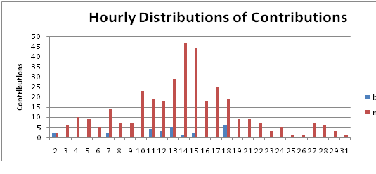
      • Distribution of contributions over time and by person
      • Classification of contributions
    • Qualitative
      • Can a group solve things faster than a really talented individual (yes! We squeezed in 400 manhours in 18 real hours)
      • Is there any correlation between quantity and quality (hard to tell. This was a complicated challenge and the solution didn’t need to be anything more than a one off solution.)
      • Are there biases by contributor (80/20 rule, is 80% of the work done by 20% of the people) (yes! But different levels. Breakthroughs supplied by handful of people, grunt research supplied by another group.)
      • What makes a successful collaboration (solving the problem, of course! but doing it with fewer errors, better documentation, on time, on budget.)
      • What didn’t work (redundant work on encoder/decoder, multiple threads going at once, timezone differences without known “schedules” kept folks out of sync at the end… would improving these speed up this solution? improve its quality?)
      • What were some of the group dynamics (more to come on this in later posts… roles people filled…)
      • What schedules of reinforcement were at play (more to come on this… the feedback loop of the group and how code/solutions become reinforcers)
    • What I wish I had access to (Companies if you are reading this, please provide it will be WORTH IT FOR ME TO ANALYZE IN TERMS OF GOODWILL AND PUBLICITY. UPDATE 12/24 morning: N-Brain reached out to collaborate!)
      • Traffic Logs from Google
      • N-Brain (company behind it) assumptions
      • Traffic logs on N-Brain
      • Interviewees Invited
    • Follow Up Analysis (will follow up in January or sooner)
      • Traffic generated to the end site, n-brain.net (can tell in quantcast.com, compete.com, and alexa)
      • Traffic generated to http://wanted-master-software-developers.com/
      • Profiles of the contributors (get resumes/cvs/bios and/or some basic demographics)
      • Success of N Brain Product Release

    The Analysis

    Key observations

    There was almost NO FLAME WARS/NEGATIVE COMMENTS AT ALL

    Very little correlation to posting frequency/amount and breakthrough chance (biggest breakthroughs produced/cited by some of the least frequent posters)

    Key Facts

    Dataset

    Over 600+ postings, 300+ real contributions, 25 breakthrus (less than 10% of contributions were breakthrus)

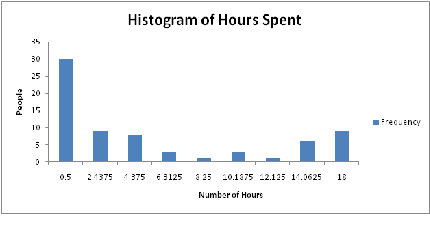
    Took 18 hours and 132 people (73 contributors, 59 observers) to solve challenge.

    No Slashdot comments were included in this analysis. It should be noted that several key findings appeared there first. The main finding being the google group to launch the real challenge. Many of the key postings on Slashdot were made by persons who migrated to google group, so it should not affect analysis too much.

    Workload

    Estimation that approximately 19 people put in 10+ hours. Approximately 400 man hours put in, with more than half by 19 people (analysis adjusted for sleeping time and by timing of contribution. E.g. if contributor had to sleep, discount 7 hours)


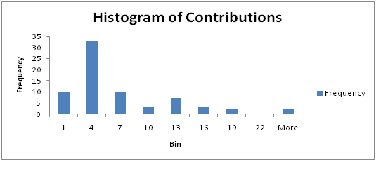
    5.65 contributions per person. Max contribution count was 25. Minimum was 1. Most people contributed less than 5 times. It should be noted 3 of the key breakthroughs came from contributors with fewer than 5 contributions.

    Peak activity and Peak breakthroughs not correlated

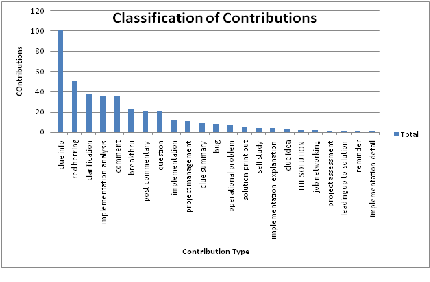
    Classification of Workload

    (classifications subjective to analyst. Probably could use a second eye)

    Most of the contributions were research or clues. A lot of research chased down dead ends or irrelevant facts. Very little banter or small talk. No flames on Group. A few on Slashdot.

    Breakdown of contribution classifications by Contributor.

    Note: the data has been scrubbed for contributions/postings that weren’t mere banter or blank. (I full admit to likely misclassifying and even misassigning breakthrus and solutions to contributors. Please correct me if I did.)

    Note: I considered breakthroughs as contributions that were sub solutions, code implementations that lead somewhere or key insights into clues.

    Please SEE PDF FOR TABLE ON CONTRIBUTOR BREAKDOWN
    (PDF of Draft Analysis)

    Conclusion

    N-brain got more than their money’s worth for creating this test. Beyond uncovering great talent, they learned a lot about collaborative development, especially in a wide open problem set.

    Open style collaboration is incredibly efficient. We squeezed in 400 manhours into an 18 hour period on a holiday weekend.

    There’s room for all types. Almost all contribution behavior that HELPED was quickly reinforced (follow up analysis of feedback loop to follow). Anything that was redherring or slightly counter productive was extinguished almost immediately. We had one instance of information withholding early on that was quickly eliminated and never resurfaced.

    Tracking of projects happens quite naturally now with all our web based toolsets. No disruption of creativity or coding occurred and we have a fully analyzable project.

    We need to analyze more of these situations to give businesses, organizations and individuals a strategy for existing in this flat global world. More on this later…

    What do you conclude?

    ~Russ

    Anatomy of Software Collaboration

    –––––––

    Dec 24
  • Man, whew! had a great last 18 hours DORKING OUT.  i’ll admit it.  i just participated in one of the biggest dorkouts ever.  It’s relevant to business, behavior and media because it represents EXACTLY what is so crazy and different about doing business in a connected world.

    Sometime around 10am PST this story hits slashdot.org:
    http://developers.slashdot.org/developers/07/12/22/1746220.shtml

    In this post developers are keyed off to a mysterious job posting for Master Software Developers.  The job posting contains a list of attributes and then a challenge to find out who the company is and what the significance of the date 1/18/2008.

    The initial solving the challenge begins in the comment threads on slashdot but quickly migrates to Google Groups as the first piece of the challenge is solved – a URL is uncovered in the posting of the job title based on a base64 encoded string at the bottom of the fake job posting AND a redirect URL to a google group is “encoded” in the main style sheet of the found website.

    Those of us first arriving at the google group work quickly to port loose threads on slashdot and get an organized thread/conversation going on the google groups.  We quickly uncover a huge amount of clues that are related to current tasks in the challenge and future tasks.  A few javascript gurus educate and code the group through the first task which is a test driven development of a javascript function.  Some of the rest of us reverse engineer the site uncovering an image which clearly has an encoded message or a useful pattern.  We also uncover an interesting css file that, again, looks as though it has an encoded message.

    In fact, it’s quickly realized by the group that this challenge is going to be a long series of encoded messages, each one getting more complicated than the first.

    At this point, the group starts showing strengths in different areas.  We find some folks that are well versed in ciphers (encoding messages), some that are quick coders, others with great eyes for clues and patterns and so on.

    The first message we uncover is the word “collaborate”.  This was found after decoding a message embedded in the original test page which was only revealed by cleaning up and “indexing” a snippet of text about Henry Ford found from completing the javascript function successfully.  One person posted a great javascript function, several folks indexed the quote, and several other folks found the hidden message.    At this point we were pretty good as a group, but definitely not all working100% together.  Some folks had gotten ahead.

    But then bam.  it got hard. real hard.  No one splintered off to go their own way.  the group converged on one thread in the google group and a someone started maintaining summary pages of “What We Know”.  The real work began.

    A couple of people set out to decode the hidden message in the CSS file.  I, personally, set to work on the code in the image file.  On suggestions from others I chased down some image analysis that went no where.  Someone solved the css file which lead quickly to get us to the final task, without us yet fully completed the second task.  It was extremely useful though because we got a bigger view of the problem set.  this continued on for sometime…

    It got absolutely amazing when everyone collaborated on decoding the image file.  An amazing amount of work went into finding patterns.  People posted a variety of analysis.  finally someone noticed, for the second time!, PI.  Pi was somehow involved in the image and PI had been hinted at earlier.  it was a great tip that lead quickly to uncovering a difficult-ish cipher for our last 2 puzzles.

    A few code gurus pounded out a decoder based on that cipher. (that was impressive to me!).

    The clues came forth.  Most of the rest of the task was clue hunting, not coding.  it took about 6 man hours to finally put it all together and uncover the final answer.

    sometime between 4-6am PST the answer went in to the challenge websites.  SOLVED.

    Early in the task speculation bubbled up about possible association with a movie coming out on 1/18/08.  We shirked that speculation early (though it came back up a lot), which proved to be right.

    The challenge was put out by a Boulder, CO company, N-BRAIN.  N-BRAIN produces Collaborative Development tools for programmers… go figure!  the answer happened to be the release date of their software.

    This was such an unbelievable collaboration.  I was personally engrossed enough to take my laptop and cell phone modem to my child’s gymnastics practice and to make sure I was connected at a holiday dinner via my smart phone.  I put in at 12-14 straight hours myself. and for what?  THE CHALLENGE and the exhilaration of working with other people equally excited.

    No doubt N-BRAIN will get some good tech press for their new product.

    I suggest picking through the Google Group: http://groups.google.com/group/wanted-master-software-engineers

    You’ll get a full view of the story and threads and approach.

    There are many interesting learnings here.  The big one for me is… collaboration on challenging problems where the approach can grow organically can be extremely powerful.  i.e. this group had a goal.  the method was not prescribed.  use any language, use any tactic… just go.  The second big thing… how much more quickly did 50-100 people working together solve a difficult problem than one would do on their own.  This problem wasn’t limited to one domain – it involved ciphers, image analysis, pattern recognition, HTML/CSS, basic research, javascript and more.  In other words, you’d have to be EXTREMELY talented in a huge amount of things to really solve this independently this quickly.  Sure, all the knowledge is out there, but as an individual it’s hard to find and absorb it all quickly.

    I also learned a ton about ciphers, using eclipse quickly (that java encoder), piet interpreter, samual smiles, henry ford, history of boulder…  really a huge scope of learning for the saturday before christmas!

    I owe this story a follow up.  Really, there’s some incredible behavioral analysis possible here and I want to ferret it out.

    For now, I must return to the other world of Christmas, family and all that.  this time without a smart phone under the table!
    Brain Real Time Collaboration

    –––––––

    Dec 23
Previous Page Next Page

Blog at WordPress.com.

  • Subscribe Subscribed
    • Social Mode
    • Join 99 other subscribers
    • Already have a WordPress.com account? Log in now.
    • Social Mode
    • Subscribe Subscribed
    • Sign up
    • Log in
    • Report this content
    • View site in Reader
    • Manage subscriptions
    • Collapse this bar