Social Mode

,

  • Observe this graph of Google search traffic by the remaining candidates.

    Blue is Barack Obama, Red is Hillary Clinton, Orange is John McCain

    Google Trends for Barack Obama

    The spikes all correlate with voting days or the day after.

    I have nothing profound to say other than it’s pretty interesting that the days when tons of people seek info is after the die is cast.  It reminds a lot of the behavior we see in retail and ecommerce – in many product categories people are more likely to visit a retailer website AFTER they have made a purchase (confirm value of purchase, sink deeper into buyers remorse..). Companies spend a ton of money figuring out why people abandon carts, which isn’t actually what’s going on.

    …

    ~R

    add to del.icio.us :: Add to Blinkslist :: add to furl :: Digg it :: add to ma.gnolia :: Stumble It! :: add to simpy :: seed the vine :: :: :: TailRank :: post to facebook

    Barack Obama vs. Hillary Clinton vs. John McCain – Voting Schedules

    –––––––

    Mar 23
  • I received the following from a director of ad operations, Jeremy Jones, in response to yesterday’s post on collective behavior and the other day’s post on vertical media.  His remarks focus on the confusion over social networking advertising (both selling and buying).  I include the full remark here and an annotated remark below.

    [Social networks/social sites] struggle with how to sell the concept to advertisers.  No one gets it, not even the sn sites themselves.

    I had believed that social networking and behavioral targeting was just a fad.  That it will end up just being another tool in the arsenal once somebody actually figures it out.  I think it won’t really take off until someone develops a standard that everyone can follow.  Until then it’s just a mishmash of technologies and ideas that are just tangents of the same idea.  Being in the industry, we hear about every new concept of trying to aggregate behavior and bucketing those behaviors to try and create useful targeting.  It all revolves around collecting site behavior.  Some of the more interesting ones actually involve trying to apply psychological profiles and social classifications based on the user’s browsing behavior.

    Is sn or bt about the consumers or the influencers?  Up to this point, anyone trying to use influencers has typically been exposed.  All those attempts at viral are quickly uncovered as manufactured.  It is true what they say that the internet is the world’s greatest laboratory.  The collective intelligence will typically uncover a insincere effort rather quickly.  SEO has generally been regarded as a good thing.  Even though it has been used by every advertiser to increase their influence.  It has ensured that any content worth knowing can be found.  But what about social networking and behavioral targeting?  The impact of social networking is just beginning to be felt.  So much personal data.  Will the collective eventually see this as a good thing or bad?  It’s influence will be far greater than SEO.  Will they approve of having their personal details used for the purposes of a more efficient marketing machine?  Can they do anything about it if they really wanted to?

    One of the current problems with behavioral targeting is that no one has developed a method of success reporting.  What is a success metric for a bt campaign?  Advertisers are still using visits and clicks as success metrics.  Widgets is an interesting method.  It requires adoption by users, and once adopted, do they interact with your widget?  Consume it’s content, pass it along to friends?  Do friends adopt it without prompting?  It certainly opens up a whole new area of measurable behaviors that were never available before.  This gets back to the influencer vs the consumer.  How do you target the influencers?  Heck, how do you identify the influencers.  That, I believe is the tricky part.  The influencers are not a stable group.  They are never the same.  They can be an influencer one day, and an consumer the next.  If you could come up with a method for identifying the influencers for any advertiser then you would really have something.

    I think this response underscores the general discomfort with media and advertising right now.  We have the technology to deliver interesting experiences and we collect a lot of data.  We simply don’t have a good enough technology/science of behavior that has left the ivory tower and trickled into business intelligence.

    We focus too much on the “biological details”(e.g. who are the influencers, where’s the meme/viral agent/contagion, what is the makeup of the content, onbrand strategies) that we’re losing site of the behavior, in particular the social behavior.  We do not need to know much about the influencers to take advtange of influencer behavior (what are the behaviors, what are the schedules of reinforcement, what are the reinforcers), history (normative behavior, rule sets, discriminant stimulus) and the context of the influence (the environment, the websites, the office, the watercooler, the telephone…).

    Here’s my direct response to Jeremy:

    [Social networks/social sites] struggle with how to sell the concept to advertisers.  No one gets it, not even the sn sites themselves.

    “It” needs definition.   The confusion may stem from unclear values and how to measure achievement of that value.  What do advertisers value?  Transactions?  Clicks? User data? Sales?  “Brand awareness”?  Being hip/cool?  Often advertisers use buying agents (agencies, buying teams, their uncle…), so the values are compounded.  The buying agent may value sticking to budget, being hip, being secure…   The confusion in measurement for media and advertising has partial roots in what the bigger financial market (venture capitalists, board members, stock market/shareholders, banks/lenders) value. Do the financiers value media footprint (eyeballs), transactional value (CPMs), advertising market ownership (spend share), loyalty (repeat spends, repeat users)?   When you look at the two value sets and try to assess whether the social networking sites fulfill any combination/which combination you find that social networks are out of whack with mainstream values.  Social networks drive huge footprints and user loyalty and are good at exposing users to brands/ideas/concepts. Social networks have yet to drive transactions or any offsite activity so most of the values to advertisers with the current advertiser approach cannot be fulfilled.

    Don’t forget to add the set of rapidly changing distribution mechanisms (the APIs, social networking platforms, ad implements, publishing toolsets, scripting languages, AJAX vs FLASH vs Silverlight, the tracking systems…)

    Thus confusion.

    Resolution?  Experience.  That’s it.  Everyone will gain experience and we’ll integrate social networking advertising and not even notice because their will be some other “new thing” chewing up attention on blogs and at water coolers.

    I had believed that social networking and behavioral targeting was just a fad.

    A common response to an unknown stimulus.  Until you experience new methods enough, everything we don’t know about is a fad.

    That it will end up just being another tool in the arsenal once somebody actually figures it out.  I think it won’t really take off until someone develops a standard that everyone can follow.  Until then it’s just a mishmash of technologies and ideas that are just tangents of the same idea.  Being in the industry, we hear about every new concept of trying to aggregate behavior and bucketing those behaviors to try and create useful targeting.  It all revolves around collecting site behavior.

    Right, see my note above.

    Some of the more interesting ones actually involve trying to apply psychological profiles and social classifications based on the user’s browsing behavior.

    Pyschological profiles?  ugh.  It’s behavior that matters.  The psychology, in typical usuage, is a useless abstraction.  As a thought experiment, profile yourself.  What’s you profile?  Another experiement: Go to your amazon.com page – based on the products you’ve purchased and they recommend, what does it really say about you and can you do much to target yourself that you couldn’t do by matching like categorized products that get ok user reviews?

    Behavior classifications based on schedules of reinforcement,with historical and contextual classification is the way to go.  Read up on schedules on reinforcement to understand the concept and how it might be applied to online advertising.  Basically, a publisher needs to understand rates of reinforcement and what schedules a user behaves under.  You can have the perfect product and a great message but if you miss a users schedule, they won’t buy.  Schedules can be:

    • buying schedules
    • reading schedules
    • relationship schedules
    • job schedules
    • cultural schedules
    • learning schedules
    • …

    One topical example that might help understanding. Think about this years elections and why the candidates might be having more success with their platforms vs. in previous years.  The voters schedules are inline with some politicians message.  The context of economy, health care, unpopular war, social upheaval, housing issues are both on social schedules/cycles and personal cycles.   Certain politician presentation styles and stance on these issues fit better in the current schedules than others.

    Your own schedules impact how you vote and how others might influence your vote.

    I suppose you could say “timing is everything.”

    Is sn or bt about the consumers or the influencers?  Up to this point, anyone trying to use influencers has typically been exposed.  All those attempts at viral are quickly uncovered as manufactured.  It is true what they say that the internet is the world’s greatest laboratory.  The collective intelligence will typically uncover a insincere effort rather quickly.

    Is there a difference between consumers and influencers?  and does the exposition of that difference matter at all?

    Authenticity and credibility are very much tied to values.  A manufactured attempt a buzz is usually the result of the manufacturing body not understanding the values of the consumers. Often agencies, marketers and publishers get the optics (the outside packaging) of a product or service but totally miss the utility. (hint: ipods are much more than music on the go with a nice digital store)

    SEO has generally been regarded as a good thing.  Even though it has been used by every advertiser to increase their influence.  It has ensured that any content worth knowing can be found.

    I suppose.  A sidenote: SEO was also a product of the search companies themselves to improve their own product.  The better content can be found the more useful the search engine.

    But what about social networking and behavioral targeting?  The impact of social networking is just beginning to be felt.  So much personal data.  Will the collective eventually see this as a good thing or bad?

    It’s neither good nor bad and will never be labeled as such.  It’s all about value.  You give all your professional data to LinkedIn and Monster because they help you get a job, you do not always share this information with your land lord because he might use it against you.  You give your friends names to Facebook because it helps you communicate.  You give google all of your search queries because it finds the info you need, but you’d never share your search query list with your girlfriend – you’d have far too much explaining to do.

    It’s influence will be far greater than SEO.  Will they approve of having their personal details used for the purposes of a more efficient marketing machine?  Can they do anything about it if they really wanted to?

    Social networking traffic is different than search traffic.  It’s not greater or lesser in any quantifiable sense, certainly not yet.

    Yes, you can do something about your data.  Always.

    One of the current problems with behavioral targeting is that no one has developed a method of success reporting.  What is a success metric for a bt campaign?  Advertisers are still using visits and clicks as success metrics.  Widgets is an interesting method.  It requires adoption by users, and once adopted, do they interact with your widget?  Consume it’s content, pass it along to friends?  Do friends adopt it without prompting?  It certainly opens up a whole new area of measurable behaviors that were never available before.

    See my earlier notes on the confusion of values.

    This gets back to the influencer vs the consumer.  How do you target the influencers?  Heck, how do you identify the influencers.  That, I believe is the tricky part.  The influencers are not a stable group.  They are never the same.  They can be an influencer one day, and an consumer the next.  If you could come up with a method for identifying the influencers for any advertiser then you would really have something.

    My focus is on coming up with a way to track, analyze and respond to schedules.  If I know your schedules, I don’t need to know you.  Tracking schedules doesn’t require demographic studies or surveys or other intrusive methods.  I can use the behaviors you exhibit.  The web is excellent for this.

    My point is that I can spend time classifying people into various categories by gender, “personality”, social status in an effort to predict behavior OR I can just observe the behavior and schedules and attend directly to that.

    ~R

    add to del.icio.us :: Add to Blinkslist :: add to furl :: Digg it :: add to ma.gnolia :: Stumble It! :: add to simpy :: seed the vine :: :: :: TailRank :: post to facebook

    Social Networking and Behavioral Targeting Response

    –––––––

    Mar 23
  • There’s a remarkable feature on Edge.org.  I point it out because it’s robust dialogue about collective behavior.  In particular, the discussion is decidedly not casual agentish, mind-body dualist nor monocasual.  Dr. Couzin is refreshing!  His approach ties very well to analysis of media (collective behavior!)  (Read his other stuff like this essay, too!)

    how can a colony decide between two food sources, one of which is slightly closer than the other? Do they have to measure this? Do they have to perform these computations?

    We now know that this is not the case. Chris Langton and other researchers have also investigated these properties, whereby individuals just by virtue of the fact that one food source is closer, even if they are searching more or less at random, have a higher probability of returning to the nest more quickly. Which means they lay more chemical trail, which the other ants tend to follow. You have this competition between these sources. You have an interaction between positive feedback, which is the amplification of information—that’s the trail-laying behavior—and then you have negative feedback because of course if you just have positive feedback, there is no regulation, there is no homeostasis, you can’t create these accurate decisions.

    There’s a negative feedback, which in this case is the decay of the pheromone, or the limited number of ants within the colony that you can recruit, and this delicate balance of positive and negative feedback allows the colony to collectively decide which source is closest and exploit that source, even though none of these individuals themselves have that knowledge.

    Great exposition on the web of contingencies and the feedback loops capable of reinforcing complex behavior that we typically claim is “free choice” like or conscious decision making.

    One of the big challenges that still remains, and one that we’re beginning to address—I’m not saying it’s a new question; I’m not saying people haven’t addressed it—is the level at which selection is acting within populations. The view of individual level selection, and selection at the level of genes, of course, holds. But if you consider, say, a school of pelagic fish—these large schools that make these dramatic maneuvers—the individuals are unrelated to each other. They drift around as pelagic larvae, so when their schools are comprised as adults, they’re completely unrelated.And yet the individuals’ functioning is entirely within the context of these schools; you can see the integration of the behavior when they are attacked by predators, you can see why in the ’40s people thought there must be thought transference, must be telekinesis, because of these remarkable maneuvers. We now know that these maneuvers are created by the relatively local interactions among the individuals. But if you take an individual, say, a herring, from the school and isolate it, it will die of stress.It is a bit like taking cells from your body—when you take them outside the body, they are unable to function. Of course it is not as closely integrated as a body, it is not as closely integrated as an ant colony. But there is this high level of integration among unrelated individuals. And in terms of how the genes are going to propagate, genes that allow individuals to function collectively as a group are going to be extremely important. So one has to then begin to think about the level at which selection is actually functionally acting. There is nothing new in terms of the genetics here, but it just in terms of how you begin to understand how the collective behaviors emerge and evolve within these types of systems.

    Yes! Selection by consequences. Selection happens at many levels – genetically, epigenetically, and behaviorally.  This is a clearer and more accurate description of collective behavior than some previous discussion on edge.org.

    It doesn’t stop there though.  Dr. Couzin reminds us yet again observed behavior emerges from simple, often unexpected, contingencies.

    Another example that we’ve been investigating arehuge swarms of Mormon crickets. If you look at these swarms, all of the individuals are marching in the same direction, and it looks like cooperative behavior. Perhaps they have come to a collective decision to move from one place to another. We investigated this collective decision, and what really makes this system work in the case of the Mormon cricket is cannibalism.

    You think of these as vegetarian insects—they’re crop pests—but each individual tries to eat the other individuals when they run short of protein or salt, and they’re very deprived of these in the natural environment. As soon as they become short of these essential nutrients, they start trying to bite the other individuals, and they have evolved to have really big aggressive jaws and armor plating over themselves, but the one area you can’t defend is the rear end of the individual—it has to defecate, there has to be a hole there—and so they tend to specifically bite the rear end of individuals. It is the sight of others approaching and this biting behavior that causes individuals to move away from those coming towards them. This need to eat other individuals means you are attracted to individuals moving away from you, and so this simple algorithm essentially means the whole swarm starts moving as a collective.

    I mean, really. Think about this… how different is human behavior? (I know, I know, it’s more complex, but…).   Consider the elections, consider online behavior, and consider office politics.  We move towards what we move away from and then you get this behavior that appears collective.  Perhaps in our rush to be anti-brand, unique, a cut above, a stand out, we all come together????

    In the human sphere it takes us a great deal of effort and complex cognitive abilities to decide what to do if we are going to decide in a collective. What we can now show is that animal groups, with really simple cognitive powers, can actually perform these types of computations. What we now want to understand is under what conditions these types of cognitive capacities work. How can these animal groups take information from multiple sources; how do they filter out noise and yet amplify weak signals?

    Right, we should get some data to back that up!  We are on to it…

    Second idea that is interesting is one reason I’m interest in NKS Summer School – simple rules applied over and over and sometimes compounded can generate very complicated behavior.  Sometimes the behavior is so complicated we’re inclined to model it with complex rules.  I want to explore this in depth and showcase it visually.

    Dr. Couzin makes a great case for why the study of behavior is key to understanding.

    The locust is one of the best-studied organisms for physiology and neurobiology. It is really an amazing model system for looking at these principles. Yet the last time people looked at the swarming behavior of locusts in the lab was in 1954. So there is this dearth of information, and no matter how much you look at a locust, and how much you know about the biology of a locust, you cannot predict what will happen when you start to put these organisms in swarms. …. Issues like the dimensionality of the problem are important; issues such as certain details of the interactions are not important if you want to understand the general principles of how it changes—the phase transition is very important for us in the case of locusts because, as everyone knows, locusts are always around. But then suddenly there is this transition from one state to another almost liquid state—so its driven liquid-type state—where the swarms can become enormous.

    He, too, arrives at a similar curiousity in the application of these abstractions to the study of media.

    Individuals can have a certain opinion on certain topics, and we can allow individuals to interact across a social network, and of course the social network’s topology is partly defined by what opinions you have. You tend to interact more often with people who have similar opinions to yourself because you are more likely to meet them in your sphere of life. But interacting with people can change your opinions, which can then change your social network, which can change your opinions, so again we have this recursive feedback. And so we are using it to explore these types of properties?I am sure that these types of principles also would apply to understanding dynamics on the Web.

    I know there’s some excellent work by Duncan Watts on how individuals buy on-line, or how they judge information that they have on-line, how your judgment of something is dependant on what previous people have said about it. What they used was an on-line music store, where you either have information about what previous people have thought about a song, or you have no information and you just have to rank the song without that previous buyer. This strongly changes people’s behavior because of course when you see what other people have been doing, you can have this autocatalysis, this positive feedback. You can tend to buy into that because you have seen other people do it.

    Yes, like so many of my posts, we’ll leave with a simple take away:

    We are constantly looking for areas where we can create a more data-driven science behind the spread of these normative behaviors.

    And maybe this constant looking is also a spread of a normative behavior?

    ~R

    p.s.
    For info on Duncan Watts weave your way to his Kevin Bacon paper and his take on online music/social trends.  You may want to hit up his wikipedia page for more links.

    And Yahoo! research, where he works, has some kickass concepts, publications, apps.

    add to del.icio.us :: Add to Blinkslist :: add to furl :: Digg it :: add to ma.gnolia :: Stumble It! :: add to simpy :: seed the vine :: :: :: TailRank :: post to facebook

    Collective Behavior Perspective

    –––––––

    Mar 22
  • How convenient!  Slashdot had a lead post about Google ad patents and these patents are all about behavioral targeting.

    19. The computer-implemented method of claim 18 wherein actions of the user monitored are selected from a group of user actions consisting of (a) cursor positioning, (b) cursor dwell time, (c) document item selection, (d) user eye direction, (e) user facial expressions, (f) user expressions, and (g) express user topic interest input.

    A few other posts around the web lead to other coolish behavior based ad information.

    One key aspect of behavior based anything – you need computing power.  lots of it.  This is yet another reason most vertical ad networks, targeted publishers and standard marketers can’t really do behavior based, uber effective advertising campaigns.  They simply lack the raw horsepower.

    Google Behavior Based Advertising

    –––––––

    Mar 22
  • Today a little bit of a spat broke out about Federated Media and Glam.

    John Battelle wanted to make a general statement when specific ones can easily be made.  Most of these vertical ad networks and vertical ad plays stink.  They aren’t good (or any better than anything else).  They aren’t special for the user, the publisher, nor the marketer.

    Why?

    They aren’t based on behavior.  Most of the targeting and site rollups are based on the terrible panel based demographics and some lame content classifications.  The ad implementations, as John clearly points out, are based on IAB standards – i.e. not behavior.  Unfortunately for John’s argument his company, Federated Media, has the same non-behavior “targeting/verticalization”. He’s got all the tech sites.  That’s not different than Glam.

    Recalling the heyday of magazines and cable is hardly a step in the right direction either.  Why?  None of those mediums could deal directly with behavior.  Sure, they influence behavior, but they are mediums that cannot be conditioned in return.  The mags and cable (broadcast in general) depend on a shotgun blast approach.  They have to get in front of you at every newstand, every tv, every checkout lane.  They have to blast you with house promos, drop cards, and numbing outdoor campaigns.  All the ways they had/have to attract you to the content (and ads) is non-responsive, non-personalized.  Luckily these mediums can spend a ton of cash to blast you into readership, viewership and mass appeal.  It’s tried and true, but very expensive.

    In short, those experiences aren’t the internet. 

    The ad rates weren’t based on the performance of the 2 page ad spread nor any other verifiable metric.  Brand Perception and marketed readership/viewership and sales connections sell those ad rates.  Powerful facets then, powerful now.

    Guess what?  The internet doesn’t have mega-brands and most sites ad rates are based on hard to juice metrics (so many ways to verify actual traffic and interaction.).

    I do believe high CPM rates are possible.  Integrated experiences built around schedules of reinforcement (conditioning, rewarding, reinforcing) the user and in return other users, editors, the site and so on are worth the money.  These experiences are usually not standard across sites – how can they be?  They need to specific to the service!

    Alternate reality, iphone apps, immersive game worlds, user to user games, recommendation ads, mystery games, scavenger hunts, interactive novels…

    Note: The only mass market / standard ad that is loosely based on behavior is search ads due to Google’s massive optimization and bidding engine.  The system (prices, creative, number of ads, etc.) morphs constantly to what’s going on and the ads are nearly ubiquitous so they follow the user (reinforce them) regularly (schedules!).

    So what’s the next mass market behavioral advertising option?

    The next behavior based ad ecosystem is the social network.  Some don’t think its there yet. I disagree.  The social networking apis and the resultant applications are the behavior based ads.  Facebook/MySpace/Hi5/BeBo don’t make money from them yet, but plenty of publishers do.  These “apps” are far more interesting and robust than the ads most agencies, media buyers and marketers stage.   It’s too bad that more brands, companies and products that depend on massive marketing don’t take advantage of these more.  If some of the big companies spent more of their considerable resources on building interesting apps and services, they’d get so much more out of it than the easy to do but usually worthless online ad campaigns and these tired vertical ad networks.

    What’s the hold up?

    There are a whole set of contingencies preventing online marketers from doing more and running campaigns behaviorally.   Knowledge of behavior, solid analytical approaches, technical skill, time, bucking the system… and more.

    There’s simply not enough knowledgeable, creative, competent talent to go around.  And, now, it’s no longer all aggregated at the big five agencies and the big five consumer product companies.

    In the heydey of print and broadcast, there weren’t as many variables to pay attention to, not as many options on how, where, when to spend your ad dollars.  There wasn’t even as big an ad market.

    Ad budgets are growing, certainly, but not enough to give a growing amount to every publisher, every broadcaster, every newspaper.  TNS predicts a 4.2% US ad spend increase from 07 to 08.   That’s about $340mil extra to split among the cable, network tv, radio, newspaper, magazines and internet options.  Let’s say only 340 new ad outlets become available in 2008 (new websites, cable channels, new magazines, etc. etc.).  That means the only $1 mil for each one of these, assuming existing options don’t grow.  Exactly… ad dollars per publisher, on average, is going to go down over time.

    With each publisher getting a smaller slice of the ad pie, they have less money to help marketers try interesting things.  Smaller budgets don’t reinforce greater effort. Less effort doesn’t encourage repeat business.  The free third party metrics sites erase the advantage of heavy hitting sales people.  The rapid trading of talent gives everyone access to the same ideas, same approaches… and so on.

    All of this normalizes the options.

    Now what?

    Rarely do  standard approach turn into a runaway success.  On average, standard approach get standard results.

    Vertical sites and vertical networks – most are standard fare.   The High CPMs aren’t going to go to standard fare. The people who can afford high CPMs typically value non-standard options.  Publishers who want high cpms need to put in the effort to develop behavior based experiences.  Users habituate quickly to standard approaches – pattern interrupts are key to engagement. As such, there’s no advantage to advertising in a vertical ad network.  The vertical ad networks exist for the benefit of the publishers, not the users.  Many publishers don’t want to sell their own ads so they let someone else do it.  Turning to a vertical ad network main help run out a budget, but no one has published any data to suggest the performance of vertical networks does any better than advertising on Google.  (why?  well, one of the main factors – most of the vertical sites targeted get 40-80% of their traffic from Google via SEO or SEM.  🙂 )

    No, really, now what?

    Argh, so much to write about….not enough time!

    I’m going to pull out some killer ad campaigns/integrated media as a showcase.  Do you know of any behavior based/game changing ad executions?

    ~R

    Vertical Media (Glam, Break, Federated…) – blah!

    –––––––

    Mar 22
  • After a prodding from a pal, I decided to apply to the Wolfram Science NKS Summer School. NKS is a fun and exciting research area and Mathematica rocks. I have done some preliminary research in trying to merge automata to experimental analysis of behavior. Three solid weeks of study and interaction with others could do wonders to furthering those efforts! Heck, three weeks doing anything different always does wonders!

    Below I present the thought process in applying to NKS Summer School. I’m not sure it’s interesting to anyone, but I am trying more and more to catalogue the web of contingencies involved in my own behavior.

    John said, Go!, let’s go check out the app process. I got that same email, hmmm, I’ll check it out again. I saw the application form, looked simple. I read a few blog posts from the event last year. I swivele in my chair to see how accessible my NKS book was… oh, it is right there. I flip it open and read the preface and chapter 1. I look at the clock. Oh, shoot, I really need to finish this code for tomorrow’s 11am meeting in Santa Monica. Oh, shoot, this is so cool. I’ll read a bit more. Oh, look at this… when I picked this book up 4 years ago this all seemed so crazy hard and really he spends an awful lot of time and paper on repeating the same points about automata behavior. Gee the good stuff is left to an appendix after page 1100. OOo, he’s talkinga bout space and time and automata. That’s kinda fun and a different approach, oddly know equations or mathematica symbolics to mathematically meld them. lemme flip ahead…. check email. check clock. check blog stats. Crap it’s 2:30. and if i’m going to apply it has to be within 45 minutes or I’ll never do it. better take some notes. where was that stuff on responsibility and behavior? casual networks, that’s good stuff and interesting in that it meshes well with john’s visualizations. skinner, wonder what their opinion on skinner is. the phrasing in the book is somewhat dismissive of non computational sciences and of behaviorism. that’s usually the case. also their site is fairly devoid of social sciences and anything that goes beyond low level biology and physics. oh well, if i were to do this i’d want to mash behavior models to this. not sure you can even do that in 3 weeks. talking to wolfram himself would be cool. i should ask dani about this. yeah, but then I’ll question it. the app doesn’t lock you in. dump it in and see what happens. vermont for 3 weeks. hmmm, that’s cool. ok, how do I couch my response. they also want a resume. gotta dump that out from the blog and format it. should i submit as openoffice doc so they know i’m a tech. hey, i gotta download the latest release of mathematica, i got a note about that a week or so ago. that’s a big download, going to take awhile. alright, i have these notes. now I have to put together some indication of research interest. how to show detail in reading NKS? and what are they looking for… people who spent a lifetime working in it or is this a reach out… attract newbies who have solid interest? is commercial background a hinderance? is my commercial resume good enough, should it be reworked. cool, I went to uchicago. ENTP, wonder if they will get that. my resume is fun but certainly is an odd read. oh well, more time on that later. alright i’ve got these statements. ugh, lots of errors. this is why you don’t write in a text editor. takes too long to clean it all up. alright, i’ll correct the basics, read it outloud and then go. crap, running out of time. just get it in. fill it out… i bet this will crap out on upload and i’ll have to do it again. hahaha. oh, cool it worked. alright quick shoot it to john. ah crap, there’s a wrong tense or two and a mistyped word in the basic statements. not a lot I can do now. they have the blog and my resume. if i’m interesting as a personality and can twist NKS in new ways, maybe they will be into it. Let me quick confirm there’s no one who proposed some of my thinking… one dude did a social sciences lecture. crap requires mathematica to view. damnit, redoing linux messes up my flow. i should just do this on my laptop. based on the title and his bio doesn’t look much different than most social sciences. everything else typical bio, phys and math. alright, now i have to finish this code….first a vault soda and some cheez its.


    Here are my original application answers to their open questions.

    Tell us about your interest in Summer School?

    NKS offers a new model for researching and applying an experimental analysis of behavior (empirical behaviorism). Popular sociology and psychology (and even some of the cognitive disciplines) rely far too much on statistical analysis and, perhaps, less accurate probabilistic models. The mathematical methods presented by NKS provides a structure that closely aligns with schedules of reinforcement we observe and the concept of selection by consequences.An intensive session in NKS should aid in my application of simple automata like models applied to the study of human behavior. In particular, I hope to research and complete a project based on social networks and the ever increasing merging of our offline and online lives.

    My professional work in new media remains too “business oriented” to get to the root of what’s going on with human behavior and our interactions with information, the world and each other. Yet, I’ve had enough deep exposure to massive schedules of reinforcement, deep troves of user data and human computer interaction within companies like eHarmony, Yahoo!, Maxim, and Business.com to know that we now have the empirical data and computing capability to map extreme casual networks and model out possible simple rules generating the complexity of social behavior.

    That said, I’m under no illusion that we’re close to fully mapping out or predicting human behavior. This summer session would aid in generating discussion and likely producing further avenues of research and applications of NKS and Mathematica.

    In how much detail have your read NKS?

      I have completed NKS once in totality and referenced in regularly over the last 3.5 years. It has served as a research launching point for me into evolutionary programming, Dennet’s work, computation vs. statistical approaches and data compression issues in modeling. (among many other areas…) I maintain this cheatsheet of questions and NKS pointers on my desk for reference as I explore new media, experimental analysis of behavior, and social networks.

    chapter 9
    casual networks and schedules of reinforcement

    page505
    want to explore the multi pathway of our existence. selection by consequences in behavior might just be simplistic automata like rules based on schedules of reinforcement…. purely human level… what does that even mean?

    page 516 is right to the heart of my questioning. “given only a causal network, what can one say about the evolution history?” that’s human behavior and how we typically represent it in the media. We report on a limited view of the casual network and have a real difficulty discussing the explicitly evolution history.

    page 518 “This has the consequence that effects in such systems can spread only at a limited rate, as manifest for example in a maximum slope for the edges of patterns…” human behavior seems to have this quality as well, which we ob Chapter 10 on perception is tied directly to human behavior. how we absorb new stimuli and mash it to discriminant stimuli. probabilities of behavior… the part on statistical analysis. Determinism in human behavior is a fundamental discussion point. Free Will.

    page 596 is key point of research here….slight variation in the rules can produce dramatically different behavior and traditional statistical analysis (what is most done in sociology and psychology) cannot help identify changes in the casual networks and/or underlying rulesets “for it has almost always been assumed that to emulate in any generality a process as sophisticated as human thinking would necessarily require an extremely complicated system” That’s precisely the assumption behaviorism goes after….

    NKS might be the mathematical backing to unwind the thinking.

    bottom of 629 contains an important disclaimer… “the system would almost certainly have to have built up a human-like base of experience.” This is worth testing. Perhaps it’s not true in that our genetics, epi genetics and physical environments are simply specifics of a simpler abstraction of fundamental “starting conditions.” There’s no need to appeal to a distinctly human quality of “human” thinking.

    The discussion of verbal behavior/language is useful. Consider the “sms phenomenon”. We’re fully capable of evolving completely rule breaking verbal structures without destroying human communication. txting has structure but it’s hardly ordinary sequential grammatical.

    The discussion in chapter 12 is useful as well. Purpose gets in the way of human behavioral analysis. We want to personify so badly, but there’s nothing in the evidence suggesting value in doing so.

    Anatomy of A Decision in Life – Applying to NKS Summer School

    –––––––

    Mar 21
  • John H. Bryant writes:

    Behaviorally speaking, what happened when Barack Obama spoke on religion yesterday?For some, like the way I approached the speech and later his presentation, Obama’s speech might have seemed to be about religion… or perhaps the American Black experience… or perhaps the generational tug of our past with what is important to us today. Well, it wasn’t about religion as much as we might think it was.

    Yes, we’ve into a shift in religion (Religious Shift in America 2008), energy, globalization, business, etc.

    I know what I heard but I noticed something else. My conclusion is there is no Hope for an undefined future condition called ‘a better America’. It has arrived.

    What I heard was a shift and a loss of cues that we all have depended upon for so long. Behaviorally they are called SDs or “S – Ds” and stand for ‘discriminative stimuli’. You know, the things we recognize, the brands, the terms, the words, the stimuli out in the environment that we come to recognize as meaning good and bad, smart and dull, etc.; anything that allows us to discriminate one thing from another. While reading the speech that came out in the AM prior to the Barack’s presentation, I couldn’t tell who was speaking. We saw a difficult subject handled without acrimony: race.

    Barack Obama speech laid waste to more of the SDs that we’ve all depended on but that are no longer dependable. What are we going to do now if we can’t depend on those old stereotypes? (SDs)

    • We lost the inflamatory rhetoric SD of White, Jackson, Farrakhan and others
    • We lost the ‘done me wrong’ SD
    • We lost the ‘one cause’ explanation for 300 years of bad behavior SD
    • We lost the ‘good guy – bad guy’ dichotomy SD
    • We lost the ‘quick fix’ remedy in my term claim SD
    • We lost the government can make it better pabulum SD
    • We lost the SD of when to have the gut wrenching sinking feeling

    I’m a pretty smart guy so I need to figure out the consequences of losing my SDs.

    • How is this going to work if Barack Obama speaks and says things that are not purely Democratic, Republican or Washington centric?
    • How is this going to work if Barack Obama speaks and you can’t tell if he favors those that are white or black?
    • How is this going to work if Barack Obama speaks and he doesn’t instill fear of the future?
    • How is this going to work if Barack Obama speaks and he doesn’t try to make you mistrust those who want him silenced?
    • How is this going to work if Barack Obama speaks and you think he is talking directly to you rather than in lobbyist code?
    • How is this going to work if Barack Obama speaks and you can’t tell why he knows what you value?
    • How is this going to work if Barack Obama speaks and you don’t hear that government knows what is best for you?

    Wow, this election is getting complicated. I am going to have to make other associations with Barack Obama when he speaks and that’s hard work because it involves changing my stereotypical SDs.

    Barack Obama’s Speech – Behaviorist Perspective, post 3

    –––––––

    Mar 19
  • Barack Obama’s speech was so full of interesting threads. The issue of religion and our ever more confusing association with a particular religion, its leaders and its every rule is central to Obama’s speech – and likely some of his more robust and potentially inflamatory arguments.

    I’m posting this article recently published by my friend John Bryant (Religious Shift in America 2008). It’s relevant because it digs in deep to the shift in religion in America.

         Religious interest never goes away but in the last decade interest has risen to new levels.  Two studies in particular to be highlighted here mark today’s on-going monologue about religion in America. The first study is not about a shift at all but acts as a reference point for this article. The research is based on structured telephone surveys of more than 2,000 households and in-depth interviews with more than 140 people in 2006 conducted through the University of Minnesota by sociologist Penny Edgell. Researchers found that Americans rate atheists below Muslims, recent immigrants, homosexuals and other groups as “not sharing their vision of American society.” Furthermore, Americans are least willing to let their children marry atheists.

    The Edgell survey was followed by the release in February, 2008, of the Pew Forum on Religion and Public Life. That survey of over 35,000 Americans found that nearly half questioned were not practicing the religion of their parents. While that finding was no big deal for some, it was a bomb for many, especially those involved with the business of religion.

    The Pew Forum study confirmed what has been speculated for years about believers:

    •   the long-held belief that denominational loyalty is fraying —
    •   those greatest impacted are mainline Protestant and evangelical churches —
    •  One in six overall (16.1%) reported they were not connected with any particular religious faith —
    •  This number rose to 1 in 4 between the ages of 18 -29 who said they were not affiliated with any religion —
    •  Twelve percent were split 50/50 between a) those that were secular and unaffiliated, and b) those who said they were religious and unaffiliated —
    •  Catholics have seen numbers diminish for almost 40 years and seem to be outside the survey radar —
      • Absolute numbers don’t reflect major declines in the last four years
      • Their age demographic has shifted more rapidly than other Protestant denominations
      • Catholics have the broadest mixture of education levels but declining numbers in the 18 – 29 age group
      • Supported by older populations including high percentage of immigrants who bring that religion with them

    After checking out that pdf, go back to Obama’s speech. We’re talking about a major politician speaking to the gray area and the shifting context of truth. Yikes, it will be pretty interesting how this will play out in America.

    Post 3 on the speech will be the full analysis of his text.

    ~R

    Barack Obama’s Speech Distribution – Behaviorist Perspective, post 2

    –––––––

    Mar 18
  • Wanna get a good idea about why asking “who would do such a thing” is not an uplifting question to ask about events like Spitzer?

    Check out these sites:

    http://www.google.com/search?q=emperors+club

    Think they benefited at all by those curious enough to go find out about Emperors Club’s services?

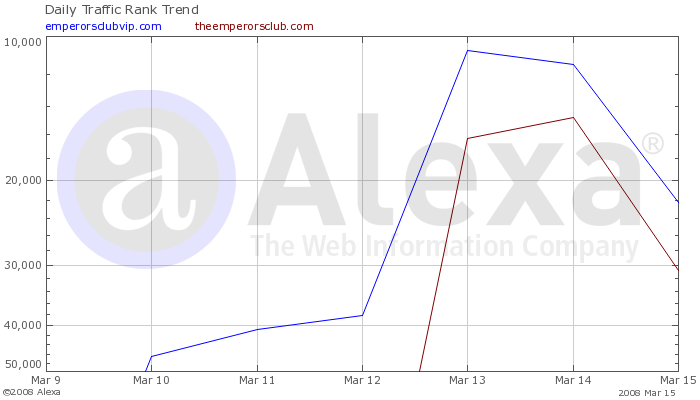
    http://www.alexa.com/data/details/traffic_details/emperorsclubvip.com?site0=emperorsclubvip.com&site1=theemperorsclub.com&y=t&z=3&h=400&w=700&range=1m&size=Large

    Spitzer and Internet Traffic Graph A

    Two domain name variations on Emperors Club put those sites in the top 15,000 for a couple of days.  That usual equates to 50-90K unique users per day.

    Wanna still get at the content like many others did that day? Use the wayback machine.

    Think I’m making this up? Strange correlation here.   See it over a longer period to see archive.org traffic…

    Archive.org and Emporers Club

    So, methinks Spitzer isn’t the only guy looking for an escort.  If I dug down far enough I’m sure I could find out who actually went to these sites during this time.

    Also interesting note is that EmperorsClubVip.com was hosted by Homestead.com, an Intuit company.  So… are they involved in the investigation….

    Enjoy

    Spitzer and Internet Traffic

    –––––––

    Mar 18
  • Check out these headlines pulled from Google News regarding the recent Obama speech (full text).  The context and content of the speech make this an excellent media event to analyze.  It’s full of taboo issues  and the stakes are sky high.  Doesn’t hurt that this is an incredibly active political season.

    What can we gather about how we consumer, distribute and understand mass media?   How does the context and the entry point affect our consumption of this speech?  How do our own views and history color the speech and alter the path we use to get at this information? How does the content of the speech and the headlines and the sources alter the spread of information?

    Obama denounces preacher, urges race healing
    Reuters – 37 minutes ago
    By Caren Bohan PHILADELPHIA (Reuters) – US Democratic presidential candidate Barack Obama on Tuesday criticized his preacher’s racially charged sermons but …
    Obama confronts nation’s race issues
    Los Angeles Times, CA – 2 hours ago
    The senator condemns his pastor’s remarks as ‘profoundly distorted’ while acknowledging the legacy of racial divide in a bid to quell the latest war of …
    Obama calls for racial unity
    Boston Globe, United States – 3 hours ago
    Barack Obama, whose presidential campaign has tried to transcend race, is taking on the issue head-on this morning, trying to quell a controversy over …
    Excerpts of Obama’s Speech on Race
    The Associated Press – 1 hour ago
    Excerpts of Democratic presidential candidate Barack Obama’s speech on race Tuesday at the National Constitution Center in Philadelphia, as transcribed by …
    Transcript: Barack Obama’s Speech On Race
    CBS News, NY – 2 hours ago
    Democratic presidential hopeful Sen. Barack Obama D-Ill., delivers a speech on race in Philadelphia, March 18, 2008. (CBS) A look at the young senator from …
    Activists go wild over Obama speech
    Washington Times, DC – 1 hour ago
    Attendees at the Take Back America conference were riveted as Barack Obama gave his address today on race relations in America and greeted his words with …
    Obama confronts racial divisions in the US
    Philadelphia Inquirer, PA – 2 hours ago
    By Thomas Fitzgerald Sen. Barack Obama urged people to move beyond the “racial stalemate we have been stuck in for years” in a major speech in Philadelphia …
    Will Obama’s Speech Work?
    Wall Street Journal – 2 hours ago
    From a political perspective, Sen. Barack Obama’s speech on race in America this morning in Philadelphia was extraordinary. Obama addressed head-on the bad …
    Obama addresses America’s racial legacy
    MSNBC – 2 hours ago
    PHILADELPHIA — Barack Obama gave a sweeping address on race in this country today, using the statements made by his pastor, Reverend Jeremiah Wright, …
    Race and Rev. Wright: Obama’s eloquent history lesson
    Kansas City Star, MO – 1 hour ago
    By Steve Winn, Kansas City Star Editorial Board Sen. Barack Obama met the race issue head-on Tuesday, discussing it with intelligence, sensitivity and the …
    Did Obama’s Speech Help or Hurt?
    Newsday, NY – 1 hour ago
    1. Obama finally confronted race head-on — but is that a good thing?. Obama’s meteoric rise — and stunning victories in virtually all-white states like …
    On Defensive, Obama Plans Talk on Race
    New York Times, United States – 3 hours ago
    Alex Brandon/AP Senator Barack Obama took part in an MTV discussion with Iraq veterans on Monday in Scranton, Pa. By JODI KANTOR and JEFF ZELENY Faced with …
    Obama talks frankly about race
    Atlanta Journal Constitution,  USA – 1 hour ago
    By AJC | Tuesday, March 18, 2008, 11:29 AM Sen. Barack Obama tackled the divisive issue of race and continued to distanced himself from controversial …
    Obama Confronts Racial Division in US
    The Associated Press – 1 hour ago
    PHILADELPHIA (AP) — Barack Obama unsparingly criticized his longtime pastor’s words while strongly defending the man himself Tuesday in a politically risky …
    A little parsing of Barack Obama’s race speech
    Los Angeles Times, CA – 59 minutes ago
    Lord knows Barack Obama’s Philadelphia speech on race is going to get dissected like a high school biology experiment, but one element jumped out as he …
    Some Quotes From Obama Pastor
    The Associated Press – 1 hour ago
    Some controversial comments by Barack Obama’s former pastor, the Rev. Jeremiah Wright, who recently retired: _ In a sermon after the terrorist attacks on …
    Obama Speech: Rebuking Rev. Wright
    Wall Street Journal – 2 hours ago
    Sen. Barack Obama confronted white resentment head-on in a way not often seen in a political race. He compared the dark thoughts of white citizens to those …
    Checking In With The Other Side
    CBS News, NY – 1 hour ago
    By Kevin Drum (Political Animal) CHECKING IN WITH THE OTHER SIDE….I thing we can safely assume that Barack Obama’s supporters will all swoon over his …
    Christopher Cooper reports on Sen. Obama’s speech.
    Wall Street Journal – 2 hours ago
    Democratic presidential candidate Barack Obama, dogged in recent days by his longtime connections to a Chicago pastor cast as radical, delivered what is …
    ‘Special Report’ Panel on the Impact of Barack Obama’s Pastor
    FOXNews – 43 minutes ago
    This is a rush transcript of “Special Report With Brit Hume” from March 17, 2008. This copy may not be in its final form and may be updated. SEN. …
    Update: Barack Obama Discusses Race, Politics In Stirring Speech In PA
    AHN – 47 minutes ago
    Philadelphia, PA (AHN)-Democratic presidential hopeful Barack Obama delivered a stirring speech on Tuesday discussing race and politics in the US today, …
    Obama’s speech on race, Wright saves his campaign — for now
    Kansas City Star, MO – 2 hours ago
    Barack Obama’s smoothly delivered speech on race wasn’t perfect. But it hit most of the right notes. His campaign for president moves on. …
    Obama confronts racial division in US
    Rock Hill Herald, SC – 1 hour ago
    By NEDRA PICKLER and MATT APUZZO · AP Michelle Obama, wife of Democratic presidential hopeful Sen. Barack Obama D-Ill., listens to her husband speak about …
    Obama Asks For Continued Fight Against Racial Divide
    KCRG, IA – 1 hour ago
    Speaking in Philadelphia Tuesday, Illinois Sen. Barack Obama gave an impassioned speech that addressed not only the controversial statements made by the …
    Barack Obama’s “I Have A Dream” Speech?
    HipHopDX, CA – 1 hour ago
    After Rev. Wright’s controversial comments about America made their way onto every news channel in the country, some believed Barack Obama would no longer …
    Obama Holds Forth on Race, Answering Critics
    NPR – 2 hours ago
    Sen. Barack Obama (D-IL) speaks in Philadelphia, Pa., where he condemned “profoundly distorted” sermons by his former pastor, but refused to disown the …
    Barack Obama Addresses Racial Wounds
    NewsOXY, FL – 1 hour ago
    Barack Obama addresses pastor’s remarks hoping to silence the storm that has engulfed his presidential campaign. During a televised speech, Senator Obama …
    Obama’s 13 Applauded Points
    MyFox Washington DC, DC – 2 hours ago
    During Barack Obama’s speech Tuesday about race and his former pastor’s recent controversial comments, 13 points received applause. They are recounted below …
    Students Say Obama Needed To Clear The Air
    CBS2 Chicago, IL – 1 hour ago
    CHICAGO (CBS) ― Some students at the University of Illinois at Chicago made a point of tuning in Tuesday morning to hear what Sen. …
    Obama: “Not This Time”
    Yahoo! News – 1 hour ago
    The Nation — Barack Obama could have responded to the controversy that has been ginned up with regard to comments made by his former pastor will a safe and …

    Follow the consequences.

    Headlines are a partial result of past data… what keywords worked in the past… what abstracts attract not just eyes but clicks.  Headlines are a partial result of the editorial bias…

    that bias is a combination of reader bias, technology limits (character limits), copy editor, editor…

    what about the Google algorithm?  how much “say” does it have it what we see? how we see? when we see?  If not the Google algorithm then the WSJ alerts, or your local paper, or your local news station…

    Check this out:

    http://www.reuters.com/article/wtMostRead/idUSN1440646120080318

    Look at this page!  It has so much automated and semi-automated content.  Look at the context it puts the SUMMARY of the speech in.  How does that affect communication of mass messages?  what do we bring to this experience plus the actual speech and the sub speeches themselves?

    No, this isn’t an arbitrary let’s ask really rhetorical questions about politics and the Internet.  How, why, by whom, and when political messages are consumed impacts our world.  The medium matters, the context matters.  For us, as consumers, it matters if we value our content. For media people who make money by making sure lots of people consume content, it helps to understand these aspects.  For advertisers and agencies, it makes a difference where, when and in what context your ads appear. For politicians, it can make or break a campaign to understand the contingencies in message delivery, not just whether the message itself was consumed.

    I ask these questions because I don’t have the answers and have only loose hypothesizes at this point and there’s no right answer, just more or less relevant data that gets us closer to understanding the contingencies.

    Post 2 contains a behaviorist perspective on the speech itself.  Religion, race, politics, history, future, an appeal to dreams, a call out for responsibility, a call out to ask questions, Obama’s bias, his speechwriter’s bias, text versus oration, timing…. Yikes!

    ~R

    add to del.icio.us :: Add to Blinkslist :: add to furl :: Digg it :: add to ma.gnolia :: Stumble It! :: add to simpy :: seed the vine :: :: :: TailRank :: post to facebook

    Barack Obama’s Speech Distribution – Behaviorist Perspective, post 1

    –––––––

    Mar 18
Previous Page Next Page

Blog at WordPress.com.

  • Subscribe Subscribed
    • Social Mode
    • Join 99 other subscribers
    • Already have a WordPress.com account? Log in now.
    • Social Mode
    • Subscribe Subscribed
    • Sign up
    • Log in
    • Report this content
    • View site in Reader
    • Manage subscriptions
    • Collapse this bar