Looking for some software to control your behavior experiments?
Delphi 5, sweet. Now there’s a language on a different schedule.
So… there’s this tax gap of $290 billion. Yup, each year taxpayers underpay what is legally owed by $290 billion.
Think that correlates at all with the growth of tax law which required only 4 pages in 1945 to explain a 1040 to 155 pages in 2007?
Yaw… methinks the lost time and money in reading 155 pages is far more reinforcing than worrying about whether you rounded incorrectly according to page 132, form 22, line 12, c.
Read more fascinating stats in this surprisingly good piece on CNN.com.
–––––––
Polygamist sect conditioned girls from birth
Washington Times – 1 hour ago
By Valerie Richardson The 16-year-old girl whose phone call led to the massive raid on a West Texas polygamist compound was repeatedly beaten and sexually abused by her much-older husband, according to state documents released yesterday.
Teen mothers reported at polygamist sect’s compound Los Angeles Times
Papers detail alleged abuse at sect’s compound USA Today
New York Times – KGAN – The Associated Press – ABC News
all 3,205 news articles »
There’s a shocker! Didn’t see that coming. Who would have thought that? I wonder what they mean by ‘conditioning’ in this Google news article on 4-9-08 about those people in South Texas? Are they claiming they were conditioned like rats or monkeys? That’s outrageous!
I guess that religion is just weird…a cult or worse! Good thing it has been discovered so that we can ‘help’ save those members of the CHURCH OF JESUS CHRIST OF LATTER-DAY SAINTS people… After all, they used all the conditioning methods below. Some are versions of other methods listed but those polygamists used them on their women and children…
Reward – Reinforcement
· I’ll reward you if you do it. “if you do this spread sheet I’ll pay you on pay day at this rate…”
· “Thanks! I’ll make certain your parents know how good you did in school today.”
Punishment
· You won’t get an allowance if you don’t clean your room. “If you don’t read the scriptures today, I won’t be able to speak to the mullah on behalf of your salvation.” “If you can’t recite the Catechism section in Church on Sunday God will not be pleased.”
Positive Expertise
· As your pastor, I can tell you that rewards will occur if you do X, because of the Gods love for you. Or “If you start working out at our gym regularly, you’ll be thinner and will make a good wife to bear children with one of the elders of the community.”
Negative Expertise
· Speaking as an authority on the subject, I can tell you that punishments will occur if you do Y, because Y is a SIN! “If you don’t recant, you may never get another chance—God’s patience in these matters is not infinite.”
Gifting, Pre-giving
· Giving something as a gift, before requesting compliance. The idea is that the target will feel the need to reciprocate later. “Here’s a little something we thought you’d like. Now about those reading the homely this Sunday? . . .”
Debt
· Calling in past favors. “After all I’ve done for you! I request this small favor and now it’s a big deal all of a sudden….”
Aversive Stimulation
· Continuous punishment, and the cessation of punishment is contingent on compliance. “I’m going to read my Bible out loud in front of your friends if you insist on playing your rock music. When stop listening to that garbage I’ll stop reading out loud.”
Moral Appeal
· This tactic entails finding moral common ground on a set of rules, also conditioned, and then using the rule set of a person to obtain compliance. “You believe that women have a traditional importance in the family don’t you? You don’t believe that women ought to work as hard as men, do you? Then you ought to sign this petition! It’s the right thing to do.”
Positive Self-feeling
· You’ll feel better if you X. “If you join our kibbutz today, you’ll feel better about yourself because you’ll know that you’re improving and contributing your soul every day.”
Negative Self-feeling
· You’ll feel bad if you Y. “If you don’t marry this Zionist and bear him children, you’ll find it hard to live with yourself or your faithful parents who brought you up to obey the law of Punjab.”
Positive Altercasting
* Good people do X. “The truly faithful people tend to volunteer for sacrifical training right after high school. Are you one of the faithful?”
Negative Altercasting
· Only a bad person would do Y. “You don’t look like an atheist. Are you sure you won’t come to services with me if I go out with you?!”
Positive Esteem of Others
· Other people will think more highly of you if you X. “People respect a man who drives a Mercedes. No one cares about his _______ [fill in the nefarious type] connections.”
Negative Esteem of Others
· Other people will think worse of you if you Y. “You don’t want people thinking that you’re a loser, do you?”
I’ll bet the vile conditioning the polygamists used was a lot different than the ‘good’ ways that others condition their members, employees, children, citizens …
|
Schools |
Dating |
Driving |
writing |
Buying |
Cleaning |
|
|
Sports |
Finance |
Eating |
Thinking |
Voting |
Typing |
|
|
Trades |
Baby sitting |
Watching TV |
Reading |
Socializing |
Lying |
|
|
Sales |
Choking |
Texting |
Loving |
Hunting |
Giving |
|
Ok, you caught me… choking is not learned; it’s a reflex. The others are all learned though through consequences as feedback. The polygamists were conditioned and we’re all conditioned using the same methods and procedures. Good guys do it and so do bad guys.
It’s just that what we call bad is arbitrary and not absolute. It too is conditioned. Along the way we all come to value some things and not value others. When some potentate says its bad some of us believe it and some laugh out loud.
What we believe gets conditioned and becomes our reference points – better known as our “biases” – which gives them their good, righteous, virtuous, and lofty titles and also their which give them their evil, sinner, heathen, crook, terrorist, bad biases titles.
So how were the West Texas women and children in the story different than other groups that do the same thing only aren’t…
· polygamists
· isolated them from other ideas and influences
There isn’t. Seems that the Catholics have their nunneries, the other religions have their missions, catechisms, bar mitzvah’s, etc. The Hasidic Jews in New York area are particularly secretive about their practices with young people. Why isn’t the New York state and US Marshall’s offices investigating them or raiding their temples?
Could it be that there are some biases going on…? “If you are like us, we can look the other way but if you are not like us and we can find some reason to make you fit in, we’ll take a shot at disbanding your, vilifying you or making your practices illegal.”
No one is tolerating the abuse that was present. However, if that was the sole criteria for raiding a sanctuary of worship we’d raid the NBA training camps where spousal abuse is treated as a collateral damage for players having the pressure of making a lot of money.
There are a lot of double standards; let’s not wince but get a clear view of what’s going on. Then we’ll all meet at the other churches and high schools where similar abuses and sexual abstinence are conditioned. That’s worked wonders hasn’t it!?
So the next time you see a heading in the local scandal sheet or city newspaper like:
“Polygamist sect conditioned girls from birth”
We’re all conditioned from birth… So, you know that it is not about “conditioning from birth” but that something else is there that the editors don’t agree with or that will sell a lot of papers.
And oh, by the way, that behavior set is conditioned too.
Here’s why Microsoft can’t beat Google:
http://find.msn.com/search.aspx?q=NFL+division+title&c=0115+NFL+division+title&form=MSNH1
a) Why is John Legend pulled up above the fold on this return?
b) Why is this a “Hot Search” featured on MSN.com portal’s homepage?
c) Live/Msn/Microsoft – which interface should I be using? they all give different results and are different interfaces
At least they will get this once they get this Y! deal done…
http://search.yahoo.com/search?p=nfl+division+title&fr=yfp-t-501&toggle=1&cop=mss&ei=UTF-8
Yeah, not a really analytic post, but sometimes media experiences are so bad they don’t even require analysis.
~R
–––––––
Lets consider a dying star. Any dying star.
They are out there you know… dying, forming and changing as assuredly as Earth’s season’s change only their timeline is highly skewed toward the million year epoch.
On a gross level, all those stars out there dying do pretty much similar things when they die. Eventually they turn into ‘white dwarfs’ and, as they cool from exhausting their nuclear fuel, they gain mass and become very dense cinders in the sky. The consensus is that white dwarfs are the end stages of the evolution of low or medium-mass stars – like our Sun, which is why dying stars are interesting.
Once the hydrogen content of our Sun is exhausted, the Sun will balloon into a ‘red giant’ on the way to becoming a ‘white dwarf.’ Besides colorful and taking a long time, the Sun will slough off its outer layers for a couple million light years and in so doing will destroy the balance that used to exist in our space time continuum. The dying star’s planetary nebula that forms will engulf everything in our solar system as far out as Mars. Long before that happens of course, it will completely and irrevocably change everything in our solar system for a couple of million light years out. More to the point, it will envelope Earth. That’s right. Earth get’s zapped millions of years prior to the Sun’s end and there is ‘zip’ one can do about it. It’s over.
Long before the planetary nebula is sloughed off and changes our solar system, Earth will be destroyed along with all life and McDonalds. Even cockroaches will be zapped back to energy stuff.
While we are all content today on watching the unfolding of the latest hockey standings or Brittany Spears’ faux pas, there are some things out there that are even more important than world peace and redistribution of wealth.
Which brings up some interesting questions...
The first question I have is, “Whose god is going to intervene and prevent this from happening?” I mean you can’t have it both ways… you can’t have subjects of your faith if you mess them up that badly. If you call this end to everything ‘your’ omnipotent doing then you are some weird deity to what that to happen. If you say it that is due to misbehavior mankind, then why zap my gardenias? Why put an end to anteaters? What I am suggesting to the gods out there, if you want a bunch of followers come up with a different solution than the Big Zap. You may want to advocate a less drastic set of consequences. If you do you’ll get a lot of followers. Just a thought.
If this is an Armageddon promised by some gods, I’d like to know which one because I am pretty sure me and my friends want to invest in a different one; one with a different value system or one that doesn’t view all everything (life and non-life) as cataclysmally irrelevant. Until the end is here or near I’ll put my efforts in that one and see if I can’t steer him or her or it to come to some middle ground. So, find me that deity and I’ll become a priest.
The next question I need an answer to is, “Who is going to discuss whose mystical work this is and what justification it has?” I’d like to know. Today it would seem to be Islam vs. Christianity but that may not be the players in the future. Maybe the players in the future will be some minor deities like minor gospels in Christianity that were passed over for various reasons. If that is the case, now is your time to shine and speak up. Then again, it seems like if you are going to start a new religion or overtake an existing one you’d have to do some planning on this topic.
Let’s move on…
I’d like to know what the actions are available to those that think empiricism and science can get us off Earth to a youthful and vital planet in another solar system related to a newer or younger star that will support my lifestyle. So here is the question: “Should I study religion or physics to make that happen?” I mean, if there is a chance of a solution without solving some transporter problems to exoplanets that will support life, I’d like to take a shot at that or tell my tetra-giga-grandchildren to forsake nano-polymer mica-physics and take up numerology or Poly. Sci. courses so that we can talk this over somewhere down the road.
So, “If talk will not work then what courses do you suggest?” “Should I go the way of philosophy and semantics of S. I. Hayakawa – not the actor – or a minor scholar at a major university?”
Another question… “If things were to get really ecumenical, how will I approach it if I am here in the Northern Hemisphere and the deity or transporter headquarters is in Rio de Janeiro?”
And a follow-up question or two…
“Will there be subjects or delegates if there is immigration to another planet?”
“Is biotelemetry going to be involved or some other form of information transfer?”
“Will my lineage be a factor or is there going to be some other criteria?”
I think that anyone’s answers to these questions will help a lot and get me headed in the right direction so feel free to share what you know.
Gratefully,
Mason Ross
–––––––
Last time I wrote a huge, esoteric post on why traditional media is in for a rough time. Perhaps you read it, perhaps it was too old school or boring or long.
I can show you better than tell you.

see more crazy cat pics

That’s right icanhascheezburger.com, a collection of LOLCAT (funny cat pictures), has over 2,500,000 unique users each month and over 10,000,000 visits generating 40,000,000 pageviews. And it’s a blog. Yup, built right on a blog service, WordPress.com.
[Note: 12/15/2008 – look how this sucker continues to grow. and look at how big brands have flailed recently. the cat is out of the bag.]
That’s a top 1000 site. That’s right out of the millions of sites, brands, products on the internet… funny pictures of cats beats 99.9% of them.
Is there money in that? Yup. Real money.
They probably get at least a $1 effective CPM on all the banners, text links and backfill. That’s at least $39,000/mnth in backfill.
“Right, Russ, but real brands would never advertise there!”
Oh, right, IAMs, Budget Rent-a-Car, and Showtime (just what’s showing today and is TARGETED)… those aren’t brands.
Also, how big is the pet industry? $10+ billion. Think there are any CAT OWNERS AND LOVERS ON THIS SITE? How about other demos? http://www.quantcast.com/icanhascheezburger.com/demographics
skews RICH and EDUCATED and YOUNG = a marketers dream. Yet, the advertisers and media buyers go to places like PEOPLE.COM which has a much smaller visit amount and an Older, less educated audience.
Ok, let’s not look just at the ad revenue side. let’s look at the COST of this.
The average LOLCAT is 35KB. Storage amount each month
The size of the page itself is about 200-350KB with all the scripts and what not so you are looking at almost 13000 GBs transfered per month
Using amazon s3 pricing as a basis you get to around 3000/mnth to host this site.
There’s probably 1 or 2 FTEs running it at about $7-10K per month
Net Profit: $10-20K per month.
Other interesting costs to think about:
Now, consider that iCanHasCheezBurger contributes 5% to WordPress.com Unique user traffic, slightly more of its visitor pie. WordPress raised nearly $30,000,000 in financing, so we can losely say LOLCATs are worth 5% of that, or $1,500,000.Real money. Real value. Undervalued really when you think about the marketing opportunity and the fact that you can consider over 50% of the audience on the site as “addicts” – very aggressive consumption.
What’s so hard for old media to grasp is how this can happen. You can’t budget it, you can’t model it, you can’t plan for it. 30 years of building brands can’t compete with it.
Contemplate that for awhile as you wonder how to make money on the internet.

see more crazy cat pics
 ::
::  ::
::  ::
::  ::
::  ::
::  ::
::  ::
::  ::
::  ::
::  ::
::  ::
:: 
A few weeks ago I covered the negative economic reality of video based advertising and the conflict between TV ads and Internet video ads. To clarify, it is negative for the major networks and those that benefit from aggregated audience, distribution and ad spending. For individuals and small companies it remains positive (e.g. a video blogger or small comedy group can make real money). This may not obvious in the short term.
Newspapers, and presumably magazines, are suffering from the SAME basic problem. Print ad dollars are drying up faster than online dollars are making up the difference for LARGE PUBLISHERS (NY Times, Tribune, etc. etc.)
Don’t let anyone fool you either. This is REAL MONEY. The industry lost billions.
“Total advertising revenue in 2007 — including online revenue — decreased 7.9% to $45.3 billion compared to the prior year.”
Do the math. That’s at least 2.5 billion in ad loses in 2007 to the 2000 NAA members. That’s 1,250,000 per newspaper. This includes the GROWTH in online advertising. At that rate, and it’s accelerating, many companies will have to consolidate and/or get out of business.
For reference in the US, and all these come with some grain of salt:
*Note: This is all REVENUE, not profit. That’s important because every other category costs a lot more than internet, in most cases.
2008 is not going to be good for most publishers – the advertising market stinks and will continue to stink until disposable incomes come back up and consumers start buying more crap again (tvs, video games, music, new cars). Online advertising growth will stay flat or maybe slow a little bit as most high margin online advertising is driven by crap (tvs, movies, video games, new cars). Magazines had a nice 2007, but it is misleading as almost all growth is in Medical, Drugs, Health, and Food. Celebrity obsession rags (People, US Weekly) and general news (Time, Newsweek) are the growth mags because they carry adds for that stuff. Any mags in tech, tv, or big ticket items are losing ground almost exclusively to online and/or some form of digital.
For more info and justification for above argument see who buys all the ads in print and online. (here’s a combined traditional mediums top 10 list. Also check out more spending lists)
Note though that there may be as much as $3 billion spent in Political advertising in 2008. This should be taken out of the final numbers this year to determine an apples to apples “size of the ad market”.
Follow the money. Online and Digital are still only a tiny fraction of the money most publishers are taking in. Most larger print publishers have almost no stake in online and losing 1,250,000 in print is less than a 1% for the top 35 magazines and even less for the top newspaper companies.
The consequences (financial, brand, audience, talent) for not succeeding online for most publishers are not painful enough yet. It’s going to take another 10 years before the losses in print scare executives into online urgency. By then, though, most of these top publishers will be at the mercy of a larger digital company.
What’s funny though is that the market (VCs, angel investors, acquirers) already see this and only value these print companies at 1-3x annual revenue where their digital competitors go for as high as 7-15x revenue (or in the case of facebook like 150x, hahahaha). Do you think that means anything to publishers? Oddly enough, I don’t think it does.
Ok, so besides lack of financial incentive, what else is going on to keep publishers from being successful online?
Publishers do not control the distribution like they used to. Large publishers have almost no advantage in distribution. Perhaps publishers have a disadvantage due to their established workflows, outdated asset management, and obsession with control.
Publishers largely do not have internal knowledge of online distribution. It’s not likely to change anytime soon either because they are reinforced for that ignorance by the hundreds of online companies that bank on that ignorance and sell them services (Brightcove, Pluck, KickApps…) that will solve their distribution problems with the publisher lifting a finger. Don’t get me wrong, Brightcove, Pluck, KickApps and the hundreds of cool online tool sets are great and useful. My point is the large publishers think there’s a magic tool or agent that can buy/generate them distribution online and these companies sell them on that misbelief.
Secondly, most publishers still do not understand that GOOGLE is the newstand, the grocery store check out line, the water cooler, the mail room, the tv guide, the movie directory, the local guide.
Some say Yahoo! has an equal share, but it doesn’t. Yahoo! is mostly a PUBLISHER. It receives a LARGE amount (10%+) of its traffic from Google and most of its organic traffic is not in its distribution features (search,video, directory, maps) but in its mail, stores, forums. (Remember yahoo gets to count traffic to all of its sub properties like geocities, yahoo stores, news, finance, movies…).
No one Googles for Google. Google directly has 50%+ of search and indirectly drives 10-30% of the traffic on other MAJOR publishers/portals and 50-70% of traffic to smaller publishers. Google also owns online video and a huge stake in blogging (the other main distribution mechanisms online)
Getting Google (Youtube, maps, blogger, news) traffic efficiently must be the number 1 traffic activity if a publisher hopes to last online.
Major publishers are horrible at syndicating their content to the general public. They are slow to embrace mechanisms like RSS, MRSS, aggregators, tag clouds, geoURL, openID, openSocial, etc. etc. They are slow in getting into the social network and twitter like things. When they do get in all the good real estate is gone.
In short, traditional publishers are still chasing the belief that they can be original destinations, buy out a corner on the internet and brand equity will carry them.
Print publishers moving online compete in a wider pool than just the other major print publications. They compete with online only content destinations, social networks, video sites, tv networks, individual bloggers/vloggers. Publishers are being forced into producing non print content to compete (games, photos, videos, interactives) and they aren’t good at it. How could they be? They are staffed with art direction and editors/writers not game developers, videographers and interactive designers. It’s not bad or good, that’s just reality and the skills required to produce a great print publication do not translate to online.
A large website or web experience cannot primarily be about reading and/or passively viewing photos. It must involve utility and interaction – search, messaging, mapping, visualizing, sharing, mashing and so on.
A large website cannot contain just its own content. It must bring together other relevant web connected assets.
Users do not equal readers. The same user may read offline and use online, but their behavior in both mediums is totally different.
The medium (a computer/pda/phone screen) is not great for long reads (for a variety of reasons).
Websites are not viewed in the same form/layout as they come of the production line. That is, the publisher cannot control even the most basic design parameters (screen size, font size, screen real estate) it can only optimize for most likely format.
Printers have to produce non print assets and doing so efficiently and compellingly is hard work. Users expect photo galleries, polls, videos, audio, interactive data visuals.
Online moves at a pace traditional publishers can’t handle in their workflow – publishers pursue perfection. They have multiple levels of “editing” to make sure every layout and word is correct. Large websites typically QA on the fly and users are very forgiving of errors (partly because they aren’t TIED to the brand and don’t value perfection over speed and availability). i.e. NY Times can’t put a BETA on their front page and have a mistake in production. Websites can and do and get away with it.
Publishers typically don’t have product managers like software companies. Editors work directly with technologists and its rarely pretty. Without a central in the trenches head considering edit, sales, layout, design, interaction and so on, a website doesn’t have a chance.
Technology is secondary to editorial in most traditional publishers. Online TECHNOLOGY is EDIT, EDIT IS TECHNOLOGY. All the big online companies have tech-edit types. People who both do code and do content.
and… TECHNOLOGY = EDIT = POWER USERS. Yup, the success stories online all involve power users who control product strategy and drive content creation almost as much as key employees.
Publishers are very far away from ever letting users to dictate much of anything in their experiences.
And more…
Publishers are a long way away from being able to deliver quality interactive experiences and they aren’t going to be able to license their brands to online properties to fulfill that. Brands don’t matter as much online OR brands online aren’t as difficult to create as traditional media. (maybe.)
Craigslist, online YP and job search sites stole the print business a long time ago. We see the damage today done by what started 10+ years. Without those nearly recession proof ad streams, print has been left with brand ads/national ads which ARE NOT recession proof.
Without these revenue streams to subsidize less monetizable editorial concepts print publications must sell their editorial souls in the form of advertorial. (Don’t believe me? pick up a back issue of your favorite mag or newspaper from like 10 years ago and pick up a recent one. Lemmeknow what you find… 🙂 ).
In the end, publishers must work harder to attract and retain users and advertisers because the steady classified revenue isn’t there anymore.
We compress online ad prices simply because we can count and audit online entities fairly accurately (or perceive we can do so). Media buyers online count everything and there’s really no way to avoid owning up to the performance of campaigns. Buyers can count the ads and the traffic it generates. There’s no loosey-goosey “brand awareness” meta metric. It’s now, “Deliver me uniques and the right uniques or stop getting my money!”
Run the standard deviations on ad revenue by print publication circulation and you’ll see that the prices do not correlate to audience very well. There’s some accounting for composition+audience but even that is dubious. And, no, ad pages (akin to impressions/pageviews online) has almost no correlation either. See below graph for circulation (x axis) against annual ad revenues (y axis)
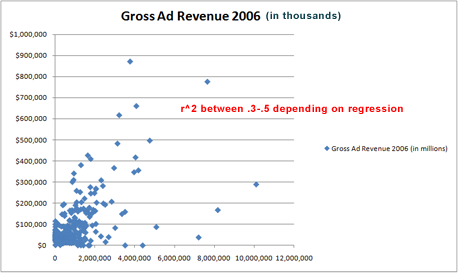
People magazine is number 1 in revenue but is well behind many other more “targeted” publications for circulation.
Magazine ad sales success is so much tied to quality of ad sales team, existing relationship, agency perception, ease of working with the company and other “soft” qualities. Add in a fair amount of “we buy print because we’ve always bought print.” It is not about Ad Impressions, Ad Performance, nor Direct Transactions Generated.
Newsprint prices are also localized in some since. If you are the only paper in town and you own circ in that town, you can raise the price. Online doesn’t have that restriction. The ad prices are normalized more universally.
Put it all together and online ad prices will never reach print rates. People magazine makes almost a billion dollars on a readship of less than 5 million. Facebook and MySpace reach over 50 million people at least 10 times a month and don’t do that kind of money (Myspace might be close). Look at that difference! 10x the audience…
Methods of counting print and online are so different most print companies have trouble making sense of both and weaving a cohesive story for advertisers.
Nothing different, really. Or rather they will do what the consequences dictate. A lot of money will be lost by some companies and a lot of individual people will get left behind over a long period of time. Advertising will grow and advertiser options will diversify. The pool of dollars available as a publisher will increase, but the amount of spend they land will not keep pace with the growth of advertising over the long term. That is, more publishers maintaining a smaller pieces of the pie.
Individual creative types and developers will continue to flourish as long as consumption increases (which it will and always has.)
Those willing to experiment before their financial sheets bully them into doing so should do so aggressively.
They should spend the considerable slushfunds generated from high print revenues on HIGH VALUATION online properties. A dollar spent in online goes much further than that same dollar in a magazine or newspaper. Excelling in interactive production requires experience and practice. They need to spend the money now so that in 5-10 years the have experience beyond writing, layout and photography and have command over the various distribution opportunities.
Publishers should acquire start ups now. Use that cash to buy highly valued fast growth companies before their valuations and user bases. sky rocket. Aggregate the digital talent before Google and MicroHoo get it all…
Again, doing this will betray the financies in the short term. Luckily in 2008 a publisher can hide experiements and acquisitions in soft ad market conditions. 🙂
Spending more online would be a GOOD IDEA, especially in 2008. The ad rates are going to fall out and you can get huge chunks of good inventory very cheaply. Most video and rich media inventory is probably sold out at less than 30% internet wide, meaning there’s a steap discount on inventory now.
Plus your ads can reach 10x more people at a lower cost than full out print campaigns. (I know, I know, certain demographics are in print, not online… bah! even AARP.org has over 2 million UUs per month!)
Besides the obvious pricing benefits and reach increases, you creative will be cheaper to create and easier to deploy.
To prove my point I propose a challenge to any agency, ad exec, or brand manager:
Give me half of your print/tv/radio budget for a particular product, service or content franchise. You keep the other half.
I bet, over a one year period, I can drive more revenue and profit with online than you can with traditional media.
Not that I wanna do your work for you… 🙂
~R
:: :: :: :: :: :: :: :: :: :: ::
 Social Mode

