Social Mode

,

  • Is this the headline you’ve been waiting for?

    Can I predict bloggers/blog readers voting preferences based on which headline they respond to?

    NOTE:  This headline and series of upcoming posts is a SOCIAL EXPERIMENT.  I am attempting to do an informal poll on key future headlines.  I will be testing a series of headlines of the coming days to see which ones get the most response in the various blogging inter connections.  Partly I want to know how far out in front of a potential news story you have to be to get the traffic and I want to measure how willing people are to read the news they want to hear versus the news that is…

    what’s your take?

    Hillary Clinton Concedes Nomination

    –––––––

    May 9
  • By now, it should be clear to most campaign organizers, media pundits and voters that politics and the Internet live in loving disharmony.  The Internet is both the most lethal medium to a campaign (gossip, candid cameras, endless gaffe replays) and the the most efficient marketing message machine. 

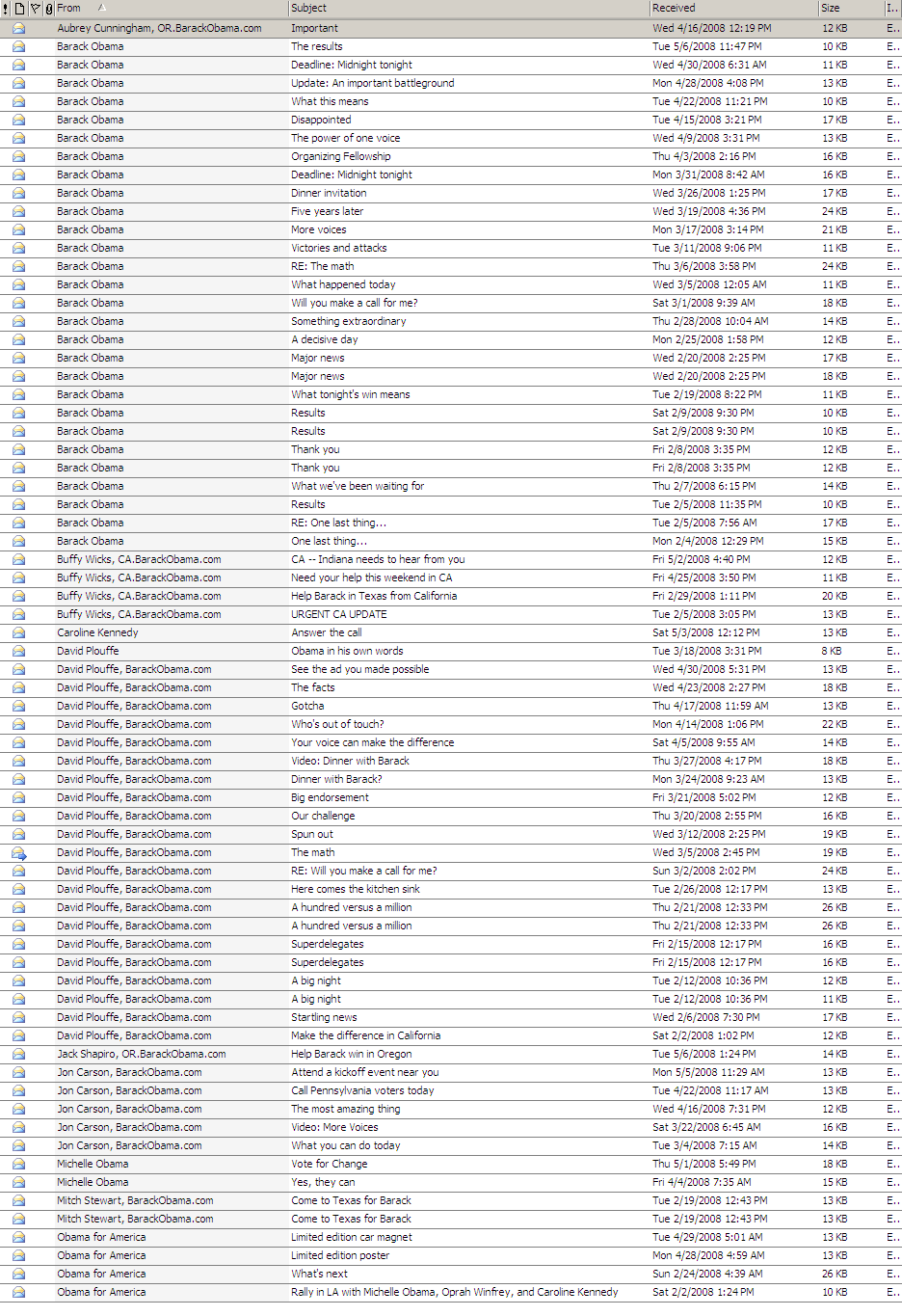
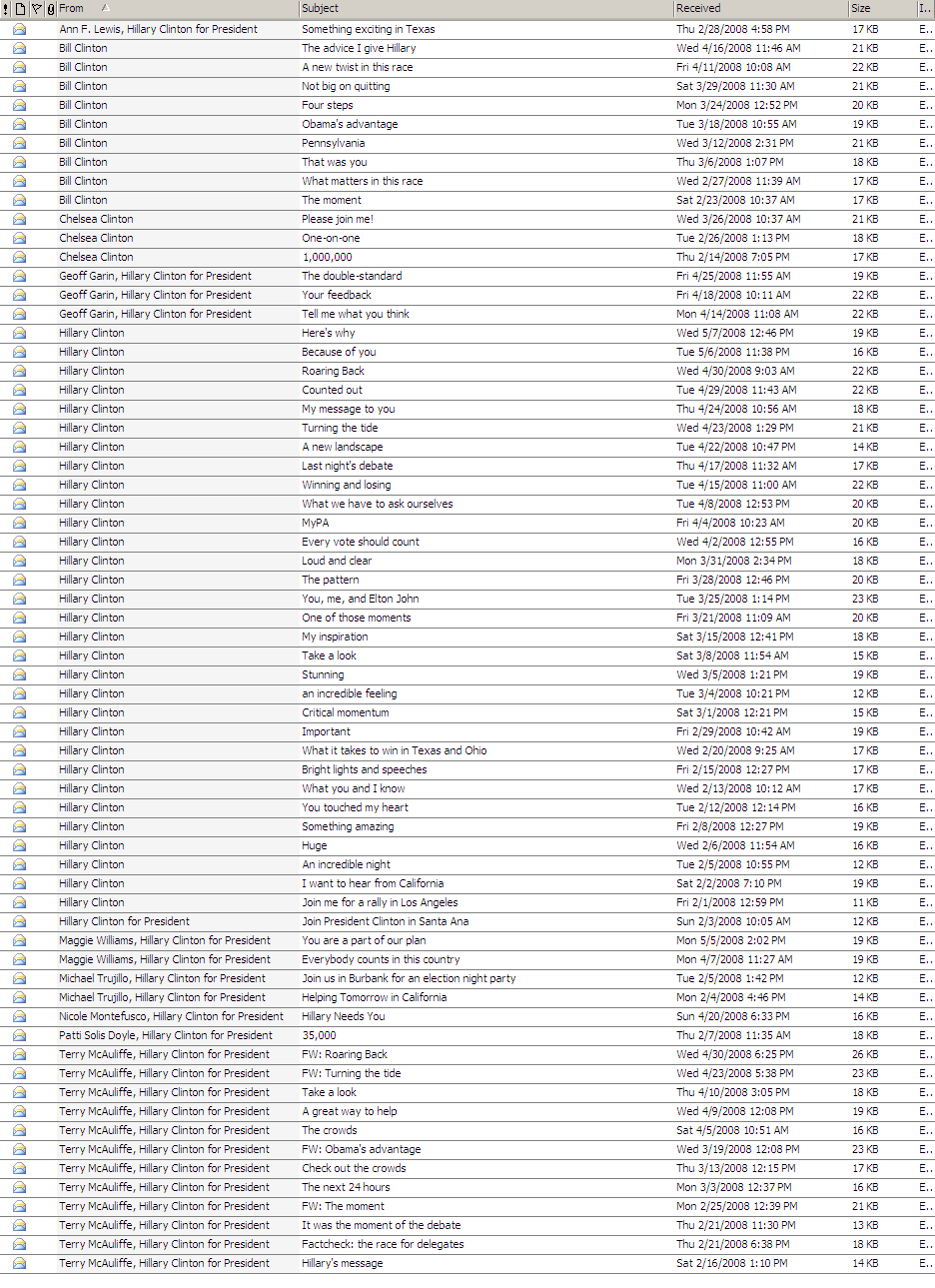
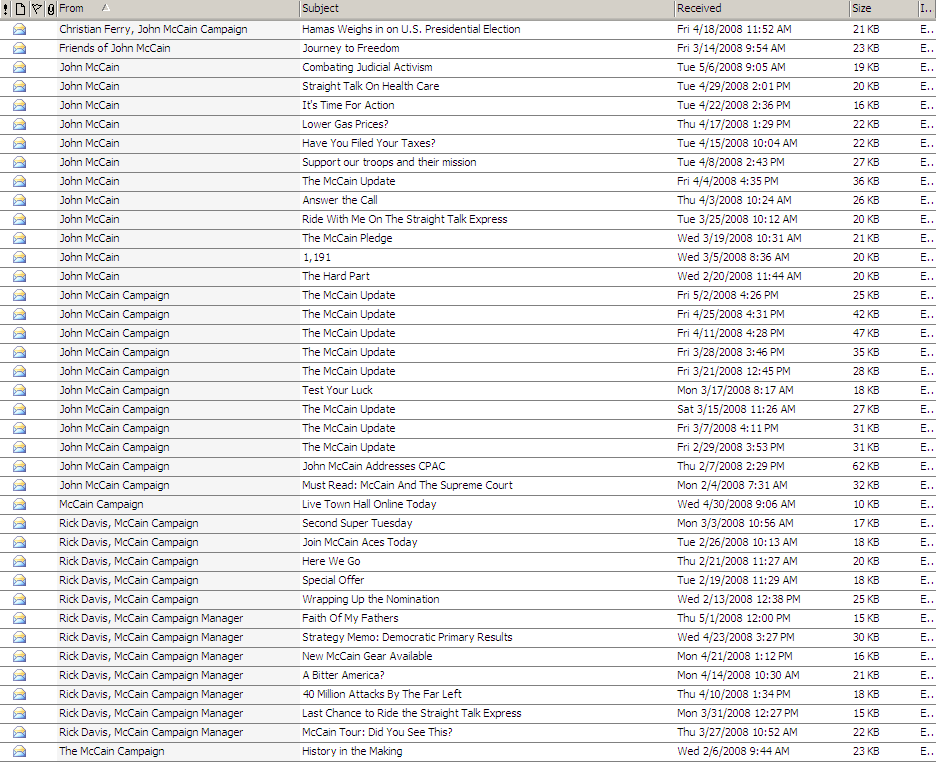
    In this post I take a quick look at the email campaigns of the major candidates.  Actually, I’m only going to go so far as to compare From names, Subject lines, send times and quantity.  Anyone who’s ever done significant email campaigns knows those are the KEY elements to get right… if you blow those the message never gets to the inbox or the user never opens it.

    For this informal study I only look at email from 2/1/2008 through 5/6/2008.  I’ve posted email inbox snapshops below for the three main candidates.

    Who’s using email most effectively?

    What are the strategies?

    Does it work at all?

    Are these sales pitches for votes or catalysts to involvement?

    Emails Sent:

    • McCain: 39 or about 3.1 per week
    • Obama: 70 or about 5.8 per week
    • Clinton: 66 or about 5.5 per week

    Number of Unique Senders:

    • McCain: 7
    • Obama: 11
    • Clinton:9

    Subject Line Style:

    • McCain: Key marketing messages, Issues, Patriotism
    • Obama: Campaign results, calls to action
    • Clinton: Campaign results, emotional statements

    Frequency and Dayparting:

    • McCain: 50% lunchtime/late morning, 45% late afternoon primetime, 5% other; 1 weekend email, all others weekday
    • Obama: 5% early morning, 15% lunchtime, 40% primetime, 40% latenight (very close to campaign results announcements)
    • Clinton: 30% lunchtime, 40% late night, 30% other; 80% weekday, 20% weekend

    Conclusions?

    Hard to tell without some real data from the campaigns.  We do know anecdotally that the Obama campaign raises a tremendous amount of money through the internet and has over 1.5 million individual micro donors.  The Clinton campaign has not raised nearly as much overall nor over the internet.

    Their respective websites follow the same traffic trends and do not show much correlation with the email campaigns that wouldn’t also be correlated to general interest in the campaigns at that time.


    Obama has a much larger web audience – for a variety of reasons.  Whether that has any bearing on the outcome of the campaign, who knows.  and whether it’s a cause or a result or an intervening variable, we’re unlikely to know without a much better view of the data than you can get publicly.


    Who do you think is using email the best and why?  What’s your experience?

    Obama Campaign:

    Obama Email Campaigns

    Clinton:

    Clinton Email Campaigns

    McCain:

    Email Inbox of McCain Campaign Emails


    NOTE: Michael Jung compiled these screenshots and went through the painful process of subscribing to everyone’s emails, even the candidates we don’t remember.  What he wanted me to remind everyone, “And don’t forget to tell everyone to go visit http://www.nowcali.com!”

    Political Spam: Does Clinton, Obama or McCain have The Better Email Campaigns

    –––––––

    May 7
  • I need a real world situation involving a rich, but somewhat contained behavior space to attempt a cellular automata model.

    In watching the rather lame De La Hoya and Forbes fight last night (gosh, I haven’t seen a blockbuster match in 3-4 years and I watch a lot of boxing!) it occurred to me that boxing might be a very good subject to study.

    Why?

    • Fixed physical space (boxing ring, arena)
    • Rich, but contained environment (ring, corners, arena, crowd, cities)
    • A huge amount of historical data (we can watch and record 100s of recent fights and study individual boxers)
    • Rewards and Punishments are severe and are both immediate and historical (large payouts, punches to the face, crowd chants… both in current bout and previous bout)
    • Possible use of local rules showcasing emergent bout behavior (avoid punch or punch at X moment drawn out over time reveals overall bout outcome, boxer movement, energy depletion…)
    • Readers would find the subject interesting outside of academics (boxing!)
    • I can remove some of the variables and likely not lose a lot of the value of the research (I might be able to ignore culture/social status/marital problems/etc. and still build a reliable model of a boxing bout and hopefully draw some connections between behavior and cellular automata modeling)
    So who cares? or what does any of this have to do with anything?
    Behaviorism has a robust theoretical framework but lacks a mathematical framework.  Up to now most of the mathematical explanations in behaviorism involves pretty standard multivariate statistics and statistics experimental design. (here’s a typical approach in schedule analysis) Researchers more and more use game theory models to generalize certain relationships.  However there is no robust mathematics of behavior (nothing even close to what we see in economics and physics) and there is no generalized computer modeling (that I can find… and I’m looking for modeling like we do with markets, the weather, and cosmology – all highly complex dynamic systems)
    Some links to explore if interested in existing mathematical “laws and models.
    WikiPedia Mathematical Psychology
    Cellular Automata might provide a framework.  
    Studying boxing might be a fun and interesting way to explore the capabilities to of automata to model human behavior.  What’s particularly interesting about boxing as a study of operant behavior is the number of obvious reinforcement schedules at play and the easy to spot emitted behavior.  
    Boxing is equally interesting as a subject for automata because of the fixed space, dynamic physical motion and finite duration (i.e. we might actually be able to model in a reasonable time).  Lastly, in both cases we should be able to verify our findings against a lot of real data, both historical and in upcoming bouts.
    More to come, certainly!
    ~R

    Simulating Boxing Matches with Cellular Automata

    –––––––

    May 4
  • As I prep for a summer in Vermont to study NKS and automata, I’m starting to build research and project concepts.  My focus, as it stands now, is to some how take concepts from behaviorism (schedules of reinforcement, operants, rewards and punishers) and use automata to study them computationally.  This is not trivial nor is their any indication yet that it will be valuable.  

    I’m attempting to mash the two lines of inquiry because there really isn’t an accurate nor reliable mathematical foundation in behaviorism even though the experimental and explanatory power of behaviorism is substantial and proven.

    IF, and it’s a big IF, cellular automata and a computational (as opposed to a partial differential equation set) can model the concepts in behaviorism we will have a very exciting line of research to chase down.  Modeling and researching complex human behaviors (those with lots of overlapping and interacting schedules and complex environments) has been impossible experimentally and mathematically – only the most basic of behavior is possible to study and it usually has to be isolated to the point where it looses the environment it so richly interacts with.  If we can devise cellular automata capable of showing operant conditioning in ever more realistic environments, we could set up very complicated models without all the laboratory fixings….and so much more.

    Note that I am not studying Social Behavior or Social Dynamics or Swarms – not in the typical “what you read on the blogs” sense.  A lot of work has been done in that area even with automata.  The study of individual behavior (how a particular individual responds and learns) needs more research.  I believe that a more thorough understanding of individual behavior will lead to stronger more robust social behavior models – as social behavior is emergent from individual behavior.

    Anywho… to whet yer whistle read some fun stuff from Alastar Hewitt on mathematical reinforcement learning and CA


    ~R

    NKS and Behavior

    –––––––

    May 3
  • Typically I am put off by analogies but consider…

    Scientific symmetry demands that there should be a fourth fundamental circuit element to compliment resistors, capacitors and inductors. The fourth circuit, which would make it possible to build more complex electronic devices was theorized to exist by Leon Chua, a professor at the University of California at Berkeley, and called a “memristor” (memory resistor), that registers [remembers?] how much current flowed through a device.

    Stan Williams, who heads up the Information and Quantum Systems lab at HP Labs, thinks that they have found it and how it works. – Nature, April 30, 2008 –

    Forget all the sophisticated electronics and chemistry which should launch a new programming branch in a move away from silicon. Instead, imagine, if you will, that this discovery is analogous to how memory works neurologically. Sounds like blasphemy buy consider it for a bit. Without staining the logic, consider a memristor-like functioning of sets of neuorchemical – electrochemical flow rather than memory being a place or network of neural areas.

    A memristor stores information based on changers of the resistance when an electrical current is applied. Memristors can have a high level of resistance, interpreted as a “1” in data terms, and a low level interpreted as a “0.” Thus, information [data] is electronically recorded (– absorbed – present, whatever new diction describes it) by controlling current. The memristor acts as a variable resistor that, through changes in its own resistance, reflects its own history, according to Williams of HP.

    In an analogous scheme being suggested here for organisms, memories occur due to the flow and patterns of resistance changes in the 100 billion neurons in the brain factored by other billions of interconnections of neuro-electrical impulses that exist throughout the brain and central nervous system.

    The amount of energy required to push around a very small number of atomic vacancies in a crystalline material to get memristors to work parallels what would be required to move electrical impulses throughout the nervous system net that is hypothesized to be what memories are. Williams said. “We can switch it [current] very fast, faster than we can measure” which is just what is experienced when evoked potential recordings are captured in neural recordings which makes them almost useless considering the number and speed of the differing neurotransmitters.

    Memristor chips will be designed function like flash memory and retain data even after a computer is turned off, just like happens to some neural areas during sleep, conscious attention and the flow of moving in an out of the “zone” at work, play or when focused on any value-laden activities in life.

    Just a thought.


    This was written after an article in CNet.com www.news.com/8301-10784_3-9932054-7.html?tag=nefd.top

    HP: thanks for the memristors…

    –––––––

    May 2
  • On any given day in the US in 2008 an average of about 148,000 people will die. Yawn. As the population swells it will grow larger. Yawn. As the population struggles with food, water, disease, contamination and war, those numbers will fluctuate higher and higher. Yawn. For many of us the numbers are so staggering that they don’t matter: 1+ million dead this week. Hummmm


    There are the wars. Yawn. The US Government stopped totaling the body count on each side toward the end of the Vietnam War. Bad press for politicians, I guess. For Afghanistan and Iraq – and wars to come – Iran, North Korea, etc., that policy is continued. Good thing too. It continues to get harder to tell who the ‘other side’ is.


    There is the US auto accident problem (3500/mo). Yawn. The US smoking problem: (42000/mo). Yawn. The US cardiovascular disease problem: (120,000/mo). Yawn.


    But wait! There is an unsafe rollercoaster in Orlando! An alligator eats a cocker spaniel near a receding swamp in Mississippi and, heavens forbid, say it isn’t so!…an asteroid will hit Earth in the next 24.4 thousand years! YIKES!


    Did you hear that airplanes are not being inspected? Bridges are unsafe. Baby bottles are contaminated by the plastic being used and don’t even mention the Chinese-made ingredients in heparin, toys, air conditioning parts and auto break pads.


    The examples above represent that paradox according to the statistical probabilities that have been kept for the last 52 years. Clearly many of the things that will kill us we don’t value as dangerous. Other things we fear have a miniscule chance of harming us.


    You are 109 X more likely to be injured in a car wreck on the way to the airport than to be injured in the airplane if you don’t get bumped.

    A few things lead to this distorted view of what we value as good and what isn’t good that we fear.


    Fear is conditioned just like eating habits are conditioned. Fear is based on losing what we value. Fear is the ‘other’ half of ‘magical thinking’ that comes from not knowing how to evaluate relationships between what is real and what is not real.


    There is a hierarchy to fear. Not everyone’s hierarchy is the same but a hierarchy exists both for what we value and what we fear. They are related.


    Our set of fears reflects our values; we engage or focus on what we value. We value what we were trained to value in our home, country, school, street corner or office. We value children… Children trump adults, having resources trumps resource dependency, helplessness trumps risky business and things close to home trump an Austrian engineer’s bazaar behavior. Circumstances around losing those things that we have learned or been trained to value is part of [conditioned] fear.


    As big as the numbers are above they represent someone else’s world. They are nothing new; they lack ‘spectacle’. That is also conditioned. You can hardly be focused on car accidents if that is the only way to get to a job that makes you the money that affords you the luxuries of life, family, etc. In time, you learn to adjust, accomidate, to level what you have to do to get what you want to get.


    Many dangerous things get conditioned to ignore: cholesterol, nicotine, sugar, over-medication, cell phones on the freeway and drugs that take the ability away to attend to consequences. That list is only 0.00000000002 % of the total list you might have.


    Here is what is known. You are human. Your were born and you will die. You are more complex than any other organism on Earth and you are conditioned to be who you are with the material you brought to the table when you were born. Actuarial numbers don’t matter to those alive or to those that are dead. They won’t protect you nor comfort those at your funeral.


    You will live to be an average of 76 (male) or so years if you are white and 72 (male) or so years if you are black living in the US. Your numbers are smaller if you fit in any of the categories and are in denial. You live longer if you plan to live longer and don’t get hit by one of those driving while eating an ice cream cone while text messaging, etc.


    Real time you can use this rule of thumb:

    1. figure out what you value
    2. question what you fear
    3. figure out the consequences for all your behavior
    4. determine who benefits from you doing or not doing something


    Identifying what we value and what we fear

    –––––––

    Apr 30
  • Elliot Masie – a corporate learning impresario has asked on his site www.learningtown.com :

    What “Learning” lessons can we learn from the current U.S. Democratic Primaries? What are your perspectives? Note: Keep this focused on the lessons .. not a push for a candidate!

    Recent response…

    It appears we’ve learned to regurgitate what we were told by speakers in learning seminars!

    What we’ve learned is that there is a constellation of people in the citizenry that are all at different positions in their education, awareness, position and attention based on what they learned to value AND the context of what’s going on for them NOW. The tasks of anyone running for office in the office or in the land is provide a defensible set of statements that increase the probability of those citizens liking what is said and a low probability of them being offended by what is said.

    Provided there is no event bigger than a position held requiring new framing, those that have touted the most big triggers [lower taxes, more security, less conflict, higher wages, less invasive government, greater order, less disorder…..you get the idea] have the higher probability of winning.

    It is the position of learning – education – training to provide access to relevant information that in some way levels the differences in assessment of this or other issues requiring a level of informed engagement.

    Or maybe do what our parents did and see what happens. We’ll see…

    YIKES! Again… another data point in the abyss…

    –––––––

    Apr 29
  • Wired has a nice highlight of the people behind I Can Haz CheezBurger.

    They also produce this hilarious site.

    Icanhazcheezburger.com gets “2 million pageviews and about 8,000 submissions daily.”  I already pointed out the crazy economics of this and how frustrating this types of sites are for major media companies that throw 100x the resources at projects that never achieve this.

    3 people manage it.  That’s it.

    More on I Can Haz Cheezburger

    –––––––

    Apr 25
  • I’m now the owner of a fancy macbook.  Here are some notes on my apple buying and using experience.

    Mac and Apple stores definitely have a distinct smell to them.  It’s been reported by many on the internet and as far as my last 5 or 6 apple products go, there’s something they do with the packaging and/or the hardware itself.  It’s vanilla smelling.

    Apple stores using Windows Mobile to process credit cards.  yup, that’s what their hand helds run.  If that doesn’t underscore the real battle in tech companies, I don’t know what does.  Apple has all the media and fun things, Microsoft still owns transactions, even at the Apple store.  Another proof of this… iWork’s Numbers spreadsheet app doesn’t do pivot tables or conditional formating (staples in financial work) and Excel crushes at that. Yes, they like to market that in a tongue in cheek way but really that keeps people stuck to Windows more than anyone can imagine.  Pivot tables and credit cards – kinda important.

    The MacBooks are cold to the touch which is very comforting considering the last 3 Sony/HP computers I have all run hot and make you very afraid of exploding hardware.  It’s a really off-putting user experience to have a hot computer.  Not sure why that’s not a bigger concern/been solved.

    Shareware is better on a Mac.  The cult of mac seems to even force software hacks to take a little more care to polish their apps.  The software works better and always looks better.  Take the shareware IM clients.  The most popular ones on Windows are funky looking and tend to be very bulky in use.  The popular ones on mac are lightweight and generally try to integrate well with the Mac OS.

    AppleCare is a rip off.  Except we all get it because Apple markets very well and the Mac products aren’t ones you “feel” you can just rip off the top and fix it up.  It’s very clever.

    Making appointments to see a Mac genius to have them fix your stuff?  Yikes, another marketing effort.  You don’t need an appointment, by the way.  Just go to the counter and ask to fill out a fix request form.  Fill it out, leave your gear, and they will fix it up fast and CALL YOU when it’s done.  Now that’s service.  Why don’t they just market that INSTEAD of the best buy like experience where I wait for 30 minutes to talk to someone who fills out the form anyway?

    Kids love Apple stores.  Kids do not like Best Buy.  Really.  Apple, yet again, got that right.  Make a place that kids ASK to go to AND behave when they are there… guess what? parents go.  Best Buy – get a babysitter or don’t go.

    Java on Mac is great.  Man, had Java worked this well for me on Windows I might have become a java fanboy.  Really.  It’s weirdly smooth to update, use applets, build stuff and the IDEs work really well.  That’s not so much an Apple Experience thing, however, it stuck out for me.

    Oh, now I’m also cooler.  I measured that.  Definitely cooler in an absolute kinda way too.  Like everyone notices.

    Not.

    Nonetheless, Apple is different, for sure.  Sometimes good, sometimes not.

    ~R


    The Apple Experience

    –––––––

    Apr 25
  • Well, are we all amused…? You know, things going your way, life better than it was a decade ago or at least a couple of birthdays ago…?


    Today it’s…

    • The Pope
    • The Supremes (Court that is…)
    • Playoffs – pick your sport…
    • Market(s)
    • War(s)
    • Civil law changes
    • Constitutional law changes
    • Pollution outlook
    • Gangstatainment
    • Food shortages in developed countries
    • Creation of diseases to use pharma’s research results
    • Barrel of pain @ $115
    • …
    • Oh, and that political thing going on…makes a person bitter just watching


    Nothing’s perfect of course so there are some things going well and others in or headed toward the big porcelain bowl.


    Check out a February, 2008, U.S. government statistic that estimates that 77 million workers will leave the workforce in the next few years.   Most are members of the baby-boom generation.  I guess that makes them “Gen B” in modern marketing parlance.


    Look to the left, look to the right, we’ll lose 6 to 10 % of the workforce by the time you all notice changes in your environment…as opposed to a written prediction that you find here.


    The up-“and thinking about it” generations of workers will not be nearly large or skilled enough to replace those Gen B workers, figuratively or literally.  Technologies promise is being fulfilled but the billion days of experience encased in those that leave the workforce can’t fulfill the needs to use the technology that exists.  It’s impossible. 


    So what we have here is a great potential for those that have a work ethic that they are able to promote to the highest bidder.  We also have a bunch of Peanut-like cartoon characters who want what they want which is not inline with what the workforce needs, the world needs or the mall needs.


    Already we have a shortage of talented workers.  That means that there are skills gaps all over every industry, every sector of commerce and every level of employment.  Again, it is contextual.  If you have the juice to do the stuff that is needed, it is a VERY good thing for you as an individual contributor.  If you have a skateboard in the living room next to your direct connect Facebook profile or your iPod tree of accessories, you may find the coming years a challenge…assuming of course that you recognize challenges when you trip over them.


    Amidst the impending shortage of workers and looming skills ‘black holes’, there is an increasing demand for results and continued pressure to improve the ‘bottom line’.  Now, there is not a big difference between the shareholder’s bottom line, the employer’s bottom line and your bottom line. As we are all finding out, we are all interconnected.  Not by some fuzzy, energy-laced icon, or a pillar of metaphorical musings or soft and romantic notions of nationality or piety but by relatedness in the absolute sense.  Screw up the aspirin formula in a lab in Malaysia and those in Germany and Mozambique get sicker, not better.


    We are all related in numerous ways that we don’t attend to.  We do things and others do things and together we interact and do other things.  We are related by the context of what is around us.  What is around us is that which is going on in Bosnia and Boston, Denver and Dubai.  THAT context is the context that will never grow smaller, never become diluted and never disappear.


    Today is always different than yesterday or tomorrow…[I know, heavy!]   But now, in this time period, we are more aware of things going on all around the world. With our greater access to everything we have greater potential for confusion when competing values must be confronted.


    With workforce changes exerting their effects and economic complexities exerting theirs, it all leads to increased pressures on whatever we are doing.  The rapid pace of business, the demands of families and the need to have some ‘stakes’ in the ground in different areas of our life… all make for a world more competitively primitive like that from which we evolved millions of years ago than a world provided by a John Grisham or some contemporary historical romance author.    


    So, here is the warning bell.  Take note… to overcome the losses from Gen B leaving and increase the probability of a single employee will be able to perform the work several employees have done in the past, there is going to be a wholesale changes in business performance software. Everything gets measured.  People are the ‘Business.’  Commerce uses what commerce needs.  Skill gaps identify contribution to cost.  Skills equate to value. 


    All this will be confounded by little attention for “casual Fridays” or a need for a window office.  Gen-NEXT will be hired based on performance at every measureable level, get evaluated seamlessly, will perform where needed, get tracked to available tasks and get paid only for results rather than ‘work’. 


    It’s already started.  There is less need to build robotics if you can get maximum production out of employees that need to feed their kin or code content.  There is a mushrooming interest in empirical learning and training that will come to dwarf philosophical and quasi-political niceties.  Get ready. 


    Oh, and then we’ll need to figure out the other parts…those family relationship changes, social community interactions and the individual identity agony that is sure to follow. 


    Hang on.


    Applications Optional: Empirical Convergence of Learning and Performance

    –––––––

    Apr 17
Previous Page Next Page

Blog at WordPress.com.


Loading Comments...
 

    • Subscribe Subscribed
      • Social Mode
      • Join 99 other subscribers
      • Already have a WordPress.com account? Log in now.
      • Social Mode
      • Subscribe Subscribed
      • Sign up
      • Log in
      • Report this content
      • View site in Reader
      • Manage subscriptions
      • Collapse this bar