Social Mode

,

  • One thing that’s definitely different about this election than all those before is the amount of data we all have access to.

    Here are some of the more clever and interesting resources for the data junkies out there:

    • Amazon’s Election Map based on what customers are buying: http://www.amazon.com/election2008
    • Real Clear Politics Polling Aggregation and Graphing: http://www.realclearpolitics.com/epolls/2008/president/us/general_election_mccain_vs_obama-225.html
    • FactCheck.org “Wire” provides really fast, unbiased fact checks of all claims as they hit the public: http://wire.factcheck.org/
    • VoteSmart.org Voting records/Legislation records: e.g. Barack Obama’s profile http://www.votesmart.org/voting_category.php?can_id=9490
    • THOMAS from Library of Congress has pretty much all the goods coming out of congress (legislation texts, treaties, reports): http://thomas.loc.gov/
    • US Treasury Economic info: http://www.ustreas.gov/economic-plan/
    • Government Accountability Office: http://www.gao.gov/

    If I have more time, i’ll round up all the local and regional info.  Some of the resources above have that.  Most states and major cities have extensive websites with voter guides and historical data.

    No excuse for not knowing the facts.

    2008 Campaign Data: Voting Records, Legislation, Book Preferences and more.

    –––––––

    Sep 20
  • I was telling my friend the complexities of hurricane IKE for us here in the outskirts of Houston. He too had the ‘experience’ and was caught not being able to adequately explain what it was like. I am tough enough to ‘enlighten’ in most cases so he wasn’t going to “help” me understand what was going to happen when we talked on his birthday last week.

    We came to the non-empowering collective conclusion that one can’t adequately explain what it feels like to have an in-gown toe nail. Thus, a hurricane or other environmental event was a bigger task approaching the impossible. That reality makes it improbable to explain the loss and your change in focus you end up having after going through it from threat to the aftermath of a hurricane or natural calamity they call IKE.

    Do not read any further unless you have time on your hands [which is an interesting idiom].

    This blog represents just one more attempt to put some analogies together to bridge what was experienced here in Houston with IKE for those that were not here in my house – yard – neighborhood or were busy elsewhere experiencing a scavenger hunt for the fiscal drain to plug the banking, mortgage and insurance events going on at the same time. Or, for the entertainment weary, some were experiencing being distracted by lipstick “issues” the desperate were engrossed in while Congress was thinking about how to get re-elected.

    Be aware that attempts you read here are like love songs, poetry, adventure novels, adventure monologues, biographies, and jokes told since you were naïve: they can’t replace the real thing…

    Whoa, let’s get back to IKE>>>

    My experiences are anchored on three things and only three things:

    1. my past experiences
    2. my present experience with IKE
    3. my responses to the milieu [behavior stream] going on around me

    I sound pretty simple when it’s put that way. I’ll try to get over it.

    None of these things are things you can join me in having… they will not help you one iota in understanding what I experienced.

    But, there might be a way…

    Because catastrophes or naturally occurring events happen all the time, there are some similarities you may recognize at the right time when you get a chance to experience your own hurricane, tornado, earthquake or tsunami, or for that matter your own in-grown toe nail. Thus, with analogies, similes and metaphors I can attempt to bridge the gap between what I experienced and what I want you to know about that experience.

    That’s right. You can generalize from one experience to another based on similarities they have in common. To the degree they have no similarities you can relate to, you are screwed. You’ll experience your calamity convinced it is unique and prevailing over all others of that type. You will have some things you’ll want to communicate and unless you can make the appeal unique and engaging, no one will read past the third paragraph! The calamity you experienced will remain uniquely ‘your’ calamity – or naturally occurring event – which ever represents your drama level best.

    No one can know what your experience is like…

    Loss of…

    “Stuff” – both complex and simple

    Behavior – the one no one knows how to talk about

    Anchors in life – both complex and simple

    Conveniences – both complex and simple

    Routines – both complex and simple

    Needs reduction – etc.

    Real security

    Comparative security

    Available food

    Available water

    Available energy

    … You get the idea…

    What’s more the things you can do no longer have any effect…

    Water spouts

    light switches

    Toilets

    Garbage cans

    Phones

    Cars

    TVs

    Computers

    Degoogolization – [loss of connection to Google for news, search and sundry interests]

    Stores – including fast foods

    … You get the idea here too…

    So I was telling my friend that during the aftermath having the power come back on after 4 days felt like Christmas morning…

    • I was giddy for hours over little things
      • Hair dryer my wife got to use
      • Coffee grinder
      • Electric razor
      • Garage light
      • Refrig light
      • Laptop

    Soon an email came to me that expressed a similar Christmas theme:

    • Decorating the house (with plywood)
    • Dragging out boxes of supplies that haven’t been used since last season
    • Panic riddled shopping in crowded stores
    • Regular TV shows pre-empted for ‘Specials’
    • Family coming to stay with you
    • Family and friends from out of state calling you
    • Buying food you don’t normally buy . . . and in large quantities
    • Days off from work
    • You speak to neighbors who you manage to ignore 360 days of the year…
    • An awkward excitement similar to the culmination of Santa’s efforts
    • Lit candles everywhere
    • Dealing with a myriad of batteries types
    • A high probability you’re going to have a tree in your house!

    In the end you thought you were getting back to the world order you had before the storm.

    It wasn’t. Some things don’t come back, particularly some behaviors. Some behaviors are there that weren’t there before. You now care about some weird neighbors that once appeared to be part of a witness relocation program. You now look at different ways to escape the pains of no electricity, no running water, no toilets, no gas, no this and no that. You take different ways to work to avoid floods, trees, crews stuck in flood waters trying to reach trees, etc.

    Soon you see that someone has their trees trimmed and the debris is at the curb, your curb! Then you realize it…you are back to the trivial, the banal, the inconsequential. Now all you have is the experience, the excitement and the memories along with a shadowing guilt because you have electricity, running water, fuel and food…and there are still 1.2 million people without those things in the 4th largest city in the US where everyone just wants to live life and enjoy their the remainder of their 28,750 days while they wait for the next natural event.

    IKE – The Houston Experience

    –––––––

    Sep 19
  • The financial issues are the ultimate consequence for huge swaths of people, policy makers, CEOs, workers, and investors.

    Nothing better than the brink of financial destruction to get people moving.

    We’ve had significant policy changes in less than a week!  When have you seen this much action in government?

    Here’s a proxy chart of stock market action (from wikipedia):

    S & P Index, proxy chat
    S & P Index, proxy chat

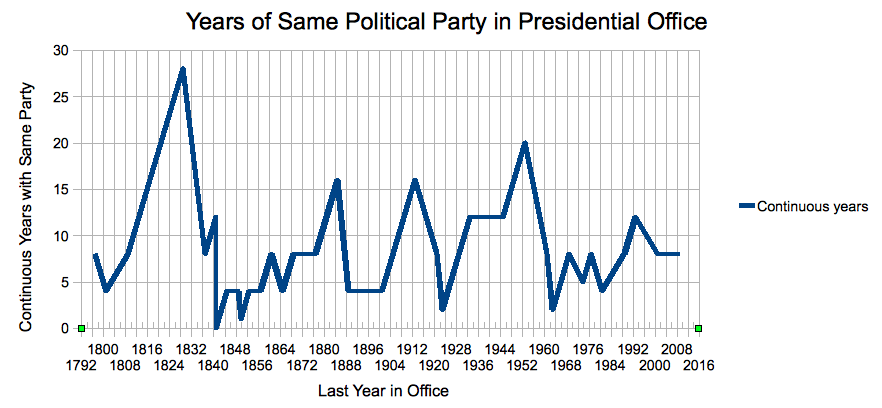
    For reference, I made this chart that plots the calendar year and continuous years of one political party that maintains the presidential office.  Spikes represent when the party changes.  Consider this against the above chart.  If you like the raw data, here it is. Volatility does not necessarily imply a change of party, but a crisis  and/or complete stagnation seems to.  Perhaps change of office is a catalyst, perhaps it’s a lagging indicator. hmmm.

    Changes in the Presidential Office
    Changes in the Presidential Office

    All that said, I’m very empathetic to everyone who’s lost money as the result of inaction.  It sucks. It is necessary though.

    I hate “corrections”.  Corrections are cute and they happen, but they aren’t CHANGE.

    Review the history of the Federal Reserve to go deep into how panics, massive failures, and brink of collapse spur rapid action.

    Since you’re here and researching, you might as well read up on the US Treasury.  Spend some time in the Timeline. Funny how the 2000s are so light?  When is “history” history?  I have a feeling 2005-2010 on this web page will have a few line items.

    I LOVE WHEN PEOPLE LOSE MONEY

    –––––––

    Sep 19
  • Great piece from Black Swan author,Nassim Nicholas Taleeb, on Edge.org.

    Read it.

    What Is Fundamentally Different About Real Life

    My anger with “empirical” claims in risk management does not come from research. It comes from spending twenty tense (but entertaining) years taking risky decisions in the real world managing portfolios of complex derivatives, with payoffs that depend on higher order statistical properties —and you quickly realize that a certain class of relationships that “look good” in research papers almost never replicate in real life (in spite of the papers making some claims with a “p” close to infallible). But that is not the main problem with research.

    For us the world is vastly simpler in some sense than the academy, vastly more complicated in another. So the central lesson from decision-making (as opposed to working with data on a computer or bickering about logical constructions) is the following: it is the exposure (or payoff) that creates the complexity —and the opportunities and dangers— not so much the knowledge ( i.e., statistical distribution, model representation, etc.). In some situations, you can be extremely wrong and be fine, in others you can be slightly wrong and explode. If you are leveraged, errors blow you up; if you are not, you can enjoy life.

    So knowledge (i.e., if some statement is “true” or “false”) matters little, very little in many situations. In the real world, there are very few situations where what you do and your belief if some statement is true or false naively map into each other. Some decisions require vastly more caution than others—or highly more drastic confidence intervals. For instance you do not “need evidence” that the water is poisonous to not drink from it. You do not need “evidence” that a gun is loaded to avoid playing Russian roulette, or evidence that a thief a on the lookout to lock your door. You need evidence of safety—not evidence of lack of safety— a central asymmetry that affects us with rare events. This asymmetry in skepticism makes it easy to draw a map of danger spots.

    The Collapse of Risk Management and Bailouts – Predicting Uncertainty is, well, not possible!

    –––––––

    Sep 18
  • Why do people not heed warnings and/or follow mandatory evacuations?

    We do not have an single, simple answer for this.  John Bryant claims, “people do what they value.”  Though an accurate statement, it still doesn’t answer the question, which can be rephrased as “what do people value and how do they come to value it?”

    In the context of a natural disaster, I contend, people have a variety of competing values and contextual factors.  All of these variables come together and the decision to stay or go is made (or in many cases NOT MADE, it just happens).

    Factors, Values, and Conditions include:

    • Protect my home
    • Protect family
    • Adrenaline of the moment
    • Job obligations
    • “white knight” syndrome
    • No where else to go
    • lack of social connects
    • Lived through it before
    • physical restrictions (health, traffic, disability)
    • ignorance (not aware of a threat)
    • Unclear on consequences
    • Distrust of forecasting, damage predictions (crying wolf, not warned enough, missed landfall)
    • “Celebritizing” of victims (media interviews, profiles of people who do not leave)
    • American “Cowboy” values (against all odds, underdog, we can do it)
    • Rescue and Recovery covers everyone, even those who do not evacuate (inconsistent messaging and delivery of consequences)
    • Do What My Neighbors Do

    What can we do to improve preparations and response?

    The goal is to reduce loss of life, loss of property and recovery expense to as close to zero as possible.  This goal can be, and often is, achieved through pre event evacuations, in-shelter preparation, post event planning, in event response and quick post event response.

    There is a difference in approaches to events we can predict and events we cannot.   An event that we cannot predict means that the most we can know is there is a potential risk (earthquake prone areas, volcano areas), but we cannot see the approaching event directly.  The key to achieving the goals for predicable events should focus mostly on getting people out of the way, property protected and having a plan to get them safely back.  The event itself, should be a none issue in terms of in-event action.  The key to the unpredictable event is in long term preparation, emergency action and recovery.  Though these two types of events share a lot in common in terms of what can work to reduce pain and suffering.

    Consider the factors outlined above and with our goals in mind, the approach to disaster avoidance and recovery should involve:

    • Effectively managing knowledge of consequences of lack of preparation and action (variable ratio schedules of reinforcement on planning, knowledge… especially in off-season months or down times)
    • Providing accurate, clear information on forecasts and actions to take (get the media to be more responsible through penalties for abuse and rewards for accuracy and effectiveness, consider forcing all broadcasters to use an NWS, FEMA, or other regulated source for all coverage of all life threatening events)
    • Disable assistance for those knowingly disobeying emergent management orders
    • Providing useful damage scales like Saffir-Simpson for flooding, storm surge, fires, mud slides, cold spells, heat spells (consider condensing the current EF scale for tornados, Richter for earthquakes, flash flooding into 1 general alert system that can be taught throughout life)
    • Increase property taxes for risk prone areas – implement a flat “recovery” fee based on estimation of damage likely to occur over a decade (need to discourage these huge build ups in risky areas or at least have cash on hand to pay for the consequences)
    • Get blackberry, Apple, microsoft, tivo and other information systems to adhere to the Emergency Broadcast System protocol.
    • Provide tax incentives and mandatory insurance rate cuts for individuals and businesses who provide demonstrable evidence of preparation
    • Devote 10% of our weapon making and robotic engineering capabilities to automated, remote disaster protection and recovery robotics
    • Market Ready.gov and other programs with the money currently wasted on “just say no” and other programs
    • Rewards for long term planning on dry brush removal, relocating older, too big of trees, stronger zoning (can manage through inspection but also after a disaster occurs, property left standing where it can be verified it was properly managed should get a reward)

    These are just some of the ideas if the goal is to reduce loss of life and property with minimal cost.  [ed. this argument/essay needs a longer treatment to demonstrate that the above concepts will actually do what I claim]

    In the end, we may decide (as we currently are) that the risk is not yet high enough to make these adjustments.  As many disasters as we have, they are still relatively infrequent.  On a bad year we have 7-8 major disasters (weather or otherwise) nationwide, most years its 3.  We are a very large nation.  Many other nations, far smaller than the US handle double or triple the disasters and their prep and recovery really is a way of life.  One proxy metric for this is how much money the insurance companies spend on disaster prevention marketing.  If we really were under constant risk, the insurance companies would need to spend a lot on marketing to us to make sure they didn’t go out of business from tons of claims.

    In fact, the media and other businesses make so much money and politicians and non-profit groups gain so much credibility for coverage and response of these events, making them less disasterous systematically is probably not a primary reinforcer. This is a subtle point, but likely accurate.

    There’s no one answer for why people stick it out in the face of “certain death.”  There are many reasons and sometimes these reasons are more potent to them than even the prospect of “certain death.”

    Disclosure: I was in the eye of Hurricane Andrew in 1992.  My family hunkered down for that storm in our stair well of a 2 story townhome in a complex that suffered significant damage, spared only because it sat behind a large hospital.  We stayed because we didn’t make a decision to do anything really until it was too late to make a move.  We barely stocked up on goods either.  And to top it off one of my good childhood friends was visiting from Colorado and experienced the powerful storm 2000 miles from his home.

    Miami, as a city, was woefully unprepared.  Very complacent. We spent the day before at South Beach with hundreds of other citizens.  I had my portable radio and pestered my parents all day that I thought it was going to be very bad.

    We didn’t have a death wish, we just didn’t know and couldn’t imagine a week without power, with no food – that’s a very foreign concept for most Americans.  We couldn’t imagine a year later that the structural damage to my high school would still be severe enough that chunks of the ceiling would fall on us during light rains.

    We also were trapped by a city that has few ways to leave.  US 1.  that’s about it.  And when your cars suck, you have no family within driving distance and you have little money, you make these types of non decisions.

    And, yes, my father and I share a fascination with weather.  He’s the type of guy that gets on a roof when funnels form (this I do not do.).  It is exciting to witness nature’s power, no doubt about it.  Some people get their adrenaline from water skiing, some from bungie jumping, some from live theater… we get some from weather.

    Put it all together and I would be one of the people you might ask in astonishment, “Why aren’t you leaving?”

    Research and Backgrounder

    I have compiled some articles, research and thoughts on the subject.

    Evacuation Simulations

    Anderson Cooper’s blog provides this quick, shortsighted explanation. It is shortsighted because it presents only 1 factor, poverty.

    Insights on how Cuba can have fewer than 30 deaths in the last decade even though they get clobbered by hurricanes (2 Category 4 hits already this year):

    The secret is the evacuations system. A quarter-million Cubans evacuated during Gustav, and the number for Ike was a staggering 2.6 million — nearly a quarter of the island’s population. Most of the evacuees found family or friends to stay with, but nearly 400,000 were housed in 2,300 government shelters.

    “We clearly cannot simply mimic their system, but I think there is a lot the United States can learn from Cuba’s hurricane response system,” said Wayne Smith, the former U.S. top diplomat in Havana. “They have a whole system of alerts that keep people clued in and we don’t have anything like that.”

    Here seems to be some of the secret sauce, accurate information and clear consequences:

    “By predicting hurricanes accurately almost all of the time, (Cuban) meteorologists have engendered the public’s trust,” said Jane Griffiths of Center for International Policy, a Washington think tank. “That’s why people voluntarily respond to evacuation orders.”

    And if anyone has doubts, authorities quickly put an end to them. The state news media often makes examples of people who fail to move out — and who are killed or injured.

    On Wednesday, an elderly man was trapped under the rubble of his evacuated Havana apartment building when he returned home before the building was inspected for safety. Coroner officials confirmed that he died.

    “Unfortunately, there was irresponsibility in this case,” said Lt. Col. Rolando Menendez, a firefighter overseeing rescue efforts. “But in general, the population is following civil defense measures well.”

    Recent piece on newsweek:

    What kind of person stays?
    I heard an interview this morning on NPR with someone who was electing to stay in Galveston. This was a guy, his family and extended family, that were moving into a masonary building to ride it out. They are strong-willed, independent individuals who I think relish the idea of riding out something most of us would consider to be too dangerous to remain. However, this is an evacuation with several days’ warning.

    We just did a study on evacuations under scenarios of disasters without warnings. We are very concerned about disasters that occur without warning when we have to do evacuations in real-time—in essence, immediate—for example, an earthquake or a terrorist nuclear attack. We found about two thirds of people with children would not comply with official orders to evacuate until and unless they were able to retrieve their children from school or day care. If we have two thirds of the population with children that would not comply, what we would have is evacuation chaos and an absolute breakdown of disaster response in circumstances that provided no warning. Under those circumstances, unless we got much better at having well-developed disaster plans that parents were comfortable with, we can anticipate extreme chaos as public officials would be unable to stop parents determined to get their kids.

    Here is an example of some of the fresh science and modeling in the works for better disaster prep:

    Because many of these managers have never had to confront the life-or-death realities of an approaching hurricane, they need a consistent analytical framework to consider the sequence of complex decisions that they need to make. For example, a poorly planned evacuation could cause roadway gridlock and trap evacuees in their cars — leaving them exposed to the dangers of inland flooding. As another example, ordering too many precautionary evacuations could lead to complacency among local residents, who might then ignore the one evacuation advisory that really matters.

    “All in all, this is a complex balancing act,” Metzger says.

    The concept of evacuating an area in stages — focusing on different categories of people rather than different geographical locations — is one of the major innovations to come out of Metzger’s work, since congestion on evacuation routes has been a significant problem in some cases, such as hurricanes Katrina and Rita. Metzger suggests that, for example, the elderly might be evacuated first, followed by tourists, families with children, and then the remaining population. The determination of the specific categories and their sequence could be determined based on the demographics of the particular area.

    By spacing out the evacuation of different groups over a period of about two days, he says, the process would be more efficient, while many traditional systems of evacuating a given location all at once can and have caused serious congestion problems. With his system, officials would get the information needed to “pull the trigger earlier, and phase the evacuation,” he says, and thus potentially save many lives. Coincidentally, during the recent hurricane Fay in Florida, a modest version of a selective evacuation was implemented successfully when tourists were asked to leave while residents remained in place.

    Other factors that could help to make evacuations more effective, he says, include better planning in the preparation of places for evacuees to go to, making sure buses and other transportation are ready to transport people, and preparing supplies in advance at those locations.

    Here are a few pieces on “disaster science”. This piece on measuring the preperation, management and response is particularly detailed and helpful.  Even you don’t like the conclusions, there’s value in the concept and bibliography.

    Riding It Out, Hunkering Down – Why People Don’t Evacuate

    –––––––

    Sep 13
  • You can shake it, get coverflow, use it as voice recorder. It’s cool. But this whole announcement reminds me of that SNL sketch where Steve Jobs just keeps making smaller and smaller ipods until they need tweezers.

    Pic from Gizmodo:

    iPod Nano
    iPod Nano

    New iPod Nano – A Picture

    –––––––

    Sep 9
  • if you’re paying attention to apple’s event you just heard about iTunes 8 and the genius feature.  Basically it makes smart playlists based on the iTunes user base and your preferences.

    Pandora, Last.fm, iLike and many others already do this.  Big Deal.  We were doing this at Launch music 8 years ago.  It doesn’t really add much value to the music sales ecology.  Very little.

    Why?

    It can’t find you music you haven’t heard that you will like.  None of them can.  A group/artist has to be popular and a classified entity before it will get mixed in.  These automatic collaborative filters can’t solve that problem for people, probably ever.

    Also, is this a feature that we all really need?  is auto playlisting really a big concern we have?  half the fun of having a huge library is the ACT of making play lists.  Seriously.  It’s like channel surfing… imagine if I had automated channel surfing.  the fun is in the surfing.

    iTunes 8 – genius feature is OLD and BORING

    –––––––

    Sep 9
  • If you need to integrate global development data into an application or want easy access to huge amounts of government, economics and social data, head over to The World Bank Developer Network.

    Plenty of mashing up to do with this data!

    World Bank API

    –––––––

    Sep 8
  • Tired of politics? football? hurricanes?

    we’re on the eve of the LHC’s first proton beam.

    Be sure to catch the live webcast here. Keep in mind all times are CEST timezone (pretty late for us on the west coast!)

    More information here. and of course, on Wikipedia, Google, youtube and journals.

    LHC First Beam

    –––––––

    Sep 8
  • I am reminded of an experiment done by a teacher, Jane Elliot, with her 32 3rd grade school students in 1968. Mrs. Elliot came to class one day and announced students were to be divided based on eye color. First, the brown-eyed group was given preference and regarded as “superior” based on their eye color, with the other group repeatedly being considered inferior in intelligence and learning ability as well as having fewer privileges and less recess. On the second day of the experiment, Mrs. Elliot said she was mistaken and it was the blue-eyed group that was superior in every way. Thus, the values, bias’ and attitudes of the groups were completely reversed with blue-eyed students being regarded as superior and the brown-eyed being seen as inferior in every way.

    Elliott gave tests to both groups on each day of the experiment. The students scored very low on the day they were racially “inferior” and very high on the day they were considered racially “superior.”

    Other results:

    • When expectations are set to do well and show improvement, people do. When those expectations are lacking, performance and the experiences are thwarted in a variety of ways.
    • When we believe “the others” are inferior, we treat them that way independent of the ridiculousness of the basis provided.
    • When we believe we are superior we treat others with discounted value showing that how we believe the world can have powerful effects on how things turn out.
    • It is justifiable to treat someone poorly if you are told they are ‘evil’. When the reverse conditions are used, the superior group who was previously the ‘evil’ group, has an additional set of emotions that contribute to their poor treatment of others.

    It is dangerous carnival that the bigotry, meanness, triviality and lack of value toward others can be institutionalized publicly every four years in America by two governing bodies when the country is rudderless of government leadership and when programs de jour are punctuated with felony indictments, earmarks, corporate handouts and loss of constitutional rights perpetuated by both groups.

    Certainly have come a long way in those 40 years!

    Government based on stereotypes and the flocking of sheep…

    –––––––

    Sep 5
Previous Page Next Page

Blog at WordPress.com.


Loading Comments...
 

    • Subscribe Subscribed
      • Social Mode
      • Join 99 other subscribers
      • Already have a WordPress.com account? Log in now.
      • Social Mode
      • Subscribe Subscribed
      • Sign up
      • Log in
      • Report this content
      • View site in Reader
      • Manage subscriptions
      • Collapse this bar