Reproduced with permission from a private e-mail from Mahesh Johari
Some quick commentary only today. The stimulus bill that just passed the House contains a “Buy American” clause, which forces materials purchased using funds from the stimulus package to come from American manufacturers.
Intuitively, this sounds both logical and appealing. If we’re spending our taxpayer dollars, obviously we want those dollars to be spread throughout our economy. It makes no sense to pass an economic stimulus package that sends our money to China. So why not mandate that?
Unfortunately it’s not that simple. The “Buy American” clause has great political appeal but will do nothing but defer job losses and prolong the overall process of adjustment that we are experiencing.
Here’s why: Let’s imagine (for example) a steel manufacturer in the U.S. The manufacturer is unable to compete globally because their cost structure is too high. They are facing the prospect of downsizing, of shuttering excess capacity, of laying off workers. But wait! Here comes the stimulus package to save the day!
Now this uncompetitive sloth of a firm has a new lifeline. They can sell their overpriced product to the stimulus package. They can delay downsizing, cost cuts, and layoffs. So as long as the stimulus package is around, they can keep being inefficient. Meanwhile their international competitors are becoming ever more efficient, adjusting themselves to true market conditions. The competitors are getting better.
When the stimulus package expires, the firm will be right back where it began: uncompetitive and burdened with an unsustainable cost structure. Then what? Of course the layoffs will come, the downsizing, etc. Everything that should have happened will happen, just a year or two later. The part of the stimulus used to overpay for those American materials will essentially have been used for zero long term benefit. The overall economic adjustment process will be prolonged.
This type of waste why we have to be very careful when it comes to government spending. Government spending packages tend to waste a lot of money. Resources that are wasted produce no long term economic benefit.
So what should we do? We don’t want companies to willy-nilly send our stimulus dollars to China. Well, at least not when they can get the same stuff in the United States.
As long as we are creating websites and transparency, let’s go all the way! We could require any purchases of commodity materials from international vendors to be subject to a domestic competitive bid first. For example, if Caterpillar feels their most economical source for steel is based in Australia, let’s require them to accept competitive bids from American firms BEFORE they are allowed to place the order to the Australian firm. If we keep the process open and transparent, it will bring the best American firms out to compete at peak efficiency – a very desirable outcome.
We have to be very careful here. Subsidizing inefficiency is not the path to prosperity.
Related Blog/News Posts (add by Russ not email author, just for further reading):
A study attacking use of fMRI (functional magnetic resonance imaging) in social neuroscience as flawed and an overselling their results by scientists printed in Nature under the above name and authored by Alison Abbott has touched a nerve in science. [Yes, it is a doubleentendre…] Social neuroscience is the study of the neurobiological mechanisms underlying social behavior.
The field frequently uses fMRI to reveal which brain areas are activated while a subject is exposed to specific social interactions or socially relevant content — e.g., situations that may evoke anger, jealousy, spirituality or guilt.
But a lengthy and no-holds-barred paper accepted for publication in Perspectives on Psychological Science and already circulating widely on the Internet, claims that many studies misused the statistics, measurement and methodology to make points and support positions what were not supported by the data assessed by a very large team of researchers that understand both the technology and the statistical logic used in almost all science fields.
Some of the papers authored responded with dismay, anger and guile.One is reported to have stated, “This is not the way that scientific discourse should take place.”
This is indeed the way scientific discourse needs to take place. I am amazed that Ed Vul and his colleagues had the stones to delve into what others suspected but, for lack of a better term, were too lazy to make the analysis and then question individual authors for their imaging methods. In any event the methods need to be substantiated more now than in the past due to the proliferation of information. If left untested the number and aura created can generate a form of viral buzz that makes some research acceptable before it is validated, reproduced or reviewed by peers. Given the sensationalism with which some of the results are heralded and spring board people to be guests of Dr. Phil of Oprha’s show, the microscope needs to be every where if we as society continue to put science on the same dais as sports and financial logic. Clearly there is always the potential of a McCarthyisque tone now that the White House has turned its attention to other things than pillorying the efforts of science.
The amount of published research from imaging experiments has drastically increased over the last 10 years. Of course, some scientists are very knowledgeable and have a really strong grasp of their methodology, from both the data acquisition end and there are others who use a plug-and-play like approach. An area of the brain lights-up and both types of experimental teams have the opportunity to explain it for the reader what it all means. When this is done in retrospect enormous problems raise their shinny little heads.
The criticized authors complained about the immediate publicity of the criticisms. This may indeed not be the way that scientific discourse took place in the past but the Internet has changed the rules as all in politics and business have come to find out. Now science is seeing that ‘change’ is part of the lab and the lecture hall as well as the fMRI tube.
Questioning findings that were publicized is a requirement of science first and the populace second.There are thousands of journals and more coming every day.Some have yet to earn their chops.Their reviews are the same that get published there and have incestuous relationships like coaches in the NFL.Clearly, for science to not return to the dark ages it must regulate its content or someone else will do it for them and that elicits pictures of Alberto R. Gonzalesor Rush Limbaugh or perhaps the former attorney general of New York State, Eliot Spitzer.It seems appropriate that the criticisms be addressed and answered by the same audience. Journals that accept manuscripts according to the chance that they make headlines in the popular press may want to consider a different strategy.
All experimenters better be sure they can explain their data, particularly those who don’t work in the field of brain imaging, and are at the mercy of the reviewers to assure them that those images weren’t made in Photoshop.
Short of that, use the Baloney Detection Kit published here. If the authors appear out to prove something rather than understand something you might want to apply the Kit. In either case, you are going to continue to hear about fMRI and interpreting results for many more years.
Now, you want to know what the real problem is?
There is a lack of empiricism in the questions being asked in the first place so this distraction is the same old pea soup in a kettle that psychologists, philosophers and non-scientists everywhere have wasted the eons away with.No matter how exact, exotic and sophisticated the instrument you use to measure, if what you measure is not observable, empirical and the concept is not falsifiable, it is equivalent to flying in an airplane at 35,000 feet at night and looking out the window for answers to even the big questions like, “What the heck is going on out there?’
Good luck with those subjective approaches… let me know how that pans out.
They set up the straw man:that it is an error to suggest people are a function of a “simple model for the metabolic, neural and Internet networks, and the same model is applied to human beings — that all parts of the network are identical and interchangeable”.
They never knock it down but extrapolate beyond the data with innuendo of their own PR.One can only imagine that Christakis and cronies will be doing collaborative work with Steven Pinker soon on the topology of the mind, call it science and write another book on the mind’s influences in support of Pinker’s postulate that the reason the Chief justice misquoted the oath of President Obama was a “blowback from Chief Justice Roberts’s habit of grammatical niggling”Or was it a Freudian slip?Hmmm… Science, huh... How very canny for the Language Don Dr. Pinker to point that out as he knows so much about both people’s histories, relevant factors and ‘mindful’ homunculi like those “inherent characteristics that govern where we [as individuals] gravitate to in the social network.”
“A second implication is that the [current] study suggests that if we really want to understand how things [?what ‘things’?] diffuse in social networks, we need to take into account people’s locations in the social networks, which are due in part to their genes,” Christakis pontificated while showing no data or peer reviewed research.
Please see the Baloney Detection Kit submitted for consideration for those reading content from any media channel, including Buzz Creation or Mythinformation efforts by mainstream print media to get more subscribers and kooks to buy their fading printed words.
I am looking forward to more “sharper predictions” from the Christakis Mythinformation crew.
“If we want humanoid robots to teach or have other social functions, we need them to trigger mirror neurons,” Oberman told New Scientist.
This logic doesn’t necessarily hold.
Having the biology of humans is not required to produce behavior (we likely just haven’t developed complex enough alternative “biology” to match the human biology)
There is a very big ambiguity with the phrases “humanoid” and “social functions”. That ambiguity makes it difficult to test assumptions and theories
AI != Human Ability
Is the goal of AI and robotics to produce humanlike abilities? I think many AI, robotics and computational complexity folks abandoned that goal a long time ago. Perhaps it’s attainable, but why would we want to attain humanness in things non human?
Besides, unless something IS human it’s always going to seem to some degree non-human to us. That statement doesn’t mean that non-human intelligence/complexity/robotics is incapable of complex behavior, learning, socializing, etc. etc. It means that those behaviors will play out in a way that seems different to us than they do in humans.
Failure to understand how users and money flow through the Internet costs media and etailers a lot of money every day. There are huge misconceptions about where the “value” actually lives for user data, advertising performance and profit margins on all this high tech.
The following figures attempt to disambiguate some of the confusion. The summarized conclusions come from a variety of data sources and real life experiences analyzing financial statements, traffic reports, advertiser analysis and experimentation. Specifically one could get someone exact figures by combining comScore, Quantcast, Compete, Google Analytics, TNS, @Plan, SEC Filings, internal reports, revenue statements and DART forecasting as I have done several times.
This post is meant to be a demonstration of the core concepts, not a statistical treatise on the topic.
If you hate reading too much, skip to the end for a somewhat realistic example of how traffic flows.
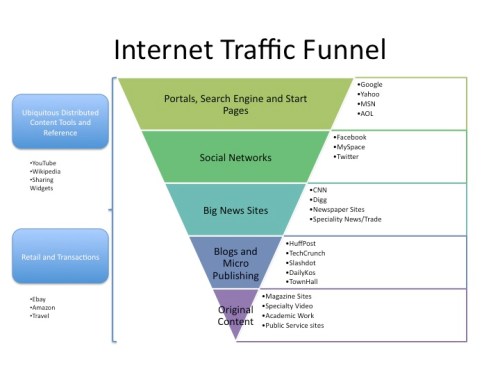
Traffic on the Internet roughly splits 7 segments. (as shown in the figures below). These segments are defined by where the sit in the user experience by amount of consumptive behavior (clicks, reading, sharing, watching). How the user gets from segment to segment is not completely linear in actuality, but when you coagulate a users behavior you’ll roughly see a funnel in terms of time spent, pageviews and ad impressions.
Traffic Funnel
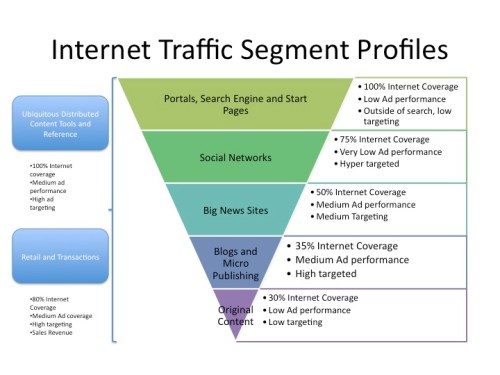
The segments can be characterized also by their ad performance, ad targeting (how specific is the user in their activity), and their audience coverage (how much of the particular audience segment does a type of site/service reach)
Funnel Traffic Segments
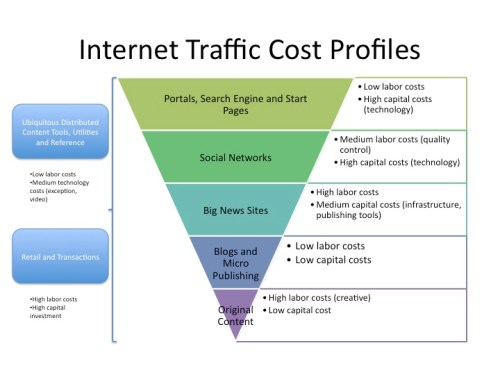
Each segment has a different cost profile. Here I look at labor costs to maintain and capital expenses to build and power.
Where's the Cost?
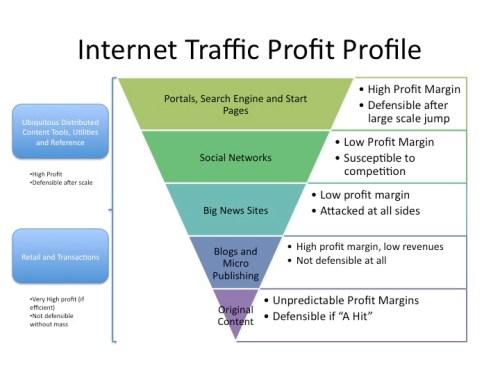
As you can guess, each traffic segment has a different profit profile too. This is largely the result of combining the advertising/revenue performance with the cost profile. Certain Internet services simply do not have a strong profit opportunity because they borrow old models and/or cost more than the market is willing to pay. (Perhaps that will stabilize one day, but I think software tools and low cost hardware disrupt the demand curve A LOT because users can often supply their own demands once the cost gets too high, hence why TOOLS are the most profitable segment.)
Profit Margins by Segment
Make no mistake about what I’m presenting here. The profit online is all in retailing, portals/search and tools/utilities. The stuff in the middle of the funnel is highly susceptible to competitive displacement and has very little intellectual property protection. You can verify this conclusion by reviewing revenue statements and SEC filings for the big tech and internet companies.
The advent of citizen journalism and self publishing flattened the media market. Owning a printing press was once “high tech” and a capital investment barrier. Owning the right location on the main street was once a logistical barrier. High speed computers and difficult programming languages was once a technical barrier. Those 3 feature are gone. Media is now, well, almost purely a creative barrier. There’s a huge pool of creative talent constantly struggling against each other. Creativity is worth a lot once it rises above everything else. That happens so rarely to make it a bad investment. Every minute more and more people enter the creative market (how many blog posts per hour? how many videos go up each day?… a lot.)
organizing, sifting, filtering, distributing, aggregating… that’s the sweet spot. There is a technical hurdle, but the investment is worth it as there will never be less of a need to filter, sift, find, distribute.
This week we had a beautiful illustration of these concepts with the Presdential Inauguration.
Most of the US users watched the Inauguration, most on TV, a lot with online video streams and 2 million in person. During and Immediately following the inauguration the Internet lit up with content creation and massive usage. The portals and search engines featured as many new links and breaking stories to the news coverage.
The social networks shot pictures, tweets and status updates around, occassionally referencing links to the confirmation gaff, benediction speech text, and satelite pictures from DC.
Micro bloggers summarized everything as fast as they could, while the search engines and utilities sucked in that content. The original content creators probably released a previously composed story and put that live.
Mainstream users shut down their video streams and took to the portals and search engine, seeking more info on what just happened or insight into a specific moment. Most times they ended up at CNN or NYTimes. Many times, but less frequently, they hit a blog that had some recent content. Most users probably ran into a wikipedia reference link or youtube video.
Some users ended up on amazon to buy Obama’s books or some inauguration swag. Finally as the day concluded and original content creators finally had enough time to craft something, users might find themselves falling asleep to a good OpEd on the history of the day or an interview with the Michelle Obama dress designers.
By 3 days later the amount of content available on the inauguration is 1000x greater than within the first 10 minutes. Original content creators are hopelessly buried amongst the blog posts, tweets, continuosly AP feed CNN articles and YouTube embeds. The bloggers are buried by other bloggers. The news stories give way to other news stories.
The utilities that sort, sift, filter and monetize on it all just got a 1000x better experience and continue to catch the huge volume of user investigation and digging. The own the head, the trunk and that dreaded long tail and collect user targeting data all along the way.
Can there be any mystery why the sophisticated symbolism of words binds people to…
Others
Ideals
Fear
Anger
Dogma
Superstition
Loss
Hope?
This learned set of symbols… these words… in whatever language they form… are powerful. Words have a value that connects people reading and hearing them as well as separates those not understanding those words.
Based on past histories and current contexts words rouse unforgettable warmth or irreconcilable anger which, in term, become learned by those experiencing them and watching others experience them. It is a reciprocal relationship; words represent traditions and traditions represent words (as we witnessed with the second swearing in of President Obama). When repeated over and over words morph oh so slowly while becoming ingrained in the fabric of civilization.Traditions, including those of religion, bigotry, superstition, inaugurations and funerals are indelible links between people all represented by words.
Sam Harris in “The End of Faith,” has many logical points concerning traditions, superstition and cultures as do so many others including this author. However, at one time or another we all miss another point that gets lost in emotional [ratio strain] self-righteousness; being right is a relative target and is not what everyone values. One thing for sure is that we all value some words organized in some order representing some experiences.
The changes Sam Harris and others search for will come only through a process of selection by consequences.The things that will replace bigotry and fear and traditions of hate must be learned just as the superstitions and belief systems they were based on were learned. If that is the case, and it most assuredly is, Sam and some of the others will not be here to celebrate a new form of enlightenment where understanding the elemental basis of how behavior works is a primary requirement of primary school graduation.
While we work for all those words describing the elements of understanding behavior in our culture we can appreciate Dr. Lowery’s words for what they represent: a plea to figure out what the heck is going on out there.
And the 2009 Oscar Nominees are…. (see last years review last years nominees)
Best Picture:
Benjamin Button
Frost Nixon
MILK
The Reader
SlumDog Millionaire
Main points of note: Heath Ledger gets a nod, Slumdog Millionaire is still the darling, Meryl Streep is up yet again, Dark Knight didn’t get a nomination. get the rest of today’s nomineeshere.
blah blah blah
The Academy Awards are such a funny thing. Like blogs, it’s content about content. It’s not really “content unto itself”. Content about content is bound to the quality and audience sway of that underlying content it makes commentary on. In that way, the Academy Awards have a difficult situation in trying to seem legit in honoring truly remarkable films while attending to the facts that a diminished awards show audience doesn’t want to see a show all about indie films and no names.
Either way, the Oscars could probably use the ratings help a box office success can bring to its broadcast. In recent years, the Academy has nominated several independent or low-budget films for top awards, many of which didn’t crack the $100 million mark at the box office. Oscar ratings have tumbled; last year’s numbers for “the Super Bowl for women” — as the Oscar broadcast is known by advertisers — were the lowest on record and a far cry from 1998, when more than 55 million people watched all-time box office king “Titanic” take home the top prize.
Again, very similar to blogs and web traffic. If I don’t blog about the oscars or post pictures and stories from the ceremony, my blog will get buried. Any website that doesn’t talk about the Oscars will get slightly less traffic today than those that do. Perhaps that doesn’t seem like such a big deal, except when you consider what a dog fight it is in the publishing and media industry to get advertisers right now. And getting those ad dollars is directly correlated to daily traffic numbers (ratings!).
Perhaps more blogs and media outlets should try to create original content and develop first party audience. Unfortunately, it’s too expensive and has a very low probability for success. The data demonstrates this.
There’s a fine line to ride here and more often than not it’s crossed on blogs, in newspapers, and the Oscars. Some purists and critics will cry fowl, but in the end, money talks.
Mysticism returns to prime time TV with this inane crime stopper series “LIE to ME*” heralding the star (Tim Roth) and his team’s ability to read people’s faces to tell when they are lying about what. Crimes are just the medium for the law enforcement to clean up with all that legal mumbo jumbo.
Forget the advance science of real life CSI groups who offer empirical data as evidence supporting suspicion of involvement or not that is shown or implied in other TV dramas.Too many big words and too much emphasis on logic over folklore. That was wayyyyyy to tough to understand.
So, I guess the Vietnam war injury from a concussion grenade will not get mentioned in the villain’s arraignment.We’ll be able to tell if President Obama really is going to address the issues of the day and, most importantly, whether or not he is embarrassed to have a middle name of “Hussain” after all.
Working with this fantasy, think of where it could all lead:you are successful based on not being able to terse your lips or raise an eyebrow due to Botox. No more need for matters as suspect as a ‘Twinkie defense.’ It was a facial tick that sealed the doom that the Olympian was using banned substances… Or, your movie is given the green light because you looked the producers in the eye and your nose didn’t flare at the same time…
If only we knew what to look for before Columbine and West Virginia events…And all along those media mongrels were leading down the path of science, contingency management and stem cell hope.But no more…
Enter the latest version of phrenology** and voodoo*** for prime consumption.
I am so disappointed.
*Not the absolute blues-grunt-rock of Jonny Lang’s live version of “Lie to Me”
**Phrenology: a defunct and debunked field of study, once considered a science, in which a person’s personality was first implied and then determined by experts “reading” bumps and fissures in the subjects skull.
***Voodoo: religion based on mix of Roman Catholic teachings and West African beliefs that there are numerous deities subordinate to a greater god spirit (who does not traffic in matters or events of mere humans). Prayers and incantations to lower gods who show their work by symbolism in everything from tea leafs to smoke – only coincidently related to the smoke from a sacred chimney announcing a new Pope.
 Social Mode