Social Mode

,

  • David Deutsch wrote an interesting essay back in 2012 (http://aeon.co/magazine/technology/david-deutsch-artificial-intelligence/).   His books follow similar themes and this article is a useful condensation of his ideas – most notable of which is the idea that intelligence/creativity/knowledge/universal computation is fundamentally about EXPLANATION – not instruction, not arithmetic, not reinforcement learning, etc.

    He decries the lack of progress in artificial intelligence as due to flawed premises of the entire enterprise.  He makes the case that “he human brain has capabilities that are, in some respects, far superior to those of all other known objects in the cosmos.”   He declares self-awareness a thing and that universal computation can do it.   And he concludes that all the ingredients for artificial intelligence are encoded in DNA we just need the right idea to unlock that and use whatever idea in other substrates to create other general intelligent entities.

    I’m grossly simplifying the article which is a gross simplification of his books already but that’s because most of the details are irrelevant.   Deutsch rightly ridicules the current prevailing approaches to AI and their inevitable failure to ultimately deliver intelligence.  I agree with a lot of his reasoning around why AI with current behaviorist / inductive instructions approaches is doomed.    But I disagree with him on pretty much everything else because he himself has built his arguments on flimsy premises.   He assumes, as almost all scientists and philosophers and people, that knowledge is something.  Something that is embodied, something that exists.    I agree in a very simply way that anything that is learned must be learned through trial and error by the entity learning it and that learning doesn’t happen through transcription.  But it’s not because knowledge results.

    Knowledge is a reductive term that explains nothing and doesn’t really even clearly represent anything.  It’s not a concept that can even be explained categorically or through endless descriptions.  It simply is a general concept that sort of can be used to refer to lots of things.

    Intelligence is the same kind of concept.  It refers to nothing in particular.   Self awareness, same.  Good and Evil, same.   Consciousness.  Free Will.  All the same.

    AI won’t be coming because Real Intelligence isn’t a thing.

    Learning is a slightly less reified concept than the others because it sort of gets at the point.  The point of all computation and any perceived awareness is merely connectivity in a networking/graph theory sense.   Advanced behaviors and “creativity” etc are merely effects of a hyper connected network.   Learning is CONNECTIONS.   “Knowledge” is CONNECTIONS.

    Deutsch is correct that no one will be programming an AI.   If something we might call AI comes to exist it won’t be because we specifically designed it.   I would argue that it already exists, always has.   It’s highly flawed to think that humans are the only things capable of awareness and thinking.   It simply doesn’t add up.  But that’s an argument for another post.

    Everything is connected.   Extensions of connections continue to evolve as more things connect to more other things in more ways.   It’s such a simple, boring concept that it doesn’t seem that it would “EXPLAIN” it all.  It doesn’t.  It won’t.  Because explanations are not the stuff of existence – intelligence or otherwise.

    Thinking is not a thing.   Thoughts are not things.   There are connections between neurons and cells and organs and computers and planets and trees and galaxies and numbers and words and pictures and colors.  Where one thing ends and another begins is very not clear…. even with the “laws of physics” which Mr. Deutsch uses almost exclusively to justify everything.   The laws aren’t really laws.  Ironically.

    What Are We?  There is no answer because it’s always changing.

    What Are We? A Response to David Deutsch’s Creative Block Article

    –––––––

    Sep 19
  • “IS” creates. Its mere utterance, inscription, trace imbues existence. This IS. That IS. 1 IS. 2 IS 1 and 1. This IS different than that.

    FIght to Exist

    IS wordform is the trivial sign of the miracle act of creation. The giver of existence is merely Making It So. Made so by a finger pointing, a twitch of the eyes, a sentence declaring something is, action potential in the nueron, a bit flipped, a sum of numbers, movement in spacetime. IS. IS existence IS?

    IS supercedes from the classic BEING and EVENT philosophy. There is no seperation of BEING from EVENT. Just as light is not a wave nor a partical. IS being split is a valid creation, all creations are, but the phrasing and philosophy of BEING and EVENT as the two actual, distinct creative gestures doesn’t mean they are.

    IS in all its guises is the singular gesture, ex nihilo. And yet, really, the act IS NOT something from nothing. For nothing is a something. It is something from something. Nothing, redefined is SOMETHING in-distinguished from SOMETHING ELSE. There IS NOT some thing!

    A word game? Hardly. IS can be experimented with and falsified. In fact, IS requires it. The completion of the IS is NOT. Negate it with another IS. This IS IS not THIS. Ad infinum. Do it without words, without thoughts. Merely observe in any perceptive medium and any perceptive tool. What “happens”? is happens.

    This IS not satisfactory though. The meaning or import of IS to practical understanding should be established. Only through another series of IS can this be carried out. Paradoxically the truth of the IS cannot be established without an IS.

    In fact.

    Truth IS. Truth is the only concept that resists the IS, truth cannot be IS-ified. Truth IS true. This IS true. There is no basis outside of the truth that can objectify that IS statement. The true is primary to the IS. or IS it? IS anything true before the IS establishes it for evaluation? Truth is. IS truth? IS TRUTH? IS TRUTH. TRUTH IS.

    In an newtonian world (and his associates Kant, Descartes, Lovelace, Darwin, Boole, Laplace, Jesus, Muhammad, Zeus, Curie) where IS and TRUTH are mere approximations, it doesn’t matter if we really know. ? It does. IS and TRUTH matters with more and more specificity depending on the relative stakes. To land humans in a rocket on the moon the recursion of physical mathematics and physical engineering needs a much more robust IS TRUE than two humans playing catch with a ball. The near infinite regress of IS TRUE of rocket physics pales in comparison to the IS TRUE of ALL OF KNOWLEDGE. In fact – if fact IS TRUE – ALL OF KNOWLEDGE cannot be established because IS TRUE goes on beyond all cardinal infinity. But yet, here we are. Something IS. Something is TRUE. some things are true. TRUE is. FALSE is not. FALSE IS not. FALSE IS NOT.

    How much IS and how much TRUE one needs for existence… NOW THAT IS THE QUESTION.

    IS

    –––––––

    Aug 23
  • Hi Greg,

    I love you, first of all – and really that’s all that matters. Thank you for reaching out to me. It’s selfish but I needed someone to reach out to me. It’s been a long time since I was young and confused and mad about the universe ripping living people in my life into the grave. It’s been long enough that sometimes I wonder whether it really happened and whether all these years if I didn’t just go insane.

    People die. They really do. And it’s as terrible as anyone can imagine. And it’s as natural as the science books suggest.

    And it hurts. God does it hurt. It is punishment. I still feel guilty. Every day. I don’t know what I did or was or could ever be to deserve anything that’s be given to me. I really don’t. Rage isn’t even close to how it feels. AHHHHHAAAGHHHHH.

    Comfort doesn’t come in words. Comfort doesn’t come song. nor travel. nor food. nor anything. You see, death just rips. It rips your anchors, your beliefs, your ideas and completely and totally destroys them in one fell swoop. And it doesn’t give you anything in return.

    My heart breaks for you, for her, for him, for all. Because I know. I know that I will never know – never know those that died, those that died in your life, those that died in my life. And, GOD!, do i want to know those that died in my life. There they were … and then… no they weren’t.

    You are young, and so was I, and so are so many people. Who are we to feel guilty? or mad? or sad? who are we, with life, to rage against the universe? who are we to dare to ask why? knowing no answer is coming. but secretly hoping in all these books. SO MANY BOOKS… there is no answer.

    I searched for you. I’ve read them all. There are no answers, I’m afraid. I know you will read many more and talk to many others and take walks i haven’t taken. and yet we will both arrive right here.

    broken.

    hearted.

    Somehow, someway, I made it to 38.9 years old. I don’t really know how. But here I am. Thank you for reaching out, your tender years. Lost in this universe I remain. Is that hope? if i can do it so can you? hardly. but maybe….

    I am so sorry she was tossed from a car and tossed from your life. No universe we imagine has that outcome. and yet, here it is. here it is. here you are. here i am. here your mom is.

    greg, oh, greg. you are not alone. oh no you are not. but you feel like you are because in so many ways right now you are. and its real. oh god is it real. oh god am i alone right now. i wish you were here, even though we barely spend any time together. but we are also connected and not alone. i don’t know how you feel. i didn’t and don’t really know how i feel now. other than i just HOPE, goodness do i hope, somewhere out there something touched someone in some way. even for a moment. For A Brief Moment… anything that made someone think God I Do Matter.

    greg you matter. amber matters. i matter.

    i hope you keep talking to me.

    i love you,

    uncle russ

    To Mourn The Past and The Present

    –––––––

    Aug 7
  • About 13 years ago d and I made the passive aggressive decision to open ourselves up to the chance of procreating.  I’m sure the reader can figure out the choice we made.  Well the chance turned into a probability of 1 rather quickly.  

     I was a 26 year old idiot who believed literally “I could move mountains of if I had to.” Yup I said that seriously in an argument back then.  So my decision making ability then was as optimistic as it is now only it was further enhanced with nativity and hubris.   Nonetheless the die was cast and I was to be a dad.  And the learning and appreciation needed to come fast.   Fast it came or so I thought.  
    I distinctly remember the moment d’s water broke.   OH SHIT OH SHIT OH SHIT.  what do we do?!?!   We are generally intelligent beings who faithfully read the curriculum and attend all required classes. But in that moment it was gone. All of it.  So of course WE CALLED OUR PARENTS.  mine laughed and when they were done they repeated a simple instruction: go to the hospital. Do not pass go.  Do not collect $200.  
    We got our literal and figurative shit together and did just that.  Generally things went as expected.  It’s sort of all a haze.  I remember that I was not to talk nor point out when a contraction was evident on the seismograph as she “was very well aware of the situation!”  It was July 4, 2003. Barry white passed away earlier in the day.  I listened to Barry white songs while d came in and out of sleep and pain.  
    Then came go time.  The sun was setting (hey this is my blissful memory so don’t go fucking fact checking).  It was time to bring baby Bella into the light and air of Santa Monica.  D was so amazing and as the sun faded hell if I didn’t see a purple headed offspring come screaming into the world.  These moments are what I’ve called before HI FIDELITY. the streams of data are so intense and the change of state so intense it leaves you transformed and awed.  Awed I stood watching them clean that little thing and watch purple turn to pink.   And then fireworks shot off in the distance and they handed d the Beautiful Light and we were officially a family of three.  
    That’s my dad origin story more or less. And I couldn’t have dreamed of one of my more Ill thought out just do it non decisions turning out any more beautiful.  
    And so here we are today. In less than a month my first procreated turns twelve.  Over the years I’ve gone through waves of confusion and disbelief and low confidence that I had or could get things right.  I’ve openly questioned what any right any of us have bringing kids into a world so far from being worthy of their existence.  And yes the whole last few sentences are some weird cultural and philosophical backdrop that is sort of irrelevant. 
     Things happen.  We happen. I happen to be a dad.  And with what happens I must do what I can to make it happen as best I can.  My daughters are passed the point where I swaddle and bottle and make it ok with simple gestures.  I have not transitioned quickly into going from provider to confider.  Just as I started figuring out how to properly feed them they learned logic and peer pressure and emoji.  And so now I’m a dude that occasionally can mumble something about relationships or why pot isn’t legal or why reality shows aren’t really reality but what is anyway.  I’m still pretty clear on mathematical things so not all is lost on first providership.  
    And this is why I paint and write and sculpt and generate programs.  My kids long ago escape a linear relation to me or the world and I don’t have enough solid dad talk tracks built up.  I guess my artistic endeavors and other attempts to express and give back some synthesis of the world are me trying to pass on a little of what I’ve learned.  It ain’t easy.  It ain’t obvious.  It ain’t entitled.  It ain’t certain.  
    Put some same beautiful light on a canvas and get on with it.  
    Peace and love dads of the world.  And moms and kids.  
    – Russ

    My Dad Origin Story

    –––––––

    Jun 21
  • From within the strange loop of self-reference the question “What is Data?” emerges.  Ok, maybe more practically the question arises from our technologically advancing world where data is everywhere, spouting from everything.  We claim to have a “data science” and now operate “big data” and have evolving laws about data collection and data use.   Quite an intellectual infrastructure for something that lacks identity or even a remotely robust and reliable definition.  Should we entrust our understanding and experience of the world to this infrastructure?   This question seems stupid and ignorant.  However, we have taken up a confused approach in all aspects of our lives by putting data ontologically on the same level as real, physical, actual stuff.    So now the question must be asked and must be answered and its implications drawn out.

    Data is and Data is not.   Data is not data.   Data is not the thing the data represents or is attached to.   Data is but a ephemeral puff of exhaust from an limitless, unknowable universe of things and their relations. Let us explore.

    Observe a few definitions and usage patterns:

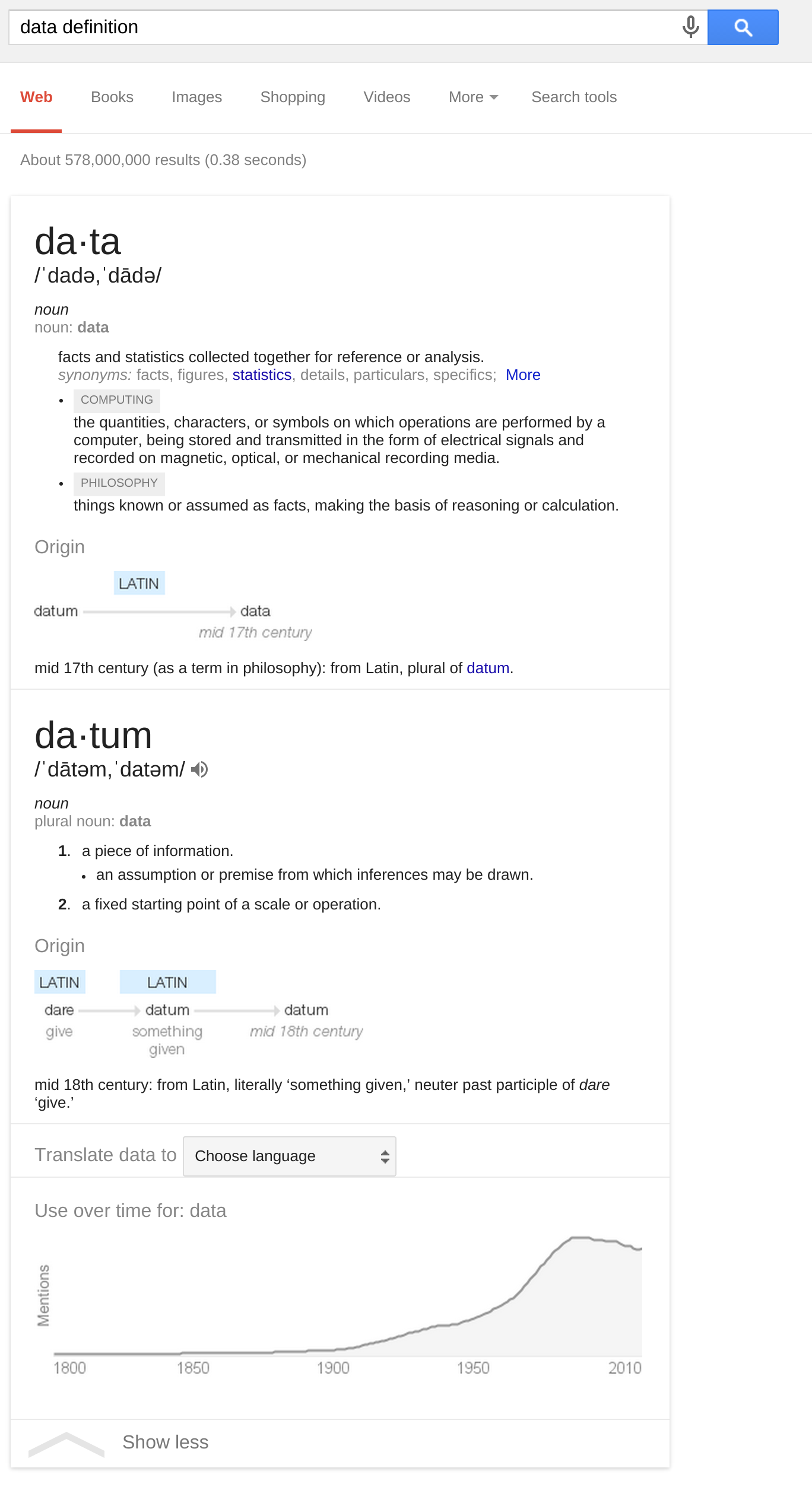
    Data According to Google
    Data According to Google

    https://www.google.com/webhp?sourceid=chrome-instant&rlz=1CAZZAD_enUS639US640&ion=1&espv=2&ie=UTF-8#q=data+definition

    The latin roots point to the looming mystery.  “Give” -> “Something Given”.   Even back in history data was “something”.   Almost an anti-definition.

    Perhaps we can find clues from clues:

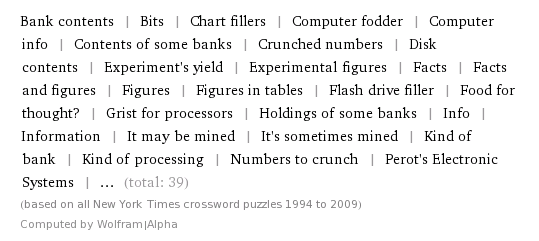
    Crossword Puzzle Clues for
    Crossword Puzzle Clues for “Data”

    http://www.wolframalpha.com/input/?i=data&a=*C.data-_*Word-

    Has there been a crossword puzzle word with broader or more ambiguity than that?   “Food for thought?”  seems to hit the nail on the head.   The clues boil down to data is: numbers, holdings, information, facts, figures, fodder, food, grist, bits.   Sometimes crunched and processed, sometimes raw.  Food for thoughts, disks, banks, charts and computers.

    ????????????????????????

    Youtube usually can tell us anything, here’s a video directly answering What Is Data:

    Strong start in that video, Qualitative and Quantitative… and then by the end the video unwinds the definitions to include basically everything.

    Maybe a technical lesson on data types will help elucidate the situation:

    Data Types

    Perhaps sticking to computers as a frame of reference helps us.   Data is stuff stored in a database specified by data types.  What exactly is stored?   Bits on a magnetic or electric device (hard drive or memory chip) are arranged according to structure defined by this “data” which is defined or created or detected by sensors and programs…   So is the data the bit?  the electric symbol?  the magnetic structures on the disk?  a pure idea regardless of physical substrate?

    The confusing self-referential nature of the situation is wonderfully exploited by Tupper’s formula:

    Tupper's formula

    http://mathworld.wolfram.com/TuppersSelf-ReferentialFormula.html

    What exactly is that?  it’s a pixel rendering (bits in memory turned into electrons shot a screen or LED excitations) of a formula (which is a collection of symbols) that when fed through a brain or a computer programmed by a brain end up producing a picture of a formula….

    The further we dig the less convergence we seem to have.   Yet we have a “data science” in the world and employ “data scientists” and we tell each other to “look at the data” to figure out “the truth.”

    Sometimes philosophy is useful in such confusing situations:

    Information is notoriously a polymorphic phenomenon and a polysemantic concept so, as an explicandum, it can be associated with several explanations, depending on the level of abstraction adopted and the cluster of requirements and desiderata orientating a theory.

    http://plato.stanford.edu/entries/information-semantic/

    Er, that doesn’t seem like a convergence.  By all means we should read that entire essay, it’s certainly full of data.

    Ok, maybe someone can define Data Science and in that we can figure out what is being studied:

    https://beta.oreilly.com/ideas/what-is-data-science

    That’s a really long article that points to data science as a duct taped loosely linked set of tools, processes, disciplines, activities to turn data into products and tell stories.   There’s clearly no simple definition or identification of the actual substance of data found there or in any other description of data science readily available.

    There’s a certain impossibility of definition and identification looming.   Data isn’t something concrete.  It’s “of” everything.  It appears to be a shadowy representational trace of phenomena and relations and objects that is itself encoded in phenomena and relations and objects.

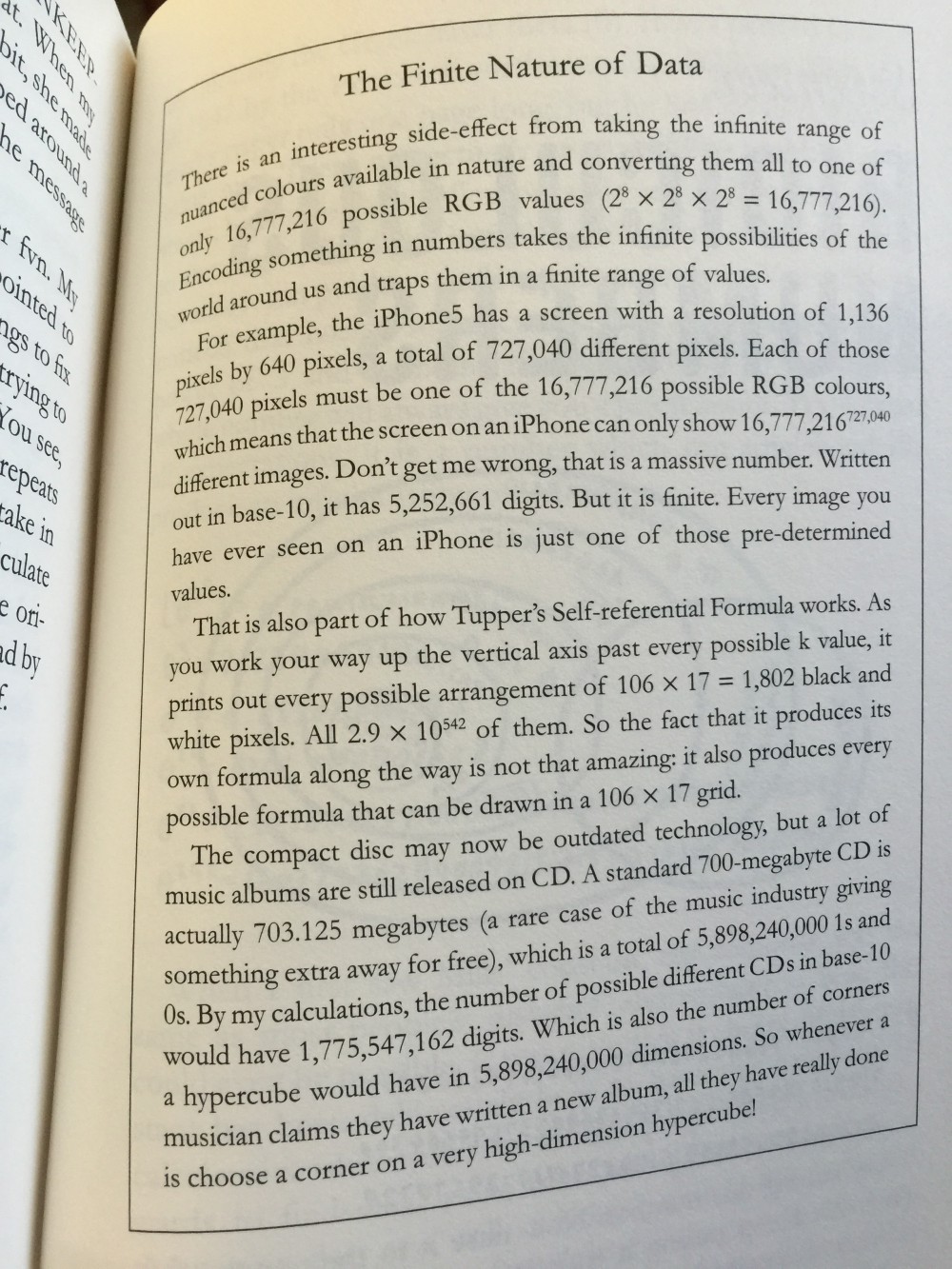
    There’s a wonderful aside in the great book “Things to Make and Do in the Fourth Dimension” by Matt Parker

    Finite Nature of Data
    Finite Nature of Data

    https://books.google.com/books?id=wK2MAwAAQBAJ&lpg=PP1&dq=fourth%20dimension%20math&pg=PP1#v=onepage&q=fourth%20dimension%20math&f=false

    Data seems to have a finite, discrete property to it and yet is still very slippery.  It is reductive – a compression of the infinite patterns in the universe, it is also a pattern. Compressed traces of actual things.   Data is wisps of existence, a subset of existence.   Data is an optical and sensory illusion that is an artifact of the limitedness of the sensor and irreducibility of connections between things.

    Data is not a thing.   It is of things, about things, traces of things, made up of things.

    There can be no data science.   There is no scientific method possible.   Science is done with data, but cannot be done on data.  One doesn’t do experiments on data, experiments emit and transcode data, but data itself cannot be experimental.

    Data is art.   Data is an interpretive literature.  It is a mathematics – an infinite regress of finite compressions.

    Data is undefined and belongs in the set of unexplainables: art, infinity, time, being, event.

    Data = Art Data = Art

    What is Data?

    –––––––

    Jun 20
  • She stood at the tree waiting.   Rain had softened the ground overnight so her feet sank a little as time passed mud creeping up.   Long ago the childish message carved in the tree disappeared as new layers of bark did what they do – cover up the years.   She kept her hand where the message used to be.   She did not move even as sweat matted her hair and tears streaked her face.  The bugs didn’t care about her situation.  They swarmed and nipped at their motionless meal.

    The Tree
    She Waited Here

    ~~~~~~~~~

    He never made it to the tree.  Three years ago on a trip overseas he fell ill and with barely any notice slipped away.  He was traveling alone and had not noticed the severity of his illness when he fell into a deep sleep one afternoon.  He never awoke.

    His body was removed from his temporary dwelling after finally being noticed by the housekeeper who had been away.   He had paid cash up front and left no useful information behind for the housekeeper nor anyone else to contact anyone.  The housekeeper had him buried in a slightly marked grave and buried his meager personal belongings, a journal and wallet, with him.  She kept a description of him on hand in the house in case a future visitor inquired.

    Years passed.

    ~~~~~~~~~

    When the search party found her she was still attached to the tree.   Drenched from several nights of rain and a near perpetual sweat rashes covered her bitten and weakened body.  She rarely blinked and her face was flush white.   At some point during the waiting it occurred to her he wasn’t coming and she wasn’t going to leave.

    “Are you ok? Are you ok,” they repeated over and over.

    No response.

    “Let go of the tree.  Come with us.  You’re going to be ok.   Let go,” the pleading continued until they finally forced her hands away and carried her to the vehicle.   A tear, so slight, crept from her left eye.

    ~~~~~~~~~

    “Let’s find ourselves,” the note ended openly and without commitment.   One night she had written the note and hastily dropped it in the mail after a long week of anguished failed attempts to compose.  The writing was sloppy and rushed and the stamped was not flush with the corner.

    ~~~~~~~~~

    “Let’s find ourselves,” he read trembling.   Normally the envelope would have been thicker with more words stuck inside of it, but this one had been impossibly thin.   It contained few words.  He packed his bag in haste taking a few clothes and his journal.  He left immediately on the next boat with no idea when he would come back other than to meet at the tree.

    ~~~~~~~~~
    With a little knife they carved “our love grows” deeply into the tree that day.   The hugged when they were done and whispered their promises to return to that tree 15 years from then.  They hugged and hugged.   The wind was gentle and did not rush them.

    ~~~~~~~~~

    The Tree (a very short story)

    –––––––

    Jun 13
  • Like most things Disney, Tomorrowland is a delicious snack of seeming subsistence. This movie is chock full of “I wanna believe” and “I must be a terrible person if I don’t believe” sentiments and relationships. “We are the future”, “I can make it work”, “Light and hope – the wolf you feed”, “You still have hope”, “Anything is possible” and “We make our destiny” – are just a few of the inspirational tugs. The story itself is cute, watchable and, by in large, moving. And herein lies The Problem.

    Human Progress is Not A Thing
    Human Progress is Not A Thing
    In an ironic twist, if that’s even an American possibility anymore, Tomorrowland, violating its own story premise, espouses overly simplified, imagination-limiting Propaganda. The movie presents the future worth chasing as people standing in amber waves of grain aweing at a technological, automated city of industry and digitization out in the distance. Hard to be irritated by the vision all of us Americans have been sold since the nanosecond we were conceived. The irony of this vision in this movie is that the realization of this future, and the children sold into it, end up creating the technology that brainwashes the world into its own destruction.

    The bigger philosophical, ethical issue is that humans by in large cannot imagine a future without humans at the center of it. And in America we can’t sincerely adopt a future without technology and industry made by humans. Americans, and most “developed” societies, mostly do not view non-human growth, creativity, and prosperity on the same level as human efforts. We justify our existence by our ability to continually re-wreak havoc on the world so our human solutions can prevail again! Us humans do have a remarkable ability to solve various issues, especially through technology. But is it remarkable enough to justify our existence, and more pressingly, our proliferation in time and space?

    Tomorrowland and the millions of other political, cultural narratives will never be able to ask questions penetrating enough to even hint at a possible justification. These narratives survive and thrive by preying on cognitive bias – asking “is my existence justified?”, “is my worldview accurate?”, “is my limited perception sufficient for external imposition?” isn’t exactly the stuff of mega block buster movies, toy shelf marketing, school room pledges, company missions and political campaigns. And we as consumers and producers of these narratives will not be able to imagine, adopt and create a future worth having nor even a possible future if we can’t ask those questions. The future contemplated by this Dream of the Dreamers is not one that can exist – a perpetual recycle of humans at the center of everything isn’t really a thing has been clearly demonstrated by 13.5 billion years of the universe doing its thing.

    Are there popular narratives and dialectics that seem to ask deeper questions – things like “Planet of the Apes” to “The Singularity” movement to posthumanism to mathematics to most philosophy books and departments? On the surface all these things all seem to contemplate non-human centrality but they still all have anthropomorphic aspirations at their core. Anthropomorphism is very hard, if down right impossible, to avoid.

    The way forward may be not be forward at all. That is, progress is a very misguided, humanistic concept. Progress is at best a relative, self-serving concept, it is not a physical law or a feature of the universe. It is a misguided concept because it guides at all. The Dream of the Dreamers is always one of Progress, never one of restraint or contemplation or admission or apology or submission.

    Inside of me there is a battle. All these questions well up and make me feel like a bad father for not wanting to pass on “wisdom” but only questions. I’m a bad capitalist for questioning the unending creative destructive power of markets. I’m a bad American for questioning The Dream of the Dreamers. I’m a bad creator of technology for anguishing over its ultimate value. I’m a bad person-person for not having an identify or a mission or end goal or a five year plan and question my own centrality to my own existence. I’m a bad artist and writer for lacking happy, hopeful endings and conclusions – never answer a question with a question! I’m a bad revolutionary for not fighting every fight. and I’m definitely a bad philosopher for having no particular philosophy at all. Right?!

    The Dream of the Dreamers is potent because it certainly makes for pleasant sleep and a comfortable way to get out of bed and get on with the day’s work. But it is not reality it is marketing against reality. And it is more de-pressing than the struggle with unanswerable questions.

    Tomorrowland: The Unreal Dream of the Dreamers

    –––––––

    May 31
  • The edges of existence.

    Everything is an edge – an edge of an edge – an edge of an edge of an edge. Existence is an infinite regress of edges encoding, decoding and recoding other infinite regressing edge networks. The explanations for the unexplained, even in their simplicity, are infinite regresses.

    A dictionary is a book of words defining words. Where does a definition end?

    Human language is a loose collection of rules to be excepted and exceptions to be ruled by effect. If a communication communicates it’s acceptable?

    Sensory perceptions and the instruments of perception cannot be fully perceived. Are we to believe our eyes about our eyes?

    Mathematics and its objects and relations are designed to perfectly articulate all that is the case and yet hiding with infinity are infinities and transcendentals that cannot be defined, systematically discovered, nor hardly described. (http://vihart.com/transcendental-darts/)

    Our science modernized from the mystics (Kepler) and numerologists (Newton) and the faithful (Leibniz) strikes out, pathetically, against leaps of faith. This science likely has led to the heating of the planet via industry which now can only be reversed by more science?

    Turing conceived computers to mirror the way humans thought – conceived when our collective knowledge of brains was rather small. Ironically, within a few lines of code computers (theoretical and physical) become nearly inscrutable in terms of what they might do. Are more inscrutable machines required to create and understand more inscrutable machines?

    Currency is abstracted not just from physical objects but from any tangible value other than a sustained believe that this $ will be understood and honored by some anonymous entity beyond oneself. The beliefs sustained by what most label as “the dismal science” (economics) and its backer, the state.

    The desired progress of all of the above can be summarized as “prediction”. If something is predictable it is controllable is the underlying point of most modern obsessions with science, technology and information. Even though our most precise and abstracted efforts have shown prediction, by in large, is impossible. Not just for complex systems of the natural world but the very simple mathematical objects we create. https://www.youtube.com/watch?v=sHYFJByddl8

    Despite all the empirical evidence over hundreds of thousands of years and the theoretical proofs of the 20th century as a whole, our culture – primarily in the US but spreading elsewhere – simply refuses to give up control through prediction. It persists, likely, because we are limited beings in energy and time and need whatever perceived advantage we can get. Right? Seeming identification of a pattern reinforces that identification when paired with the perception of reward or advantage. That is learning itself is an edge of an edge of an edge and fully infinitely regressive to its own contradiction.

    Prediction and learning and control are all about probability. For a prediction to be useful it must tell us something about the probability of conditions coming to be. For us to do something based on a prediction we must believe that prediction to be as accurate at least as much as the probability of events it predicts. That is, our beliefs should only be as strong as the probability predicted. Or so logic would suggest. However, probability itself turns out, with no surprise here, to be an infinite regress. Probability is really a statement about lack of information. (Sure some people argue that chance/randomness is implicit to existence while others say it’s an artifact of our limited perceptions. In either case our ability to say anything about the existence of things comes down to ignorance and the infinite regress of existence.)

    This information remains forever out of reach. It is both at the heart of everything and is the edge of everything. We cannot know. We can only play with these edges, find more of the edges, recode edges into edges. Our struggles philosophically, scientifically, spiritually and educationally come down to this straightforward non-fact. Should we continue our answer and prediction seeking efforts in spite of their impossible hope? That is a personal question that each will have to answer over and over for themselves. For me, I will, not so I can be right or in control, but because I enjoy the edge want to live outside of control. I paint to paint, not because the painting says something about reality. “The good life” is proportional to the number of edges explored, clanged to, jumped from, thrown away, revisited, and combined.

    The Edge of Existence and Predictions Lost Cause

    –––––––

    May 24
  • In 2002 my wife and I decided having children might not be the worst possible decision we could make in life (turns out we got two amazing, intelligent, engaged daughters).   I pushed pretty hard for us to at least try, especially because we were relatively young and I had at least an inkling that parenting (not sleeping) couldn’t get easier as you aged. (I was almost 26 so I didn’t know that much mind you.)
    What I really didn’t know, and probably didn’t really understand at all until this year with my mom’s own life hanging in the balance, is that I was pushing for an impossible sacrifice.   Asking a woman to have a child seems almost natural until you actually think about it.  Beyond the basic What To Expect When Your Expecting fluff the sacrifice is a total self-exchange of the woman for the child.  She will not only dramatically give her body over to the child for 10 months, she does so forever.  She gives over her career, spiritual life, social status, friends and pretty much everything else.   And we ask her to do in some sort of manifest destiny “of course this is what you always wanted” way.
    In the end, it turns out ok. For the most part.  If she’s fortunate enough that the pregnancy and birth don’t kill her or diminish her.  And if her economic situation can afford it.  And if she has tremendous support around her, in her family in her community and her work.   And if her hormones and nervous system keep up to the task.  And if her body can withstand the adjustment to post-birth life.  And if the media and pop culture don’t twist her into self-loathing for failing to be good at everything AND have a kid.   I might turn out ok.
    I have a tattoo on my left arm.  It’s a phrase in cuneiform, “Redeeming Sacrifice.”   I got it a couple of years ago with the idea that in life I could only possibly ever hope to scrape the surface of such a sacrifice by trying my best to do whatever it took to not only provide for my family and my community but actually help them thrive.  I fail most days, in my opinion. The sacrifice made by my mom and my wife and countless other women around me to give me life, give my children life, support me, somehow get themselves to an ok place is of a magnitude greater than anything I’ve ever done.   The tattoo isn’t meant as a signal of a one time event but instead as a life long, infinite commitment to try to even approach the impossible sacrifice that is being a mom and being a woman.
    My wife is an amazing mother.   Whatever the criteria you have for that distinction I’m pretty sure you’ll rank pretty highly.   She has given everything to these children and to me.   And as far as I know her mom did the same for her kids and I know my mom did for her kids.
    What have we given them, really, in return?  A life long wondering whether they’ve done enough.  Whether they are doing enough.  Whether there’s someone else they have left behind. Whether they deserve the vacation or money they get.  Whether they’ve earned out respect and love.  I’m as guilty as anyone on that front too.  I want to blame our culture, which is pretty blame-worthy, but I cannot. Maybe blame or responsibility isn’t the right phrasing, but again I do feel all of us, especially males, need to think really hard about our own existence and decide to sacrifice more to make the pressures of being a female go away. Pushed to my most honest position we need to relinquish our patriarchy totally because we have not even come close to this impossible sacrifice.  We’ll never make up for the past but we certainly can leave the future with a slightly better chance that if you’re a female you can be just as much of Homer Simpson as I am or a leading Dr. or cheating football player or a president or whatever you damn well please.   As long as you’re taking on the burden of existence of ALL OF HUMANKIND you can and should do whatever you damn well please.
    Happy mother’s day.  And really happy women’s everyday.  I don’t deserve it but I hope all of you will keep letting me try to redeem the existence you give me through my own self-sacrifice.
    much love.

    The Impossible Sacrifice – A Mother’s Day Note

    –––––––

    May 10
  • We have a problem.

    As it stands now the present and near future of economic, social and cultural development primarily derives from computers and programming.   The algorithms already dominate our society – they run our politics, they run our financial system, they run our education, they run our entertainment, they run our healthcare.    The ubiquitous tracking of everything that can possible be tracked determined this current situation.   We must have programs to make things, to sell things, to exchange things.

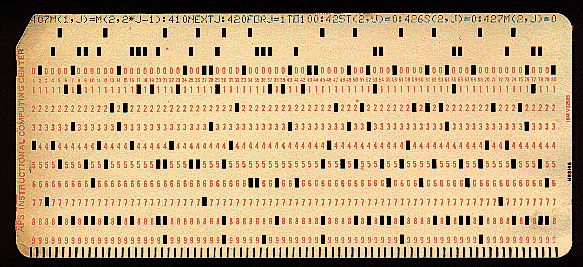
    punchcard

    The problem is not necessarily the algorithms or the computers themselves but the fact that so few people can program.    And why?   Programming Sucks.

    Oh sure, for those that do program and enjoy it, it doesn’t suck. As Much.   But for the 99%+ of the world’s population that doesn’t program a computer to earn a living it’s a terrible endeavour.

    Programming involves a complete abstraction away from the world and all surroundings.  Programming is disembodied – it is mostly a thought exercise mixed with some of the worst aspects of engineering.   Mathematics, especially the higher order really crazy stuff was long ago unapproachable and completely disembodied requiring no physical engineering or representation at all.  Programming, in most of its modern instances, consequences very far away from its creative behavior.  That is, in most modern system it takes days, weeks, months years to personally feel the results deeply of what you’ve built.    Programming is ruthless.  It’s unpredictable.   It’s 95% or more reinventing the wheel and configuring environments to even run the most basic program.  It’s all set up, not a lot of creation.   So few others understand it they can’t appreciate the craft during the act (only the output is appreciated counted in users and downloads).

    There are a couple of reasons why this is the case – a few theoretical/natural limits and a few self-imposed, engineering and cultural issues.

    First the engineering and cultural issues.   Programming languages and computers evolved rather clumsily built mostly by programmers for other programmers – not for the majority of humans.    There’s never been a requirement to make programming itself more humanistic, more embodied.    Looking back on the history of computers computing was done always in support of something else, not for its own sake.   It was done to Solve Problems.   As long as the computing device and program solved the problem the objective was met.   Even the early computer companies famously thought it was silly to think everyone one day might actually use a personal computer.   And now we’re at a potentially more devastating standstill – it’s absurd to most people to think everyone might actually need to program.    I’ll return to these issues.

    Second the natural limits of computation make for a very severe situation.   There are simply things that are non-computable.   That is, we can’t solve them.   Sometimes we can PROVE we can’t solve them but that doesn’t get us any closer to solving some things.    This is sometimes called the Halting Problem.  The idea is basically that for a sufficiently complex program you can’t predict whether the program will halt or not.   The implication is simply you must run the program and see if it halts.  Again, complexity is the key here.  If these are relatively small, fast programs with a less than infinite number of possible outcomes then you can simply run the program across all possible inputs and outputs.   Problem is… very few programs are that simple and certainly not any of the ones that recommend products to you, trade your money on wall street, or help doctors figure out what’s going on in your body.

    STOP.

    This is a VERY BIG DEAL.    Think about it.   We deploy millions of programs a day with completely non-deterministic, unpredictable outcomes.  Sure we do lots of quality assurance and we test everything we can and we simulate and we have lots of mathematics and experience that helps us grow confident… but when you get down to it, we simply don’t know if any given complex program has some horrible bug in it.

    This issue rears its head an infinite number of times a day.   If you’ve ever been mad at MS Word for screwing up your bullet points or your browser stops rendering a page or your internet doesn’t work or your computer freezes… this is what’s going on.  All of these things are complex programs interacting with other programs and all of them have millions (give or take millions) of bugs in them.  Add to it that all of these things are mutable bits on your computer that viruses or hardware issues can manipulate (you can’t be sure the program you bought is the program you currently run) and you can see how things quickly escape our abilities to control.

    This is devastating for the exercise of programming.  Computer scientists have invented a myriad of ways to temper the reality of the halting problem.   Most of these management techniques makes programming even more mysteries and challenging due to the imposition of even more rules that must be learned and maintained.   Unlike music and writing and art and furniture making and fashion we EXPECT and NEED computers to do exactly what we program them to do.   Most of the other stuff humans do and create is just fine if it sort of works.  It still has value.  Programs that are too erratic or worse, catastrophic, are not only not valuable we want to eliminate them from the earth.   We probably destroy some 95%+ of the programs we write.

    The craft of programming is at odds with its natural limits.   Our expectations and thus the tools we craft to perform program conflict with the actuality.  Our use of programs exceeds their possibilities.

    And this really isn’t due to computers or programming, but something more fundamental: complexity and prediction.    Even as our science shows us more and more that prediction is an illusion our demands of technology and business and media run counter.    This fundamental clash manifests itself in programming, programming languages, the hardware of computers, the culture of programming.  It is at odds with itself and in being so conflicted is unapproachable to those that don’t have ability to stare maddeningly into a screen flickering with millions of unknown rules and bugs.   Mastery is barely achievable except for a rare few.   And without mastery enjoyment rarely comes – the sort of enjoyment that can sustain someones attention long enough to do something significant.

    I’ve thought long and hard about how to improve the craft of programming.   I’ve programmed a lot, lead a lot of programming efforts, delivered a lot of software, scrapped a lot more.  I’ve worked in 10+ languages.  I’ve studied mathematics and logic and computer science and philosophy.  I’ve worked with the greatest computer scientists.  I’ve worked with amazing business people and artists and mathematicians.   I’ve built systems large and small in many different categories.  In short, I’ve yet to find a situation in which programming wasn’t a major barrier to progress and thinking.

    The solution isn’t in programming languages and in our computers.  It’s not about Code.org and trying to get more kids into our existing paradigm. This isn’t an awareness or interest problem.   The solution involves our goals and expectations.

    We must stop trying to solve every problem perfectly.  We must stop trying to predict everything.   We must stop pursuing The Answer, as if it actually exists.  We must stop trying to optimize everything for speed and precision and accuracy. And we must stop applying computerized techniques to every single category of activity – at least in a way where we expect the computer to forever to the work.

    We must create art.  Programming is art.  It is full of accidents and confusions and inconsistencies.   We must turn it back to an analog experience rather than a conflicted digital.    Use programming to explore and narrate and experiment rather than answer and define and calculate.

    The tools that spring from those objectives will be more human.  More people will be able to participate.  We will make more approachable programs and languages and businesses.

    In the end our problem with programming is one of relation – we’re either relating more or less to the world around us and as computers grow in numbers and integration we need to be able to commune, shape and relate to them.

    Programming Sucks

    –––––––

    Apr 19
Previous Page Next Page

Blog at WordPress.com.


Loading Comments...
 

    • Subscribe Subscribed
      • Social Mode
      • Join 99 other subscribers
      • Already have a WordPress.com account? Log in now.
      • Social Mode
      • Subscribe Subscribed
      • Sign up
      • Log in
      • Report this content
      • View site in Reader
      • Manage subscriptions
      • Collapse this bar