Getting the python mysql connector working is a truly painful experience. Alas, I can safe you a ton of time.
First thing to do. Update the Python install on Mac OS X. The default is 2.5.1. For whatever reason this default install has all sorts of trouble when trying to compile MySQLdb. I have no idea what or why and you won’t find this hint ANYWHERE.
Then, if you want Django to integrate with the install of XAMPP, follow this post. It links to another post that takes you through the steps of getting MySQLdb compiled. If you want to use MAMP, you just change the source of the symbolic links mentioned in the post (telling the compiler where to get mysql headers).
Oh, yes, you’ll need to get either the XAMPP or MAMP sources. Both projects provide the sources of their packages. You’ll need to get the ‘include’ directory from both and drop it into your MySQL directory.
Google for “xampp source” or “mamp source” and you’ll get to the latest versions. I’d link to them here but you might read this post at a later time and get confused by my links.
No doubt you will have Google’d your eyeballs out trying to find fixes to this process.
here’s what doesn’t matter:
the discussion of 64bit mysql vs python 32 bit (when dealing with XAMPP or MAMP, those are both 32 bit mysql)
messing with the types.h file on your OS x
using macports or any exotic way of installing mysql
Now, the trickiest part is getting Django integrated in the XAMPP build of apache. (The Django dev web server works fine if you’re just playing around). I would NOT try to recompile XAMPP. Instead, get the Django Stack from Bitnami, which is Apache, MySQL, Django and Python. Yes, dev on your django dev and then port to this bitnami stack. This entire stack can be moved if you need to, which is nice.
If you’re like me, coding is more fun that configuring. I believe the above will get you coding and deploying faster than all the other recompile and bizarre options Linux gurus dish out. I’d say for production/hard core sites, do the best compile you can. For hacking up python, mysql and django, do the prepackaged stuff.
This method above has the advantage that everything is upgradeable without massive recompiles. XAMPP provides an upgrade package when they do new builds.
Failure to understand how users and money flow through the Internet costs media and etailers a lot of money every day. There are huge misconceptions about where the “value” actually lives for user data, advertising performance and profit margins on all this high tech.
The following figures attempt to disambiguate some of the confusion. The summarized conclusions come from a variety of data sources and real life experiences analyzing financial statements, traffic reports, advertiser analysis and experimentation. Specifically one could get someone exact figures by combining comScore, Quantcast, Compete, Google Analytics, TNS, @Plan, SEC Filings, internal reports, revenue statements and DART forecasting as I have done several times.
This post is meant to be a demonstration of the core concepts, not a statistical treatise on the topic.
If you hate reading too much, skip to the end for a somewhat realistic example of how traffic flows.
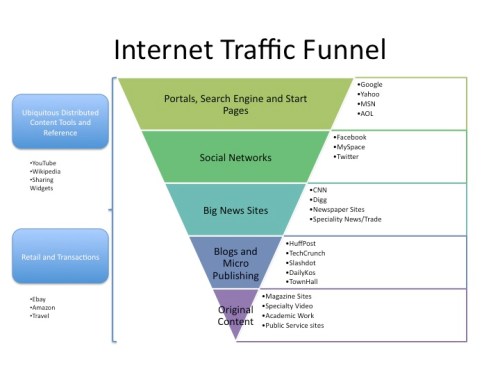
Traffic on the Internet roughly splits 7 segments. (as shown in the figures below). These segments are defined by where the sit in the user experience by amount of consumptive behavior (clicks, reading, sharing, watching). How the user gets from segment to segment is not completely linear in actuality, but when you coagulate a users behavior you’ll roughly see a funnel in terms of time spent, pageviews and ad impressions.
Traffic Funnel
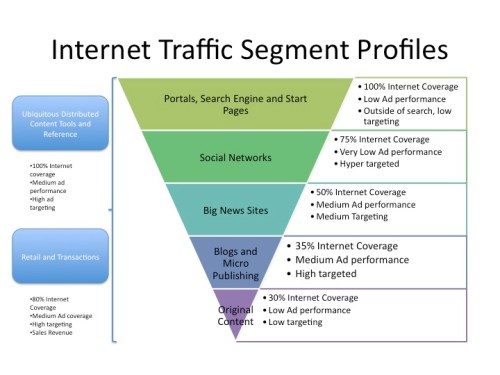
The segments can be characterized also by their ad performance, ad targeting (how specific is the user in their activity), and their audience coverage (how much of the particular audience segment does a type of site/service reach)
Funnel Traffic Segments
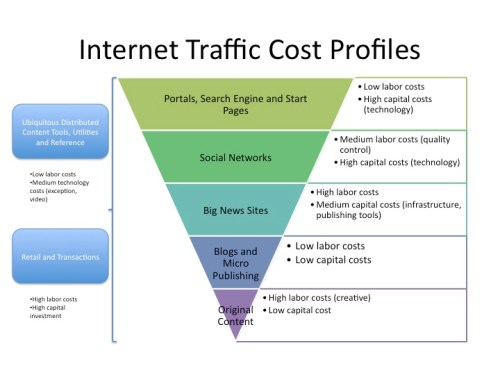
Each segment has a different cost profile. Here I look at labor costs to maintain and capital expenses to build and power.
Where's the Cost?
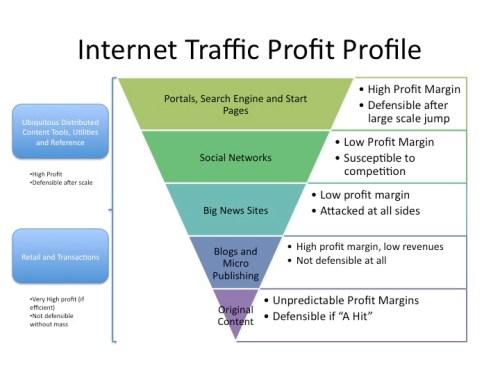
As you can guess, each traffic segment has a different profit profile too. This is largely the result of combining the advertising/revenue performance with the cost profile. Certain Internet services simply do not have a strong profit opportunity because they borrow old models and/or cost more than the market is willing to pay. (Perhaps that will stabilize one day, but I think software tools and low cost hardware disrupt the demand curve A LOT because users can often supply their own demands once the cost gets too high, hence why TOOLS are the most profitable segment.)
Profit Margins by Segment
Make no mistake about what I’m presenting here. The profit online is all in retailing, portals/search and tools/utilities. The stuff in the middle of the funnel is highly susceptible to competitive displacement and has very little intellectual property protection. You can verify this conclusion by reviewing revenue statements and SEC filings for the big tech and internet companies.
The advent of citizen journalism and self publishing flattened the media market. Owning a printing press was once “high tech” and a capital investment barrier. Owning the right location on the main street was once a logistical barrier. High speed computers and difficult programming languages was once a technical barrier. Those 3 feature are gone. Media is now, well, almost purely a creative barrier. There’s a huge pool of creative talent constantly struggling against each other. Creativity is worth a lot once it rises above everything else. That happens so rarely to make it a bad investment. Every minute more and more people enter the creative market (how many blog posts per hour? how many videos go up each day?… a lot.)
organizing, sifting, filtering, distributing, aggregating… that’s the sweet spot. There is a technical hurdle, but the investment is worth it as there will never be less of a need to filter, sift, find, distribute.
This week we had a beautiful illustration of these concepts with the Presdential Inauguration.
Most of the US users watched the Inauguration, most on TV, a lot with online video streams and 2 million in person. During and Immediately following the inauguration the Internet lit up with content creation and massive usage. The portals and search engines featured as many new links and breaking stories to the news coverage.
The social networks shot pictures, tweets and status updates around, occassionally referencing links to the confirmation gaff, benediction speech text, and satelite pictures from DC.
Micro bloggers summarized everything as fast as they could, while the search engines and utilities sucked in that content. The original content creators probably released a previously composed story and put that live.
Mainstream users shut down their video streams and took to the portals and search engine, seeking more info on what just happened or insight into a specific moment. Most times they ended up at CNN or NYTimes. Many times, but less frequently, they hit a blog that had some recent content. Most users probably ran into a wikipedia reference link or youtube video.
Some users ended up on amazon to buy Obama’s books or some inauguration swag. Finally as the day concluded and original content creators finally had enough time to craft something, users might find themselves falling asleep to a good OpEd on the history of the day or an interview with the Michelle Obama dress designers.
By 3 days later the amount of content available on the inauguration is 1000x greater than within the first 10 minutes. Original content creators are hopelessly buried amongst the blog posts, tweets, continuosly AP feed CNN articles and YouTube embeds. The bloggers are buried by other bloggers. The news stories give way to other news stories.
The utilities that sort, sift, filter and monetize on it all just got a 1000x better experience and continue to catch the huge volume of user investigation and digging. The own the head, the trunk and that dreaded long tail and collect user targeting data all along the way.
Based on their graph of searches per hour and assuming at $5-7 eCPM on searches and an estimate of 500,000,000-1,000,000,000 searches per day (or 21,000,000 to 42,000,000 searches per hour)* ….
Google lost over 20,000,000 queries during the inauguration or $100,000-140,000 on search.
Assuming a similar loss of general traffic across the web it cost Google an additional $40,000-60,000 in AdWords revenue.
Wow. that’s a lot of ad revenue to lose for about a 1 hour interuption. I suppose CNN, Facebook, and other news outlets picked up that extra ad traffic.
*Based on 2008 comscore reports and UU estimates from quantcast.
* My estimates for revenue per hour roughly equate to the quarterly earnings after you do all the math to roll it up. So the eCPM and searchs per hour seem to be solid assumptions.
Revenue in services, IBM’s largest business segment, dropped 4 percent, but IBM was able to ink $17.2 billion in new services contracts. That was a healthy showing that demonstrates companies are still forking out for outsourcing and other technical support contracts, which are often viewed as moneysavers in the long run.
Hardware revenue fell 18 percent. Mainframe revenue fell 6 percent, and sales of lower-end servers based on industry-standard processors fell 32 percent.
“IBM has enjoyed certain attributes that other tech stocks don’t enjoy. They have recurring revenue streams that also translate into profitability,” said Keith Wirtz, chief investment officer for Fifth Third Asset Management. “That’s great for IBM and that’s one of the reasons why, in today’s uncertain environment, IBM’s a very attractive name to hold.”
Hardware and big cash outlay technical things aren’t going to work in the short term. There’s going to be very little investment in non-core development and experimental concepts. This is about function, utility and making it work.
Friends and peers ask me what I think are some strategies for online media and tech companies in light of all this. As IBM is doing… cut costs via software and services efficiencies. Pretty straightfoward. If you are worker, agency, contractor, employee that provides software services more cheaply than others, you’re going to do fine. The same was true in the dotcom bust. Those folks that could accomplish the work of 3 and not need a “top of line computer” to do it, maintained a healthy paycheck and a pretty decent workload.
This is the year of maintenance, not upgrade or investment. (look at Microsoft’s earnings or Apple’s.) Reruns, nights in, used cars, after market tickets, ebay…
Advertising will be in the tank for awhile.
Hardware will be in the tank.
Financial services built on non core purchase money will be in the tank.
Services that make it cheaper to live, work, travel will thrive. For developers and media people, it’s time to focus on service infrastructure.
This isn’t too tough. It’s about sausage making and if that isn’t sexy to you, probably best to take a vacation this year.
By the fact that the site is even up means perhaps not much internet business comes from all this press.
Google Trends shows a nice spike, but the name Jason Wu doesn’t even come close to Superbowl or inauguration.
Jason Wu Michelle Obama Dress
Unfortunately, we’re just going to have to wait and see what impact this worldwide acclaim has for a designer. Perhaps fashion design is simply not measured accurately by online traffic. I suspect with my somewhat educated knowledge of the fashion industry and media that his reputation is now very secure and that will be a very lucrative career. He’s only 26!
Man, what a subtle but important change we’ll get with government, I hope. Websites that don’t suck.
Couple of notes: They need SEO help. The pagetitles aren’t as descriptive as they could be. i.e. the blog is just called “blog”, not White House Blog. Oh well.
It’s not clear how to get the alerts. the one little email box is not clear enough.
The use of YouTube as the video solution is a bit weird for me. You’d think they’d want direct control over that asset.
The use of the giant mantel up top is a fad. in 2 years sites like that will look dated, hopefully they will keep updating the design. Hopefully it won’t look as dated as that 1997 screenshot above. hahahaha
With all this viewership moving from TVs and set tops to the Internet, it makes no sense that TimeWarner, Comcast, Adelphia, etc. etc. continue to be ok with start ups partnering with studios to go around their business. Worse, the users are sucking up bandwidth via their cable and fiber connections mostly pulling content from CDNs like Limelight, Akamai, ArcoStream, Edgecast, etc. etc.
If the cable companies just purchased the CDNs they would have a much more defensible part of the digital media chain. Heck, they should even buy some of the p2p networks and/or sling media. If they had the pipes plus the delivery outposts, they could make some really smokin services.
Instead of doing that they fight the p2p users and let folks like Move Networks, Joost and YouTube steal their users and their licensed content. As it stands now the cable companies are just the cheap source of video content we can all encode and move around the Interwebs. (and not watch commercials…)
It’s one of these media ventures that seems like such a great idea but really isn’t. It has no growth potential left and is a media product that grabs user bases that really aren’t worth that much to advertisers or big exec firms – for example… the unemployed middle-aged, middle management white guys.
Now, don’t get me wrong. I like LinkedIn as a place to hosted my resume and occassionally link to people. Unfortunately, I think that’s just about what everyone uses it for, excluding marketers and recruiters.
This isn’t so unusual. Almost all other online job boards, professional networking and recruitment sites go the same way.
Site gets announced
Some people join
It catches fire and everyone puts their data in
The recruiters swarm
People get annoyed, bored, or don’t land that dream job and most accounts/profiles age
Network/Site starts blasting out emails and alerts about people looking for you, jobs waiting for you
That powers the site for years
Revenue grows slightly but never breaks out
Next site crops up and chips away at existing sites margins
LinkedIn’s traffic has fallen off. It basically has found the 16 million people looking for jobs it can offer them.
People not in the market don’t update their profiles. The folks most likely to power big network connection growth, don’t need a networking site. Folks who want a bitching resume just go off and build one at their domain or facebook page.
Put all of this together and LinkedIn is another Monster.com. It’s big, has users, might add a bell or whistle but has no place to go. It’s fate is set and completely determined but what it actually is – a job board. It’s only hope to grow is to somehow magically get people more jobs than any of the other methods. It won’t die as people always need networking and jobs.
I predict some old skool news media company will buy it one day and squeeze it for revenue. It’s a safe haven for the weary Internet exec.
Really folks. Mathematica has this out of the box.
Now, you probably should keep this a secret and go raise millions anyway. I mean, you still need to throw a killer launch party and pay for some blogger swag.
Another battle of platforms is upon us! Unfortunately this platform battle suffers from the ills of the past battles like the OS wars, Browser wars, Web video wars, HighDef format wars and the brewing Mobile OS wars.
Here are some of the keys to longevity in a platform battle.
Developers/Content Creators are the engine that makes all this go. If your platform doesn’t make it easy to create AND deploy, it’s not going to win.
JavaFX doesn’t deploy to LINUX. This is insane when you think about it. Sun, an open source embracing company, plopped out a platform that won’t work for the platform a TON of java developers primarily use makes no sense.
WPF is windows only whereas Silverlight mostly works everywhere, but the tools that make it easy to create apps are windows only and they are expensive. Expression studio is great and it would be very competitive on Mac and Linux. Probably more annoying than anything is that Silverlight still uses Windows Media for video, which really is only good on Windows and its not possible to create high quality WMV on anything other than windows.
AIR can be built on any platform with FlexBuilder, which is based on eclipse. The windows and mac versions of FlexBuilder are better, but the linux one does ok. Flash technology is ubiquitous and in version 10, so it’s well tested on all platforms
Successful platforms minimize user headaches in installing and/or using developed apps
JavaFX uses web start and all the other painful applet like launching experiences. i.e. it’s clunky. There are so many prompts to users and potential non starters making it very difficult to get a consistent install experience.
WPF is embedded in vista, not available elsewhere. Silverlight is one of the easiest Microsoft deployments. No complaint there. it actually works.
AIR and Flash have some weirdness with upgrade prompts and security issues at times. Generally it’s easy.
Branding matters
JavaFX? We’ll see on this. I personally think the Java is something that people either love or hate. Keeping Java in the name is going to hurt adoption because the haters aren’t going to go near it. Also, names like “FX” are pretty lame and non descript.
WPF is lame. Luckily end users never interact with the name. Silverlight – it’s fine. No one knows what it means, which is probably just as well so that people don’t hate it just because it’s .NET or Microsoft.
AIR – Not bad. Though, people still call anything flash related as “flash”.
Oh, yeah, the technology is the most important thing!
JavaFX. Based on my early tinkering and viewing the demos, this has some real power under the hood. It doesn’t hurt that Java has been around forever and there’s a big community and code base to repurpose. It’s likely to have more power to do bigger things natively than the other platforms, which are mostly “interface” platforms. More 3D opportunities available here.
WPF/Silverlight. There is some power behind silverlight and the .NET backbone. Flex and Silverlight are very similar, so I’m not sure Silverlight has any technology that makes it standout against AIR. If you use WPF on Windows you get the backend to do anything.
AIR. We know what we get with AIR. It’s a good interface and small game making platform. You’re not going to put tons of 3D into air without specialized libraries nor are you going to do a lot of data crunching. One of the most impressive AIR apps out there is the DirecTV NFL Superpass. It shows up some real cool technology and it doesn’t hose your system. The Flash engine is ridiculously small for what it does. The coming inclusion to embed C code may make this one killer engine.
This platform battle is somewhat odd in my opinion.
As a web developer (mostly), I’m unlikely to abandon the browser to produce a Rich Internet Application. It’s too much work for most projects and I don’t get any of the benefits of having it run in a browser (don’t have to worry about the OS or installs, etc. etc).
For any desktop apps I have to build, I’d rather just use the target platforms native toolset. The write once, run everywhere approach just doesn’t work. Not even with web server back ends. I’ve tried it many times. Unfortunately there’s always some gotcha.
I suppose the RIA concept could replace other ways of building interfaces for desktop applications. Like most web tech things though, it appears the Ad Agencies use the RIA concept more than any serious development shop.
What are you using for your RIA development? Are you doing RIA at all?


 Social Mode