“I don’t want to talk about politics.”
“Please don’t bring that up.”
“Ugh, I hate this conversation”
These are pretty common statements in my life in regards to politics. On one level, I get it. Talking politics to friends, family, co-workers and neighbors can be very frustrating, disturbing, confounding and lead to “relationship problems.” BUT. If we’re not talking politics – how we all agree to organize ourselves – what are we talking about? what else is at all worth talking about between people of various pursuits that has any actual impact on anything?
The point of politics and discussing politics is figuring out how we want to be. It’s the practical implementation of philosophy. It’s where the rubber meets the road with science and our understanding of the world.
Certainly there are others ways to organize ourselves and implement various ways of living. Maybe this democratic way of doing it isn’t the best. As far as I can tell though kings, tyrants, feudal states, anarchy and the such didn’t seem like such good approaches. Sure, we have corrupt politicians, flaws in this system, way too much corporate influence and more. Yet, in the end, we all still get a say – we get to vote.
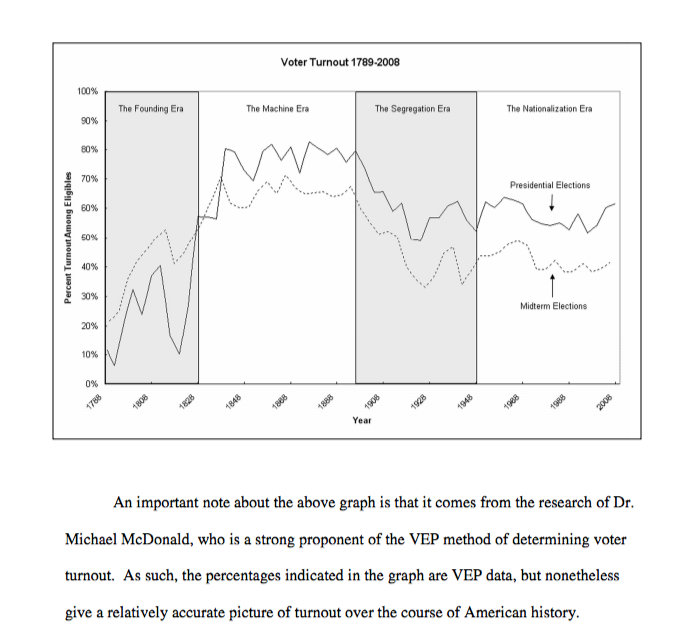
So… why bother bringing any of this up? So what, Russ? So everyone doesn’t like to talk politics. Leave it alone. Well, I think the general lethargy or disgust with the conversation leads to low levels of civic engagement, as signified by the pathetic voter turn outs over the last half century, and this has lead to unchecked corporate and political actions and a highly confused society.
This is a remarkably informative paper. http://trace.tennessee.edu/cgi/viewcontent.cgi?article=2373&context=utk_chanhonoproj
I point you to this amazing chart:
And this astounding little fact:
A 2002 study by the Institute for Democracy and
Electoral Assistance compared voter turnout in 169 countries that had at least some
degree of voting rights. Unfortunately, that study ranked the United States 138 out of
169 in voter turnout rates (Pintor et al 83)
Whoa! For a collection of peoples that generally praises itself for being the land of the free, we don’t seem to cherish that freedom all that much. (you DO what you VALUE….)
Might as well dig up local election information too. http://www.sarasotagov.com/InsideCityGovernment/Content/CAC/PDF/UofCalifornia.pdf
Moreover, trends over time suggest that voter turnout in local elections is declining just as rapidly as it is in national elections (Karnig and Walter 1983, 1993)
Additionally, I compiled more detailed data on recent federal election voter turn out for further inspection. It’s really tough to pinpoint why there is such a decline over time. The papers referenced above show a variety of facets and this data I compiled indicate some possible explanations. There’s no easy answer. (hence the need for discussion!)
Perhaps a valid argument against talking politics and voting is “I just don’t care” and “my vote doesn’t matter.” On a certain level no individual vote matters that much, nor any particular conversation. The problem happens when too many people think that. Duh. On the i-dont-care front, well, at the very least one should protect their right to not care. In some countries, you don’t get a choice to care. You care about what they tell you to care about or you die (or other unpleasant things). So not voting is actually sort of saying not only do you not care you actually don’t mind if someone else decides what you care about.
Now, do I personally vote in every municipal, state and national election? No. Over my voting history I’ve probably participated in 70% of elections I was eligible. I’ve worked/managed polling places for two elections. I regret not voting in 100% of all elections. It’s too important.
So why do I care so much beyond the basic premise of caring about my civic rights?
My mom and dad, despite jobs, 6 kids at home, and a variety of things that get in the way, managed to always be civically engaged. In the mid 80s my mom ran for State House Representative for House District 49 in Auroro, CO. She won a tough primary and then went up against Bill Owens.
I was maybe 10 years old and I remember canvasing neighborhoods with flyers and going to speeches and to the colorado democratic convention. It was a very formative experience. I remember one day I went to a door and rang the doorbell. I was very nervous. A person opened the door suspiciously. I stammered through my opening lines and ended up just handing the person a flyer. Walking down from the door to the sidewalk I heard laughter and out of a window I couldn’t see through someone shouted “Donna Smith sucks!”. I was, at first, crushed. I freaked out and ended up dumping the rest of my flyers in a nearby creek. I got home and went to my room, devastated and hurt and feeling horribly guilty.
Eventually I got back out there and the campaigned culminated in election night. We had a party that night and everyone stayed up late for results. My mom didn’t win, as I found out in the morning after falling asleep before it was all said and done. It was a bummer and yet it was such a huge accomplishment. I learned a great deal about what it means to really participate, to really discuss and engage. It’s not about winning elections or being a politician or owning a platform. It’s about talking about how we all want to be, together. How do we want to put our collective energy to work. And if a working mom with a bunch of kids and obligations can find the energy to run for office I sure as hell can get to the polls and discuss the issues of our lives with people.
[It should be noted I was able to use my mom’s campaign materials to forge the basis of my own 5th grade student class council bid. I lost despite a superior campaign because our ballots listed candidates alphabetically and Al Anderson led the way. I successfully argued for a case against the biased ballots and was appointed co-president. I never ran in an official election again but was voted class clown as a senior in high school, for what it’s worth.]
Politics: that’s the point.
 Social Mode